Flocci Graph: When Business Applications Begin to Remember Each Other
Inside Flocci Graph's approach to connected context: recorded activity, evidence-bearing suggestions and useful next steps across business applications.
On this page
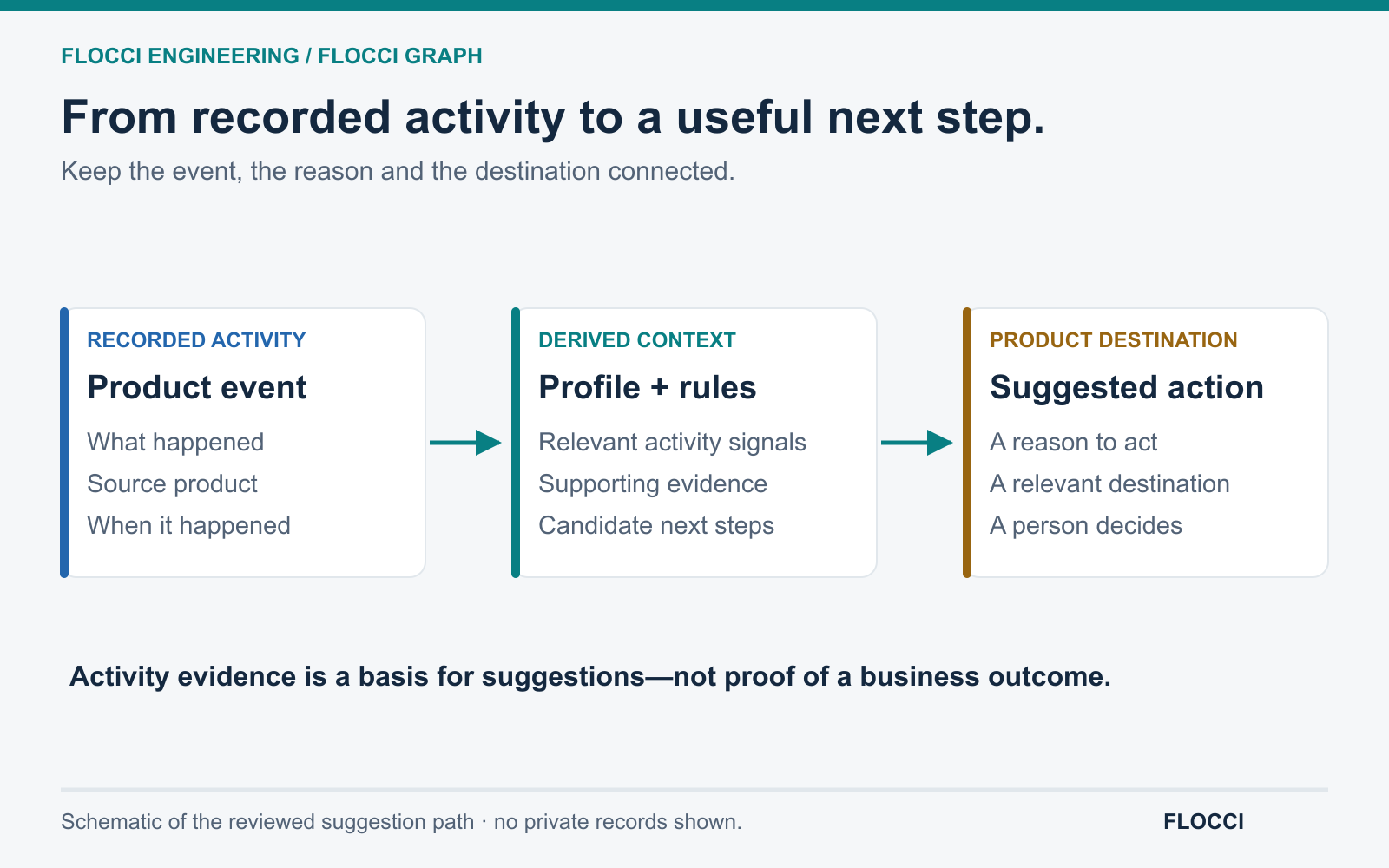
Schematic of the reviewed suggestion path · no private records shown. · Open the full-size diagram
The useful question is what should happen next
A prospecting session creates information about a market. A survey creates information about an audience. A meeting creates decisions and commitments. A knowledge page gives a team somewhere to preserve what it learned.
Software frequently treats these as separate sessions. The user supplies the continuity: remembering what happened, deciding which application comes next and explaining the context again.
Flocci Graph explores a different relationship between applications. If relevant activity is recorded in a shared vocabulary, another product can use that activity as a reason to offer a useful next step.
Start with facts small enough to understand
Graph’s foundation is recorded activity with explicit event contracts. A record identifies what happened, where it originated and when it occurred. Those records can support compact context packages and derived activity profiles.
This is a narrower and more practical idea than placing every business record into one giant intelligence store. The quality of the resulting context depends on which products emit events, whether those events arrive and how accurately they describe the underlying action.
A missing event means missing evidence. An activity count is evidence of recorded usage; it is not a measure of revenue, satisfaction or successful delivery.
Cross-product suggestions with a reason attached
The reviewed implementation includes complement rules that connect activity in a source product to a suggestion in a target product.
For example, sufficient recorded prospecting activity in Flocci Leads can produce a suggestion to explore the market through Flocci Pulse. The suggestion carries evidence about the activity that triggered it and identifies a relevant action destination.
That is useful because prospect discovery and audience understanding can belong to the same business question. It is also bounded: the rule does not prove that a prospect became a customer, identify which survey will succeed or automatically move a contact into a campaign.
Other implemented relationships connect research capture to working knowledge and collaborative activity to durable documentation. Each relationship offers an opportunity to hand work forward rather than merely advertise another application.
Evidence and presentation have different jobs
Graph’s suggestion engine creates structured facts and actions. A separate narration layer can explain selected suggestions in natural language. This separation gives the system something concrete to preserve when generated wording is unavailable.
The evidence should be inspectable independently of the prose. A fluent message is an interface; the recorded signals are its foundation.
The companion intelligence article examines that division in more detail.
Feedback can improve relevance without pretending to predict everything
The ranking implementation uses recorded acted-on and dismissed suggestions to adjust priorities. It limits the influence of that feedback rather than allowing sparse responses to completely replace the underlying rules.
This is a specific adaptive mechanism. It is not evidence of an autonomous reasoning system or a validated model of business performance. Its value is easier to assess: are relevant suggestions reaching the right surface, and does feedback help order them more usefully?
Memory becomes useful at the boundary between products
The opportunity for Flocci Graph is contextual continuity. An application can become more helpful when it receives relevant evidence about work outside its own screen, under the appropriate access boundary.
That opportunity still requires reliable event delivery, clear scoping, meaningful actions and product-level integration. The code provides mechanisms for these capabilities; public availability should be assessed on the relevant product and release.
Explore the Flocci ecosystem and the shared foundation beneath it.
Frequently asked questions
What is Flocci Graph?
Flocci Graph is Flocci's substrate for recorded cross-product activity and derived context. Its implementation includes activity profiles, evidence-bearing suggestions and registered actions. It is distinct from the intelligence execution layer, and it does not mean that every product shares all of its content or that every capability is publicly available.
Do Flocci Graph recommendations automatically execute work?
The recommendation paths discussed here connect recorded signals to suggested actions or destinations. A suggestion is not proof that a workflow has executed, and it is not an automatic transfer of records between products. Product access, action availability and the user's decision remain separate questions.
Sources & further reading
Keep reading
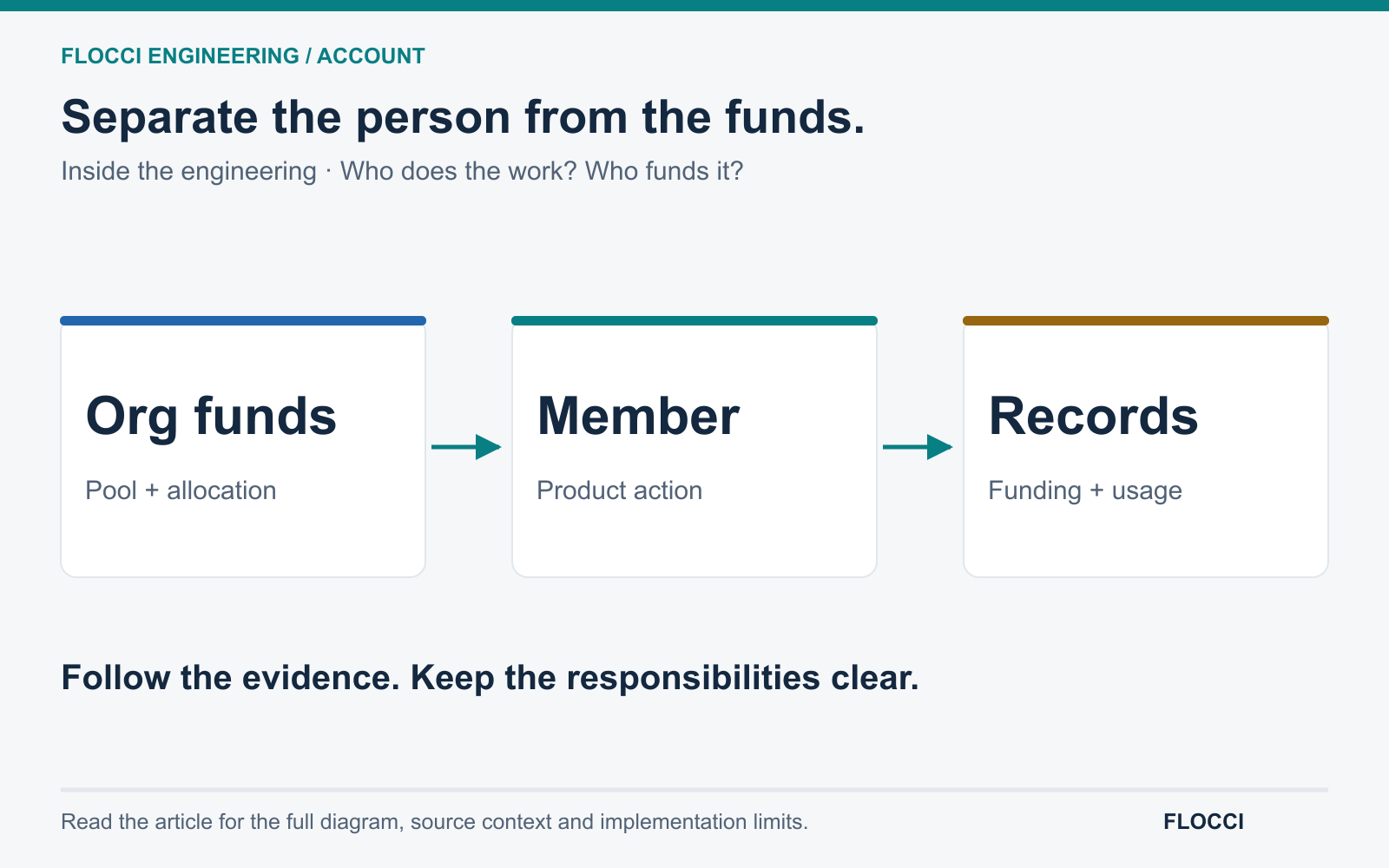
Freedom to Use AI, Control Over Its Cost: Inside Flocci Account
How Flocci Account and shared payment capabilities connect personal credits, organization funding, allocations and accountable spending across products.
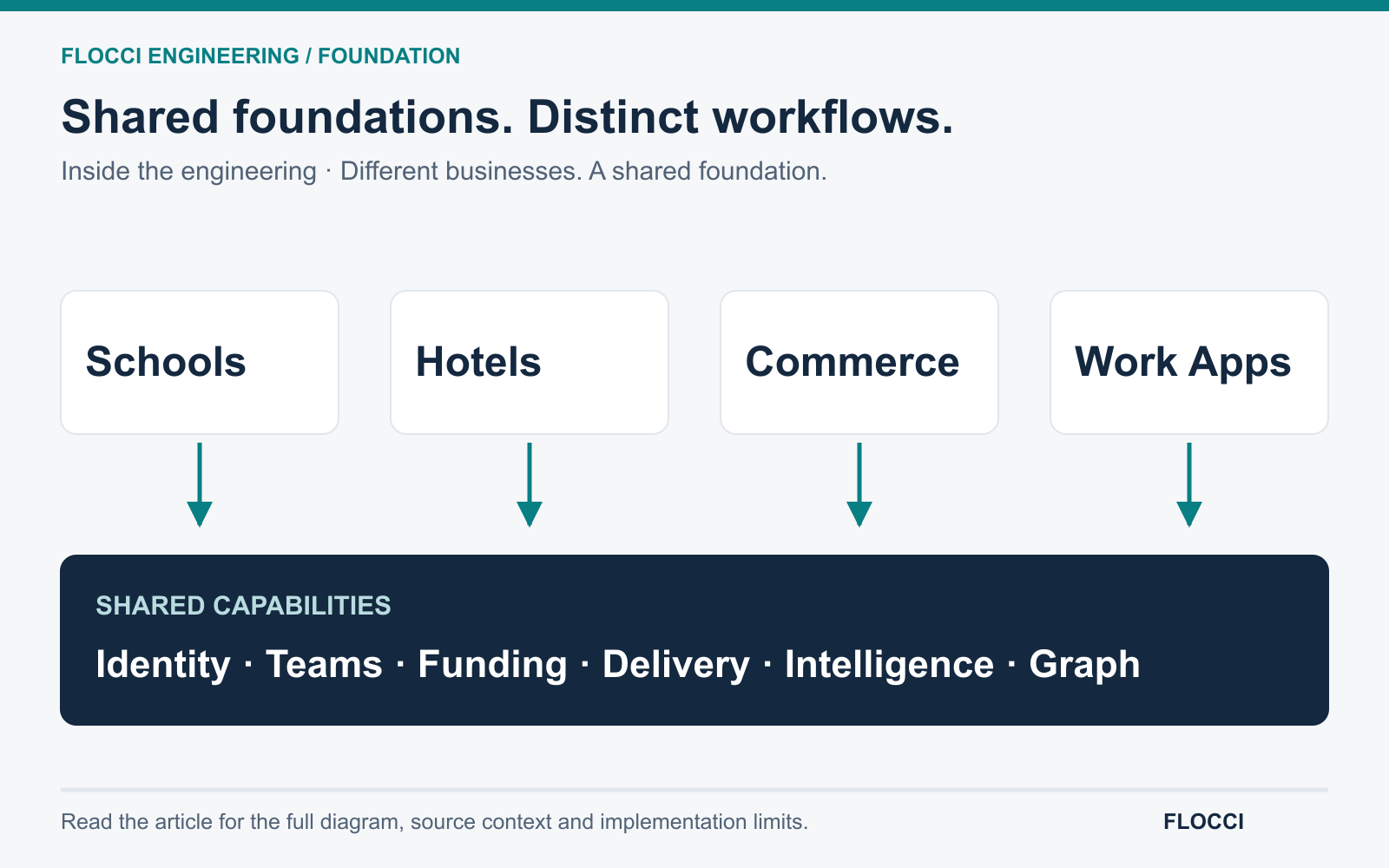
Inside Flocci: The Shared Foundation Beneath Very Different Businesses
How Flocci connects specialized business products through reusable identity, spending, delivery and intelligence while preserving distinct workflows.
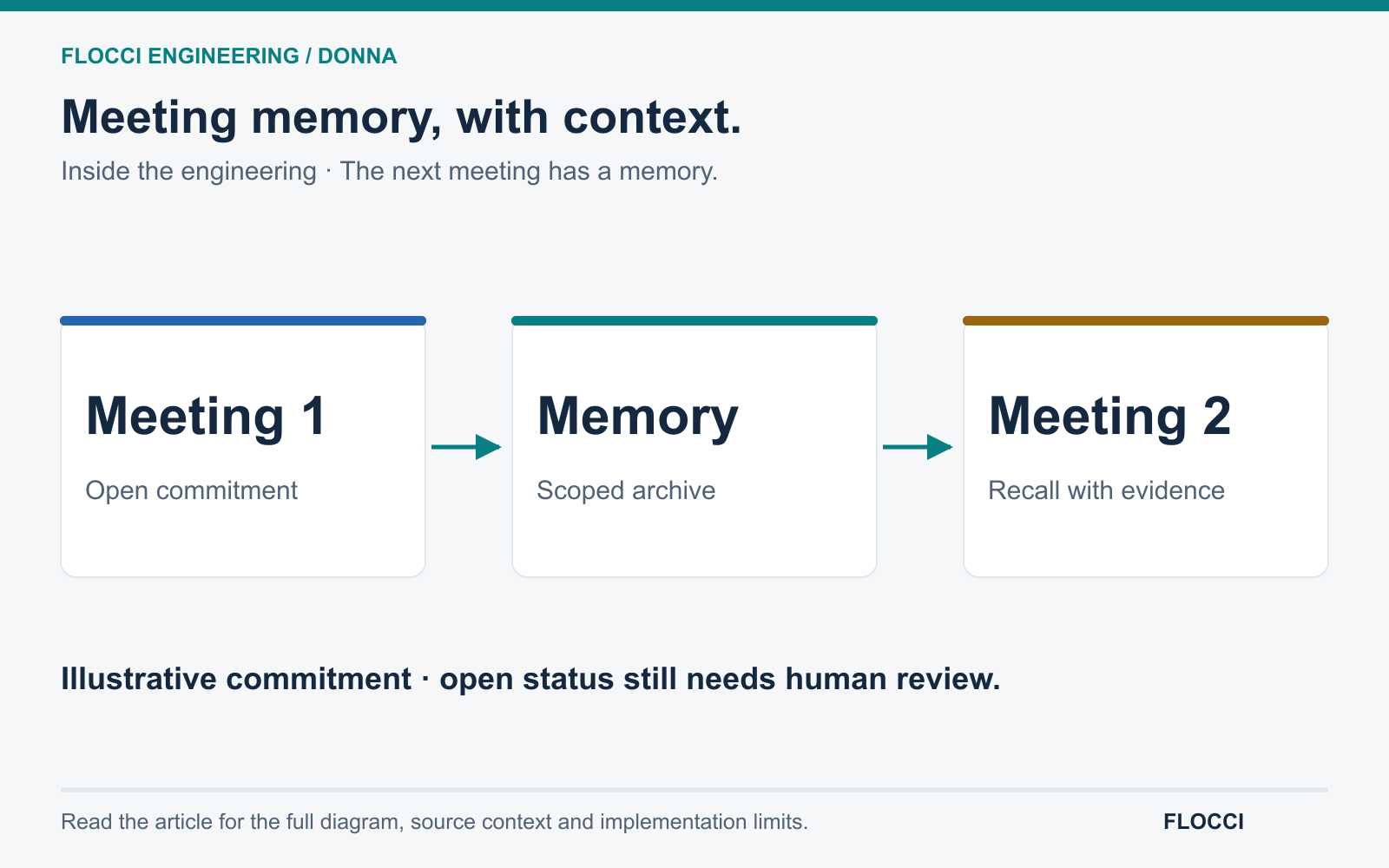
The Meeting Ends. The Commitments Stay: Inside Flocci Donna's Memory
Donna brings unresolved commitments and earlier questions into later meeting analysis, giving recurring conversations a memory with context and evidence.
/* Comments */
Comments are offline right now — we reconnect automatically, nothing is lost.