
Evidence Before Eloquence: How Flocci Designs Useful Business Intelligence
Flocci separates recorded facts, computed suggestions and generated explanation so business assistance has a foundation beyond persuasive language.
On this page
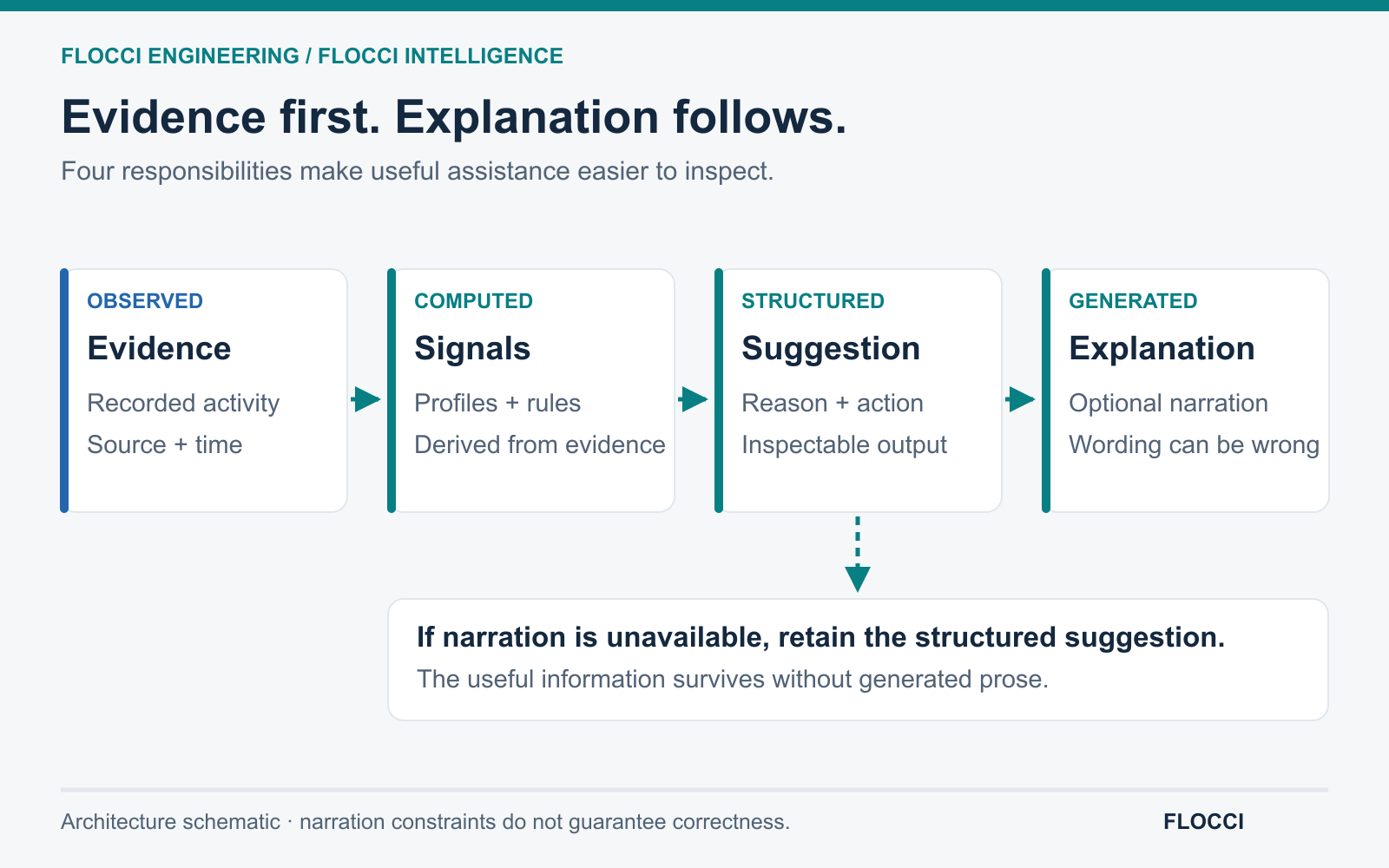
Architecture schematic · narration constraints do not guarantee correctness. · Open the full-size diagram
A beautifully written answer can still miss the business
An assistant can sound certain while misunderstanding an account balance, confusing a team with an individual or interpreting a burst of activity as proof of progress.
The interface may feel impressive. The decision can still be wrong.
Flocci’s most interesting intelligence pattern begins earlier than the generated answer. It asks which facts are available, what can reasonably be computed from them and which next action the product can actually offer.
Four responsibilities that deserve separate treatment
Consider the Graph suggestion path. Recorded product events provide the first layer. Profiles and rules derive signals from those events. A suggestion combines a reason with an available action. Finally, narration can explain selected suggestions in a concise message.
These responsibilities have different failure modes. Missing activity produces incomplete evidence. A poor rule produces an unhelpful suggestion. An unavailable action produces a frustrating interface. Generated wording can exaggerate an otherwise reasonable signal.
Keeping the layers distinguishable makes those failures easier to recognize and improve.
The explanation should follow the facts
Graph’s narration input includes precomputed suggestions and their supporting evidence. Its instructions tell the narrator not to invent numbers or facts beyond that input.
The instruction is a constraint, not a mathematical guarantee. The important architectural point is that the system retains structured suggestions independently of the generated message. If narration is unavailable, the underlying suggestion can still be presented through a simpler fallback.
This is a useful pattern for any business interface: preserve the information the user needs, even when a more expressive presentation fails.
Intelligence should fit the problem
Flocci Schools illustrates why the word intelligence should cover more than text generation.
A school timetable needs valid assignments under competing constraints. The reviewed generator models teacher availability, subject eligibility and scheduling conflicts. A language model’s plausible-looking timetable would be insufficient if it placed one teacher in two rooms at once.
The student risk implementation has a different requirement. It computes a score from observable academic signals and exposes reasons. Outstanding fees are surfaced separately rather than increasing the academic risk score. That separation keeps the interpretation closer to the question the score is meant to answer.
Generated language can add explanation to these experiences, but the underlying computation has its own job.
Shared execution, specialized context
Flocci Intelligence provides a reusable execution and metering layer for adopting products. It is distinct from Flocci Graph, which provides recorded activity and derived context.
The distinction protects both responsibilities. An execution layer should know how to perform and account for an intelligent operation. A context layer should know which recorded facts support the operation. Individual products remain responsible for their domain experience, and some retain specialized pipelines.
Read the Graph story for the context side, and the Account story for the funding side.
Better assistance has a visible basis
The strongest question a user can ask is: “Why are you telling me this?”
A useful answer names the signal, explains its limits and offers an appropriate action. It should be possible to distinguish what was observed from what was inferred and what still requires a human decision.
That is the engineering opportunity visible across these Flocci implementations: assistance that becomes useful through a relationship with real work, clear computation and accountable access.
Explore Flocci Chat or the wider Flocci product family.
Frequently asked questions
How does Flocci distinguish evidence from AI-generated explanation?
The Graph suggestion path computes structured suggestions with evidence and actions before asking an intelligence layer to narrate selected items. This separates the factual input from its wording. Instructions constrain narration, but they do not guarantee that every generated statement is correct; evidence and review remain important.
Is every Flocci intelligent feature a generative AI feature?
No. Flocci uses different mechanisms for different jobs. The reviewed Schools implementation includes constraint-based scheduling and transparent risk scoring, while Graph includes rule-based suggestions and adaptive ranking. Generated language can explain or synthesize information where it adds value; it need not make every underlying decision.
Sources & further reading
Keep reading
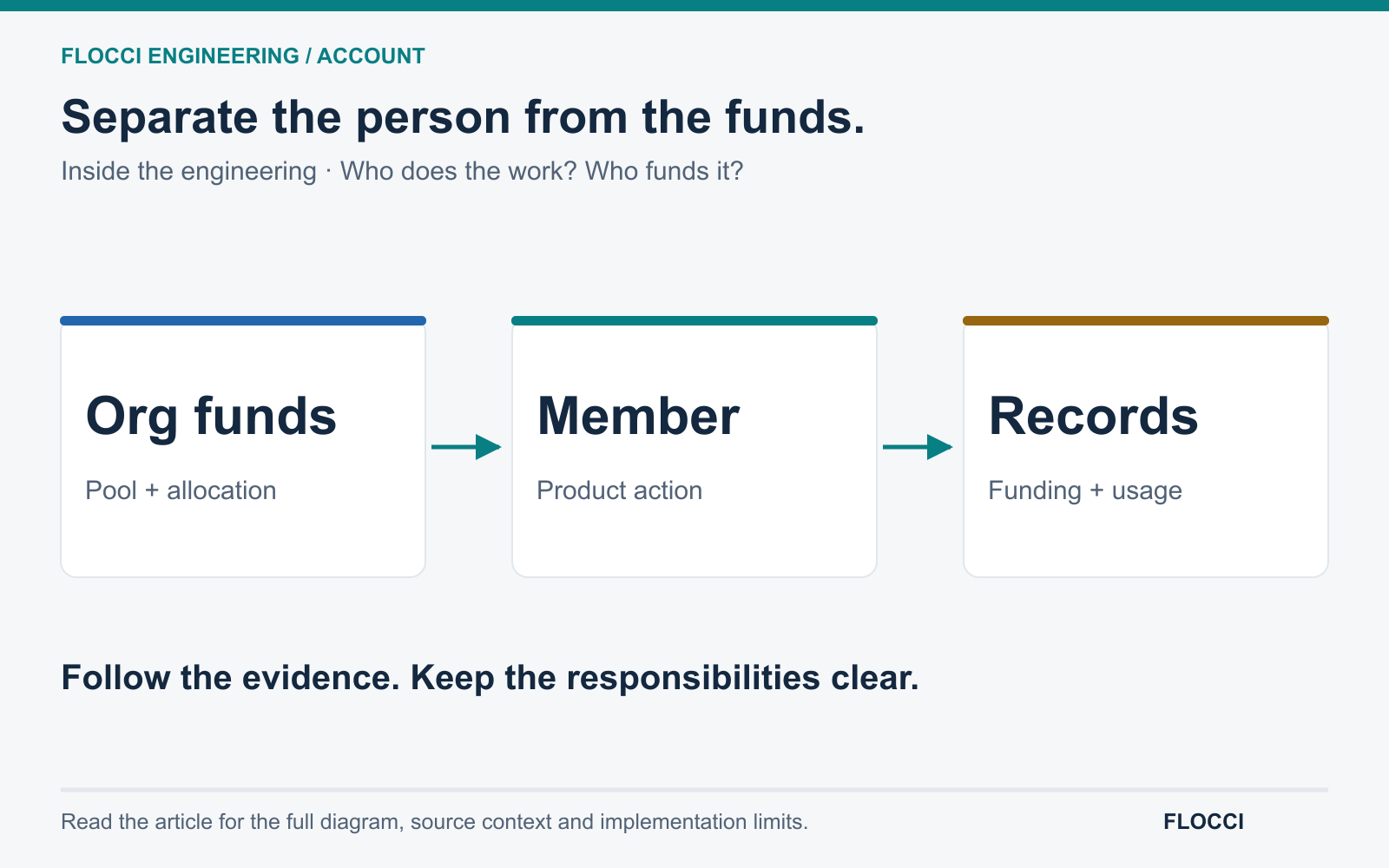
Freedom to Use AI, Control Over Its Cost: Inside Flocci Account
How Flocci Account and shared payment capabilities connect personal credits, organization funding, allocations and accountable spending across products.
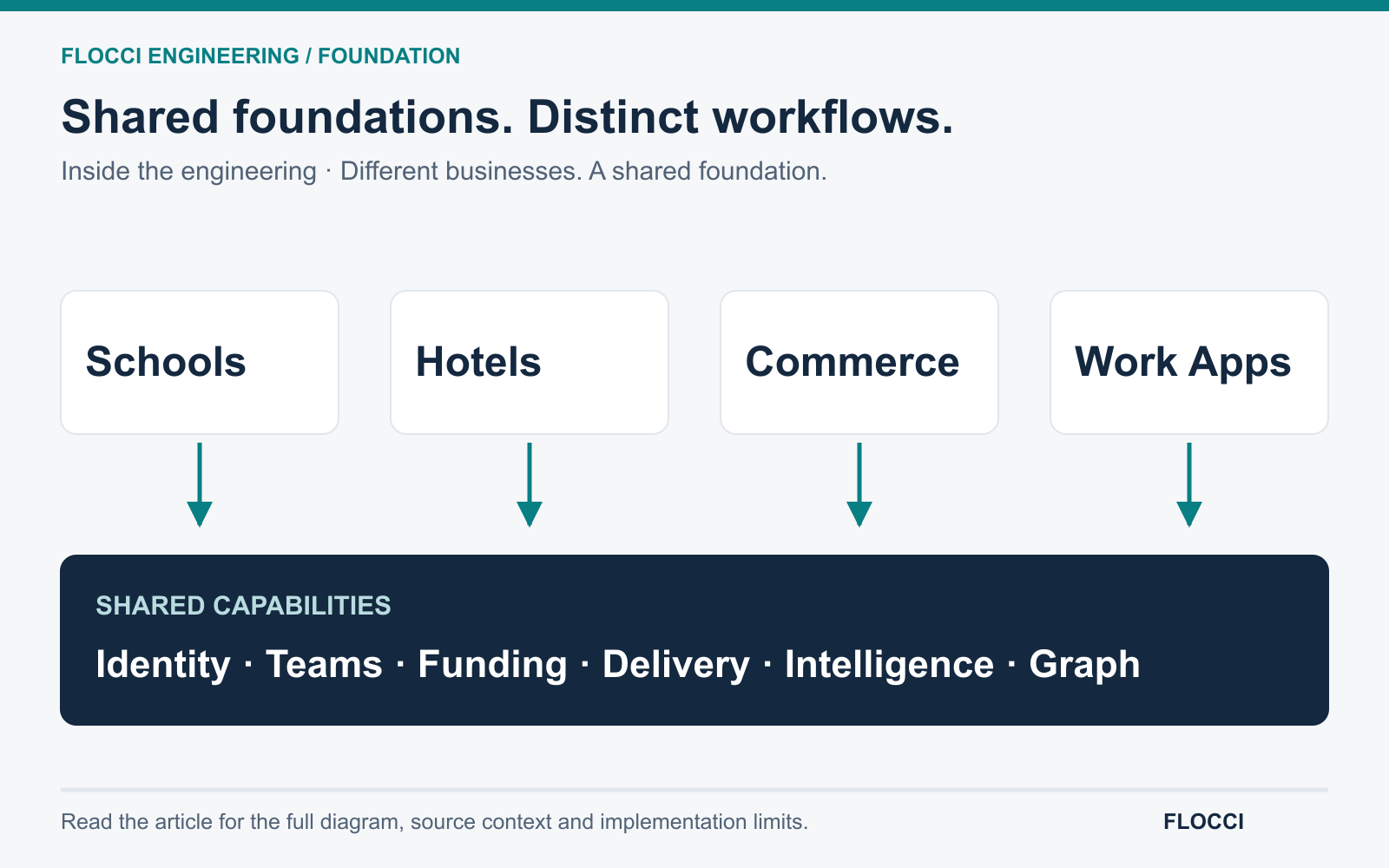
Inside Flocci: The Shared Foundation Beneath Very Different Businesses
How Flocci connects specialized business products through reusable identity, spending, delivery and intelligence while preserving distinct workflows.
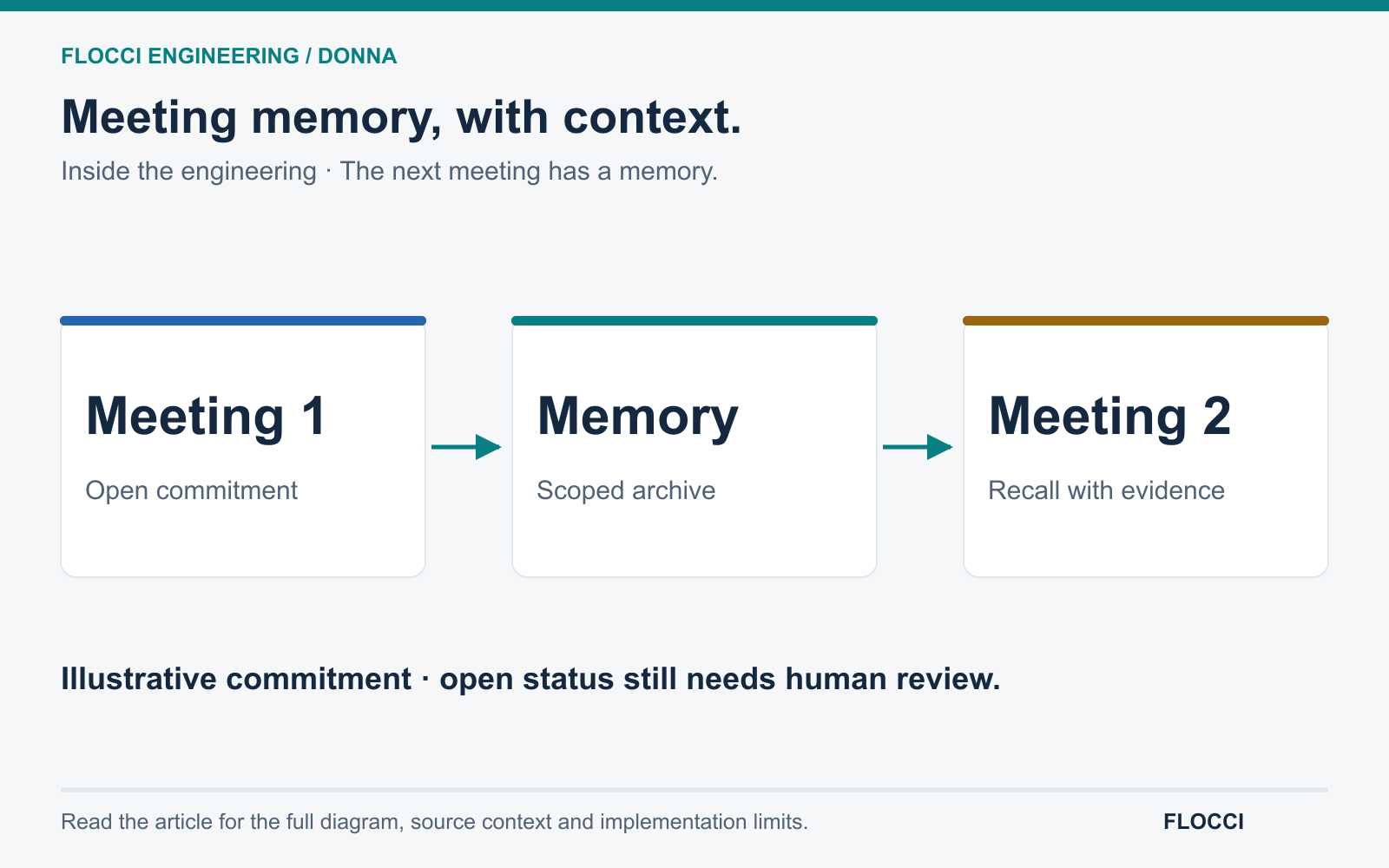
The Meeting Ends. The Commitments Stay: Inside Flocci Donna's Memory
Donna brings unresolved commitments and earlier questions into later meeting analysis, giving recurring conversations a memory with context and evidence.
/* Comments */
Comments are offline right now — we reconnect automatically, nothing is lost.