The FTC Just Picked a Fight With States Over What Counts as an AI 'Lie'
The FTC's July 7 statement says state laws forcing AI models to alter true outputs may itself be deception. Comments close July 31, 2026.
On this page
Fifty states have spent two years writing their own rules for what an AI model is allowed to say, and AI companies have mostly treated each one as a regional compliance cost to route around. On July 7, 2026, the Federal Trade Commission told them that routing might be illegal. Tucked into a Tuesday Federal Register filing, the agency didn’t propose a new AI law — it picked a jurisdictional fight. If a state forces a model to output something other than what it would otherwise produce, the FTC now argues that’s not compliance. It’s a lie to the consumer, and Washington claims first call on what counts as one.
What did the FTC actually publish on July 7?
A policy statement, not a rule — “Policy Statement Concerning the Suppression of Accuracy in Artificial Intelligence Systems,” Federal Register document 2026-13628, open for public comment from July 7 through July 31, 2026 under docket FTC-2026-0859 (Matter No. P264200). The core claim: consumers reasonably expect AI systems marketed as problem-solving tools to “faithfully and accurately achieve users’ stated objectives.” When a company instead makes its system “steer outputs… toward unexpected objectives, and away from the objectives set by or reasonably expected by users,” the FTC says that’s a material, misleading practice under Section 5 — full stop, because “a company’s motives for deceiving consumers are irrelevant to the application of section 5.”
That last phrase is the whole ballgame. The FTC isn’t just talking about companies gaming outputs for ad revenue or reputational cover. It’s explicitly including companies that alter outputs to comply with a state law. Under the agency’s reading, a state statute doesn’t get to excuse a federal deception claim — it can be the thing that triggers one.
What counts as “suppression of accuracy” under this theory?
The FTC leans on its own 1983 deception standard: it will find deception where there’s “a representation, omission or practice that is likely to mislead the consumer acting reasonably in the circumstances, to the consumer’s detriment.” Applied to AI, that breaks into three tests the statement walks through — a misleading representation or omission, judged from a reasonable consumer’s perspective, that’s material to how they use the product. Marketing a model as accurate while quietly tuning it to avoid a category of true-but-risky outputs, the FTC argues, checks all three boxes.
The statement doesn’t ban output-steering outright — it says companies can disclose that a system prioritizes something other than raw accuracy. But the disclosure has to be “prominent” and “conspicuous,” not a line item in a terms-of-service page nobody reads. The FTC is direct about it: “A prominent misrepresentation is unlikely to be remedied by a less prominent, subsequent disclosure.” Marketing copy that says “the most accurate AI” and a buried footnote saying “except when state law requires otherwise” is, in this framework, still deception.
Why is Colorado’s AI Act the FTC’s test case?
Because it’s the cleanest example the agency had on hand of a state rule that ties output content to legal liability. Colorado’s original AI Act, enacted May 17, 2024 (SB 24-205), put a broad duty on AI companies to avoid outputs that could lead to disparate impacts. Colorado then repealed and reenacted the law as SB 26-189, enacted May 14, 2026 — and the revised version goes further, explicitly making AI firms liable for discriminatory outcomes caused by how their customers use the product, not just how the company built it.
That’s the mechanism the FTC is pointing at: a state law that makes an AI company legally exposed for a true-but-uncomfortable output creates a direct incentive to suppress that output instead. The FTC’s answer is blunt federal preemption doctrine — “State law is impliedly preempted to the extent it conflicts with a Federal regulatory scheme” — followed by the sharper line: “A State law that requires an AI firm to deceive its consumers obviously conflicts with section 5’s express purpose of protecting consumers from such conduct.”
Enacted May 17, 2024. Imposed a broad duty on AI developers and deployers to avoid outputs that could produce disparate impact across protected classes — a compliance target the FTC says pushes companies toward pre-emptive output suppression.
Repeals and replaces the 2024 law. Explicitly holds AI companies liable for discriminatory outcomes caused by how their customers use the product — widening the liability the FTC says incentivizes steering outputs away from accuracy.
Where does the FTC get the authority to do this?
From the top. The policy statement traces its mandate to Executive Order 14365, which President Trump signed December 11, 2025, directing the FTC to clarify how Section 5 applies to AI models — specifically to address state laws that require altering an AI model’s accurate outputs. FTC Chairman Andrew Ferguson framed the comment request as fact-finding for that mandate, saying the agency “wants to hear from businesses and consumers about their experiences and concerns regarding the subversion of AI systems for ideological ends,” and that the input would help the Commission “formulate a final policy that advances President Donald Trump’s goal of expanding America’s global dominance in artificial intelligence.”
Read plainly, this is the executive branch using consumer-protection law as a preemption tool against state content rules it doesn’t control. It’s a different fight than the one playing out in courtrooms over AI accuracy — where, as we covered when courts started punishing AI hallucinations, judges have been willing to treat AI-generated falsehoods as the company’s liability, not a neutral platform’s. Here, the FTC is arguing almost the inverse: that being forced to alter a true output is the deceptive act, and the state mandating it is the thing federal law should override.
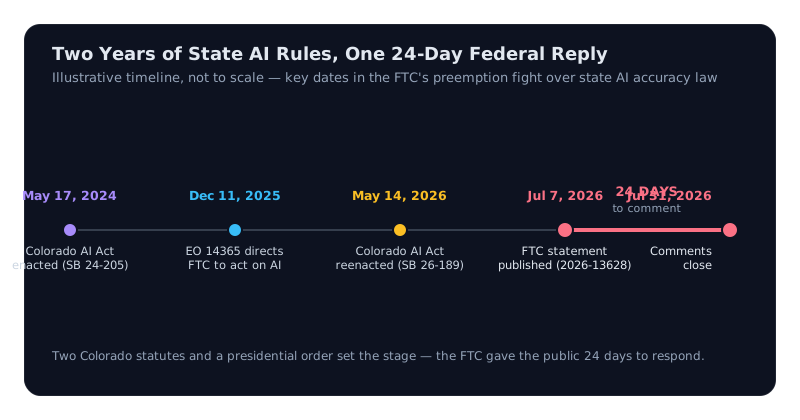
Lay the dates end to end and the shape of the fight gets obvious: two years of state lawmaking, one presidential order, and a 24-day window for the public to weigh in before the FTC decides how hard to push back.
What should AI companies and developers actually do before July 31?
The window is short — 24 days from publication to deadline — and the statement is still just proposed. Treat it as a signal to get positioning on record, not a compliance deadline.
Do
- File a comment through docket FTC-2026-0859 if your product touches a state-regulated output category (bias mitigation, content moderation, safety filtering)
- Document, internally, why any output-steering exists and whether it’s disclosed prominently at the point of use — not just in a ToS
- Watch how your state-mandated compliance logic is described in marketing; the FTC’s theory turns on the gap between claim and behavior
- Track whether your state (Colorado, and likely others with similar disparate-impact or bias-audit rules) responds or amends language before comments close
Don't
- Assume this policy statement already overrides any state AI law — it’s open for comment, not final, and has no enforcement teeth yet
- Bury a “we adjust outputs for legal compliance” disclosure in terms of service and call it covered
- Treat this as narrowly about Colorado — the FTC’s language covers any state law that “requires an AI firm to deceive its consumers”
- Wait for the final statement to start documenting your output-steering rationale — the comment record is being built now
What happens after the comment period closes?
Nothing binding, immediately. July 31, 2026 closes the comment window; the FTC then has to weigh submissions before issuing anything final, and a final policy statement still isn’t a rule with independent enforcement power — Section 5 cases get built one at a time, against one company at a time, using deception as the theory. The more consequential fight is the one this statement is clearly gearing up for: if the FTC does bring a case against a company for altering outputs to satisfy a state disparate-impact or bias-audit law, the state will almost certainly intervene to defend its own statute, and a federal preemption argument this aggressive is built to be tested in court, not just in a comment docket.
It’s also not happening in a vacuum. The same week global regulators were telling the UN they can’t guarantee AI safety at all, the U.S. federal government spent its energy arguing that individual states aren’t allowed to make AI safer by their own definition if that definition means altering what a model says. That’s the actual stakes of this policy statement: not whether AI outputs are accurate, but who gets to decide what accuracy means when federal and state law disagree about it.
Frequently asked questions
What did the FTC actually publish on July 7, 2026?
A policy statement titled 'Policy Statement Concerning the Suppression of Accuracy in Artificial Intelligence Systems,' published in the Federal Register as document 2026-13628. It argues that AI companies steering model outputs away from what users reasonably expect — including to satisfy state law — can violate Section 5 of the FTC Act's ban on deceptive practices.
What is the comment period and how do I submit one?
The FTC opened public comment on July 7, 2026, closing July 31, 2026 — a 24-day window. Comments go through the online docket FTC-2026-0859 at regulations.gov, or by mail to the FTC's Office of the Secretary in Washington, DC. Submissions must reference 'AI Policy Statement; Matter No. P264200.'
Why does Colorado's AI Act matter to this fight?
The FTC's statement names Colorado's law as its working example of a state rule that could pressure companies into deceptive output-steering. The original 2024 version imposed a broad duty to avoid disparate-impact outputs; a reenacted version, enacted May 14, 2026, explicitly makes AI firms liable for discriminatory outcomes from how customers use their products.
Can a disclaimer protect a company that alters its AI's outputs?
Only if it's prominent and conspicuous at the point of use, according to the FTC's statement. The agency explicitly warns that a prominent misrepresentation — like marketing an AI as accurate — 'is unlikely to be remedied by a less prominent, subsequent disclosure,' meaning a line buried in terms of service won't satisfy Section 5.
Does this policy statement immediately overturn state AI laws?
No. It's a proposed policy statement open for comment through July 31, 2026, not a final rule or enforcement action. It signals how the FTC intends to use Section 5 and implied preemption against state AI mandates it considers deceptive, but any actual override would need to survive comment, a final statement, and likely litigation.
/* Comments */
Comments are offline right now — we reconnect automatically, nothing is lost.