
GitHub Audit Logs Reach GHE.com’s S3 Stream Through OIDC
GitHub extended OIDC-based S3 audit-log streaming to GHE.com. Short-lived role access removes stored AWS keys, but trust and retention still need care.
On this page
Audit logs are most useful when they survive the system they describe. That principle also appears in large-scale event audit pipelines, where retention and access controls are part of the system design. GitHub enterprise events streamed to S3 give organizations a destination for retention and analysis outside the live control plane. The November 19 update makes the OIDC-based integration available to GHE.com. It changes the identity path; it does not make the bucket self-securing. [1]
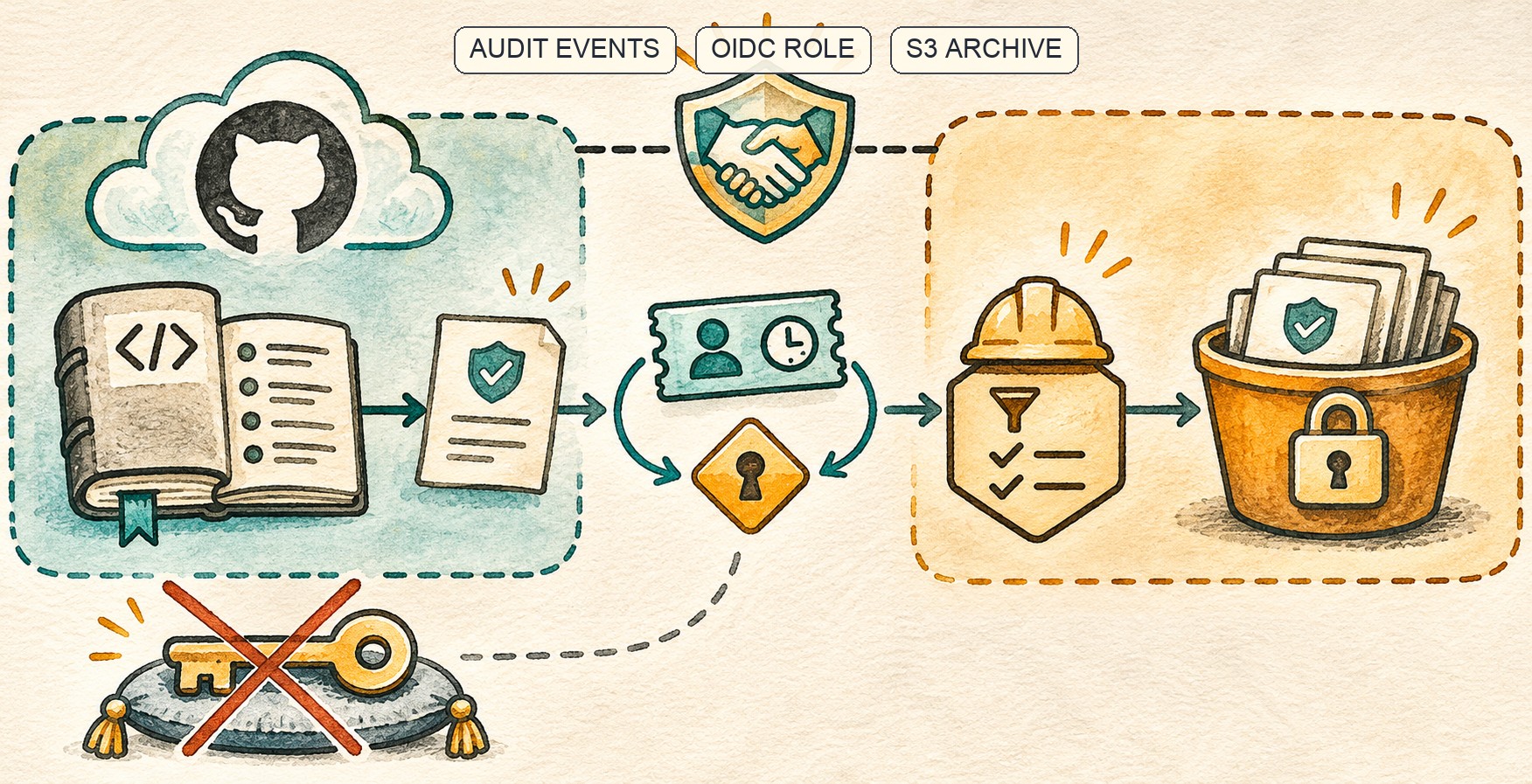
Federation changes the credential path
A static AWS access key is a durable secret. With OIDC, a trusted service presents a signed identity token; AWS checks it against a configured identity provider and role trust policy, then issues temporary session credentials. The model replaces a stored key with a verifiable identity and time-bounded access. [3] [4]
GitHub’s S3 integration uses that relationship to write enterprise audit events. The update adds GHE.com to an existing capability and avoids storing long-lived AWS credentials on GitHub. The security benefit depends on which enterprise can assume the role and what that role can write. [1] [2]
Check the expected issuer and audience and bind trust to the intended enterprise claims using GitHub’s current instructions. Avoid a broad trust policy that lets any identity from the provider assume the role. Exact claim names are provider-specific; test the intended GHE.com enterprise instead of copying an unreviewed github.com policy. [2] [3]
A stream is not a retention policy
Choose the S3 bucket and prefix, limit the streaming role’s write scope, and provide investigators a separate read path. Define encryption, retention, lifecycle transitions, access logging and alerts for unexpected deletion or policy change. If evidence must resist account mistakes or malicious deletion, evaluate versioning and Object Lock against the requirement. These are storage controls, not consequences of enabling the stream.
Confirm the destination account and region, verify the bucket policy and monitor for gaps or a disabled stream, not only successful object arrival. Periodically test retrieval with the incident-response role. A write-only pipeline that cannot be read during an investigation is incomplete.
GitHub documents event coverage and retention behavior separately. Before promising the bucket contains “everything,” establish which organization, repository and administrative events are included and whether identity, cloud and automation systems need separate evidence collection. [2]
Residency belongs in the data-flow review
GHE.com is GitHub Enterprise Cloud with data residency. Teams should map where GitHub processes events, which AWS region stores them, who can access them and how downstream analytics retain copies. Residency on one platform does not settle every destination’s geography or access model.
Document issuer, audience and trust conditions; IAM actions and bucket scope; retention and deletion controls; and the signal that detects stream failure. Test a controlled administrative action and verify the record can be located, parsed and retrieved by intended responders.
OIDC reduces secret handling because the integration no longer needs a long-lived AWS key stored on GitHub. It moves the control point to federation and role policy. A broad subject condition or overpowered role still grants excessive authority; temporary credentials do not make excessive permissions harmless. Adopt the integration with a reviewed trust policy and treat S3 as a separate evidence system. [2] [4]
Design for retries and missed health checks
Audit streaming is a delivery system, so downstream consumers should not assume every record appears exactly once. GitHub documents at-least-once delivery, meaning network or system issues can duplicate events. Make ingestion idempotent where possible, using event identifiers and timestamps rather than treating every object as a unique human action. Preserve the original compressed records so later parsers can be corrected without changing the evidence source. [2]
GitHub also documents a daily stream health check. Enterprise owners receive email when a stream is misconfigured, and the configuration must be fixed within six days to avoid dropped events. A team should route these notices to an owned operational queue and monitor the stream state instead of relying on one administrator’s mailbox. If a stream is intentionally paused, GitHub retains a buffer for seven days; longer pauses have different recovery behavior, so schedule maintenance windows and verify the resumed timestamp against the documented rules. [2]
These delivery details shape incident readiness. Build a reconciliation check that detects unexpectedly stale objects, and rehearse retrieval from the destination. Where compliance requires a bounded gap, decide who investigates and how the organization records that gap. “The integration is enabled” is not the same as proving that evidence is continuously arriving.
One detail deserves special attention for residency teams: GitHub’s setup documentation warns that streamed audit data goes to the AWS bucket and region selected, which may be outside the enterprise’s data-residency region. Configure the SIEM destination to ingest and store records in the required region before enabling the stream. The GHE.com feature makes the source deployment eligible; it does not force the AWS destination to match that geography. [2]
Frequently asked questions
What changed for GHE.com?
GitHub extended its S3 audit-log stream using OIDC to GitHub Enterprise Cloud with data residency, avoiding long-lived AWS keys stored on GitHub.
Does OIDC remove AWS permission configuration?
No. Administrators still configure a trust relationship and IAM role. Restrict the issuer, audience and enterprise identity.
Sources & further reading
Keep reading

Dependabot Dismissal Requests Now Stay Open for a Year
GitHub extended delegated Dependabot dismissal requests from one week to one year. The extra time helps review coverage but does not approve or fix alerts.

Windows Warns Some Secure Boot Updates May Add One Restart
Microsoft says a limited number of devices may restart once more during Secure Boot updates. Plan without mistaking the extra restart for a failure.

GitHub Team’s Automatic Risk Assessments Surface Work, Not Fixes
GitHub Team now runs organization security risk assessments automatically. Understand the findings and turn them into owned remediation.
/* Comments */
Comments are offline right now — we reconnect automatically, nothing is lost.