
Glean’s Outlook Agents Move from Inbox Polling to Event Triggers
Glean says eligible Outlook agents now start on new messages through webhooks, shifting the design problem to retries, subscriptions and idempotency.
On this page
An inbox agent that wakes every few minutes is simple to picture: check, compare, act, repeat. It is also a poor fit for work that should begin when a message arrives. In its November 19 release notes, Glean says Outlook email agents now start as soon as a new message or thread arrives, using webhook notifications instead of waiting for the next check. New eligible agents use real-time triggers by default, and existing eligible agents switch automatically.
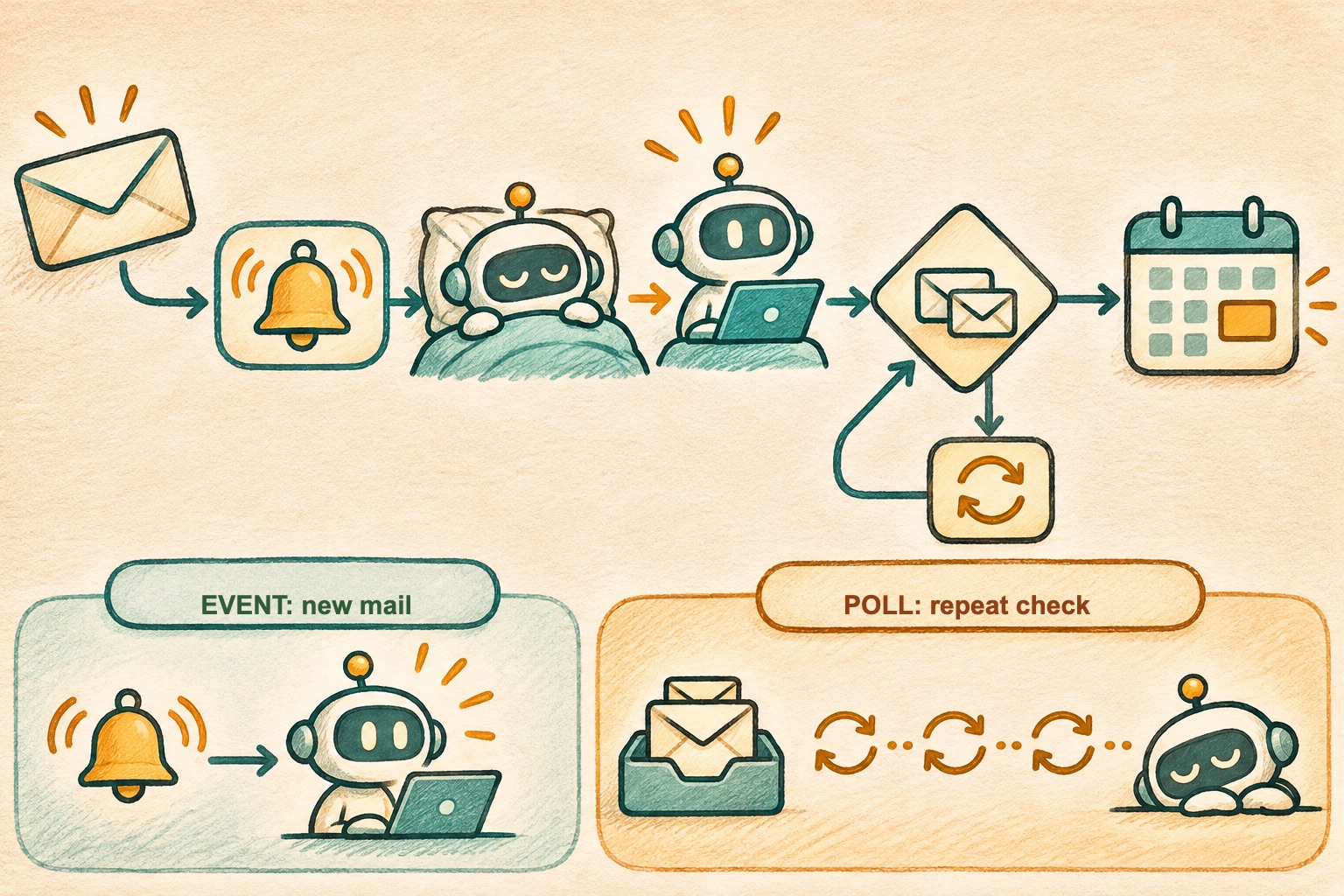
That change moves the timing problem away from a polling interval and toward an event-delivery lifecycle. Microsoft Graph’s webhook documentation describes the familiar pattern: create a subscription, validate the notification endpoint, receive POST notifications while the subscription is valid, and renew it before expiry. Glean does not publish its underlying implementation details in the release notes, so this is a design comparison, not a claim that Glean exposes Graph subscriptions directly to customers.
The wake-up is not the whole workflow
An event can tell an agent that something changed; it does not decide what the message means, whether it is safe to act, or whether the message has already been processed. A production workflow still needs a stable message identity, a deduplication key, bounded retries, and an explicit policy for actions such as sending a reply, changing a record, or assigning a task.
Consider a supplier email that arrives while a notification endpoint is unavailable. The platform may retry the delivery, or a later sync may reveal the same change. If an agent treats each delivery as a new instruction, it could create duplicate tickets or send repeated acknowledgements. A durable event record can help: store the message identifier, processing state, action outcome and retry count, then make the final operation idempotent where possible.
Faster starts create new operational questions
Polling makes delay visible in a fixed cadence and makes load visible in repeated reads. Event triggers can reduce both forms of waste, but they introduce lifecycle questions: what happens during a missed notification, how does a subscription renew, and how are failures surfaced to an administrator? Microsoft’s own webhook guidance emphasizes that subscriptions expire and must be renewed to keep notifications flowing. Teams evaluating Glean should ask how it handles missed events, duplicate delivery and reauthorization for their tenant.
The security boundary also remains important. Email is untrusted input. A message can contain a request, an attachment or quoted instructions that should not automatically gain authority over the agent. Keep tool permissions narrow, require approval for external or irreversible actions, and preserve a clear record linking the message to the agent’s decision. Our permission-boundary guide for prompt injection explains why the trigger mechanism and the authorization mechanism are different controls.
What admins should verify
Glean says there is no action required to enable the real-time trigger for eligible Outlook agents. That convenience makes a quick review worthwhile: identify which existing agents qualify, what actions they can take, and whether their owners understand that a new message may start work immediately. Test a benign message, a duplicate notification and a temporarily unavailable downstream tool. Confirm the visible run history and recovery path before allowing the trigger to initiate business-critical actions.
The product shift is meaningful because “near real time” now depends less on how often an agent checks. But webhook delivery is a wake-up signal, not an exactly-once transaction guarantee. Reliability still comes from the surrounding system: event validation, deduplication, durable state and safe retries.
Conceptual AI-generated illustration; this is an explanatory webhook sketch, not a Glean or Outlook screenshot.
Frequently asked questions
How do Glean Outlook email triggers work?
Glean says eligible agents start when a new message or email thread arrives, using webhook notifications instead of waiting for the next check; new eligible agents use real-time triggers by default.
Do webhook triggers guarantee exactly-once agent actions?
No. Webhooks deliver change notifications, but applications still need to validate events, handle retries and duplicates, renew subscriptions, and make consequential actions idempotent.
Sources & further reading
Keep reading

Google’s Teamwork Pattern Makes Verification Part of the Agent Loop
Google describes Antigravity Teamwork as parallel candidate generation followed by independent falsification, tool-based checks and human review.
GitHub Copilot Evals Turns Agent Changes Into Repeatable Checks
GitHub's Copilot Evals preview replays realistic tasks against skills, agents and MCP tools. Treat it as a regression aid, not a universal quality score.

Dependabot Dismissal Requests Now Stay Open for a Year
GitHub extended delegated Dependabot dismissal requests from one week to one year. The extra time helps review coverage but does not approve or fix alerts.
/* Comments */
Comments are offline right now — we reconnect automatically, nothing is lost.