
Google's 98.3% Quantum Magic-Square Score Is a Benchmark, Not a Useful-App Speedup
Google reports a Willow quantum contextuality result beyond a classical game limit. The experiment is notable, but it does not show faster everyday computing.
On this page
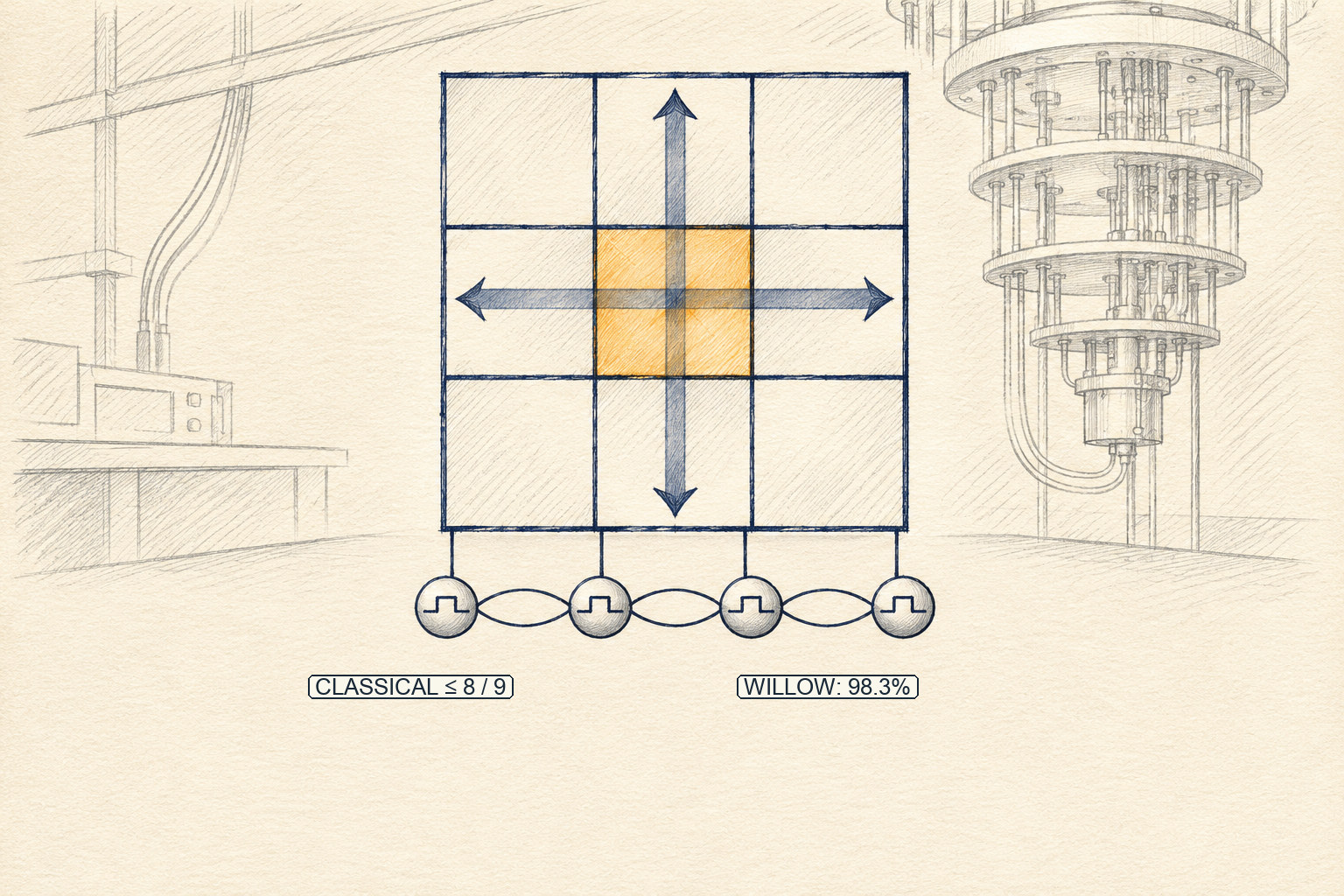
A 3-by-3 grid can expose a contradiction. If every row must multiply to +1 and every column to −1, a table filled in advance cannot satisfy both rules: counting the negative entries by rows says the total is even, while counting by columns says it is odd. Google’s new experiment turns this puzzle into a hardware benchmark and asks whether quantum measurements can beat the best fixed classical strategy.
What the game tests
In the magic-square game, two separated players receive a row and a column, then answer without communicating. They win if their answers agree at the intersecting cell while each obeys the row or column rule. A classical strategy is equivalent to writing down all nine values in advance. Because the rules conflict, that table must fail at least one of the nine possible intersections, capping its success at 8 out of 9, or 88.89%.
Google says the Willow processor used entangled Bell pairs and preset measurements for the selected row or column. Across 100,000 runs of each of the nine game versions, the hardware won 98.30% of the time, with a reported uncertainty of 0.01 percentage points. Noise still caused roughly one loss in 60 rounds. The headline number is therefore not “quantum computers are nearly perfect”; it is that this device exceeded the classical bound on this defined task.
The concept behind the separation is contextuality. In this experiment, measurement outcomes cannot be treated as values that were all fixed in advance independently of which compatible measurements are performed together. Google’s research explanation gives an accessible derivation, while the associated Science paper is the primary research record. A separate 2018 Science theorem established a formal advantage for particular shallow-circuit tasks; that theoretical result is important context, but it is not a claim that the 2026 experiment speeds up ordinary software.
This is a different claim from saying that quantum computers outperform classical computers on a general workload. A game with a known classical bound tests a property of the device and its measurements. A useful application needs a problem, an end-to-end algorithm, error handling, resource costs, and a comparison against the best classical method available for that same problem. Readers interested in the broader hardware stack can compare this result with our overview of quantum developer platforms and IBM’s System Two architecture.
The experiment adds a hardware “ruler”
Google also reports measuring a Bell–Kochen–Specker inequality, with a value of 5.590 ± 0.008 against a classical bound of 4 and a quantum limit of 6. The experiment used an ancilla qubit to record measurements while preserving the two main qubits for sequential tests. The authors argue that contextuality-based tasks can reveal coherent errors that random-circuit benchmarks may average away.
A benchmark with a fixed physical ceiling can be useful because its target does not move as the hardware improves. If the measured value sits below the quantum limit, the gap can help researchers identify errors or compare processor behavior. That does not make one score a complete quality measure: a system may do well on one structured task and still be noisy, slow, or costly on another.
The team describes two scale experiments. A GHZ parity game remained above the best classical strategy through 71 qubits, although noise narrowed the gap. A hidden-linear-function circuit ran on grids up to 105 qubits with success probabilities above the paper’s stated classical bound. Those results extend the study beyond a two-qubit demonstration, but “up to 105 qubits” is not itself a measure of useful capacity. Logical error rates, circuit depth, state preparation, readout, runtime, and repeatability all matter for applications.
How to read the result without overselling it
- Name the task. The 98.3% figure belongs to a magic-square game, not an application benchmark such as chemistry or optimization.
- Keep the comparison attached. It is above the 88.89% classical strategy limit for that game; it does not mean a 9.4-point general speed improvement.
- Separate ideal theory from hardware. A noiseless quantum strategy can win every round in principle. The measured processor did not; Google reports a 98.3% win rate.
- Treat scale precisely. The 71-qubit and 105-qubit results refer to different experiments and tasks. Do not fold them into the magic-square result.
- Look for independent replication. Google’s post is written by the research team that performed the experiment. The Science paper and future replications are the right evidence trail for the detailed methods and limits.
The paper’s importance is that it makes contextuality measurable across a larger superconducting system and explores it as both a computational resource and a diagnostic benchmark. That is meaningful progress in quantum engineering. The careful conclusion is narrower than “quantum advantage has arrived”: on specific bounded tasks, this hardware displayed correlations that exceed classical strategies, and those tasks may help engineers measure errors that other tests miss.
Frequently asked questions
What does Google's 98.3 percent result measure?
It is the observed win rate on the nine versions of the magic-square game run on Google's Willow processor, compared with a maximum classical prewritten-table strategy of 88.89 percent. It is a benchmark result, not a speed claim for a general-purpose application.
Does this experiment prove quantum computers are faster than classical computers for useful tasks?
No. Google reports a contextuality test and related structured tasks on quantum hardware. The result supports a physical and benchmarking claim; it does not establish a practical speedup for common workloads or a fault-tolerant application.
Sources & further reading
Keep reading

cuPhoton and Black-Hole Interferometry: Accelerating Correlation Is Not Imaging
NVIDIA's cuPhoton.xBeam targets VLBI data correlation; calibration and image reconstruction remain separate scientific stages.
NVIDIA SOMA Retargeter: Turning Human Motion into Robot Trajectories
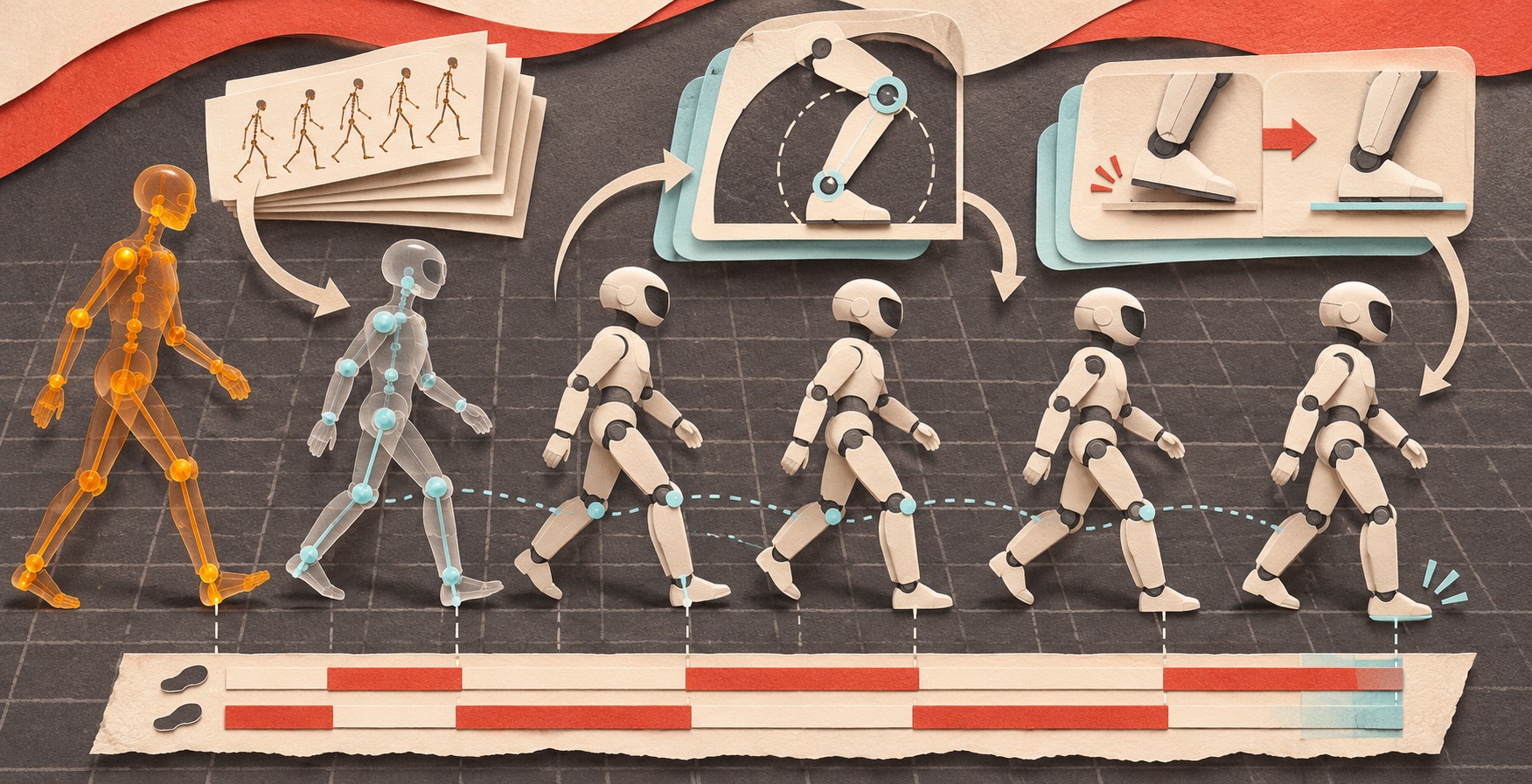
NVIDIA SOMA Retargeter turns SOMA BVH motion into robot-specific trajectories using scaling, IK, and foot-plant correction—not a validated robot policy.

AlphaGenome 2 Tries to Find the Cell Where a DNA Variant Matters
Google DeepMind's AlphaGenome 2 conditions predictions on cell type and state, aiming to connect genetic variants with the cells where their effects appear.
/* Comments */
Comments are offline right now — we reconnect automatically, nothing is lost.