
How Netflix Built an LLM-Native Recommender: Verbalization and Prefill-Only Scoring
How Netflix replaced feature-heavy recommendation pipelines by verbalizing viewing history, training catalog ranking heads, and prefill-only serving.
On this page
Recommendation engines are the economic lifeblood of streaming platforms. For two decades, platforms like Netflix, YouTube, and Spotify relied on complex, feature-heavy machine learning stacks: two-tower neural networks, matrix factorization, collaborative filtering, and gradient-boosted decision trees. These systems ingest hundreds of hand-engineered numerical features: user age, device type, watch duration percentages, time-of-day buckets, and historical click-through rates.
While accurate, traditional feature pipelines suffer from severe operational friction: engineering new features requires months of pipeline plumbing, cold-start handling for new content is notoriously weak, and models struggle to capture subtle narrative relationships between titles.
Netflix fundamentally rethought this architecture by building an LLM-Native Recommender System. Instead of maintaining thousands of engineered numerical features, the system verbalizes a user’s entire viewing history into rich semantic prose and uses a domain-adapted transformer to rank titles via Prefill-Only Scoring, completely bypassing autoregressive token generation.
The Problem with Off-the-Shelf LLMs for Recommendations
Why can’t an engineering team simply take an off-the-shelf frontier model like GPT-4, prompt it with “User watched Inception and The Matrix, recommend 10 movies”, and ship it to production?
Standard LLMs fail as production recommenders for three fatal reasons:
+-----------------------------------------------------------------------------+
|               OFF-THE-SHELF LLM FAILURES IN PRODUCTION RECSYS                |
+-----------------------------------------------------------------------------+

 1. Severe Popularity & Recency Bias
    - Foundation models are trained on public web text, overwhelmingly biassing
      them toward massive blockbusters (e.g., recommending Titanic or Star Wars
      regardless of niche personal taste).

 2. Catalog Hallucination
    - General LLMs invent plausible-sounding titles that do not exist or are not
      licensed in the user's specific geographic territory.

 3. Latency & Economic Impossibility
    - Autoregressive decoding takes 500ms to 2,000ms per user.
    - Netflix must serve personalized homepages to hundreds of millions of users
      in under 50 milliseconds at massive scale.
Step 1: The Verbalization Pipeline
The foundational breakthrough of the LLM-native recommender is Verbalization: transforming tabular interaction databases into rich, expressive linguistic narratives that transformer models natively understand.
+-----------------------------------------------------------------------------+
|                           THE VERBALIZATION PIPELINE                        |
+-----------------------------------------------------------------------------+

 [Tabular Data Streams]
  - User ID #88419
  - Interaction Log: Watched movie_id_442 (100%), movie_id_109 (15%, dropped)
  - Time: Friday 11:30 PM | Device: Apple TV 4K | Audio: English original
                           |
                           v
              [Semantic Verbalization Engine]
                           v
 [Rich Text Representation (Prompt Payload)]
  "Viewer is watching on a living room TV late Friday evening.
   Recently binged: 'Mindhunter' (Season 1 & 2, watched to completion, high engagement).
   Followed by: 'Zodiac' (watched entirely without pause).
   Attempted: 'Red Notice' (abandoned after 14 minutes).
   Demonstrated affinity for dark, atmospheric procedural crime dramas,
   David Fincher directing style, and methodical investigation narratives."
Instead of compressing user history into a static 128-dimensional embedding vector where nuance is crushed, verbalization preserves the full causal and emotional texture of the user’s journey.
Step 2: Two-Phase Training Architecture
Netflix’s architecture splits model training into two distinct cadences:
+-----------------------------------------------------------------------------+
|                          TWO-PHASE TRAINING TOPOLOGY                        |
+-----------------------------------------------------------------------------+

 Phase 1: Domain-Adapted Foundation (Quarterly / Biannual Training)
   - Base Architecture: Compact 3B - 7B parameter open-weights transformer.
   - Training Corpus: Internal movie metadata, scripts, scene transcripts,
     critical reviews, and millions of anonymized historical viewing trajectories.
   - Objective: Deep understanding of cinematic themes, tropes, and user journeys.

 Phase 2: Continual Ranking Adaptation (Daily / Hourly Fine-Tuning)
   - Fine-tuned on real-time impression and engagement logs.
   - Rapidly adapts to breaking trends, seasonal viewing shifts, and newly released
     catalog titles using parameter-efficient LoRA adapters.
Step 3: Prefill-Only Scoring (Eliminating Autoregressive Latency)
The most brilliant engineering choice in Netflix’s design is Prefill-Only Scoring.
Traditional LLM generation is slow because the model generates tokens one by one (decoding). Netflix completely disables the generative decoding phase. The model never outputs text!
 [Verbalized User Context Prompt]
              |
              v
 [Transformer Encoder / Prefill Phase] (Parallel matrix multiply on GPU)
              |
              v
 [Final Hidden State Tensor h_L] (Dense 4096-dim representation)
              |
              +-----------------------+-----------------------+
              |                       |                       |
              v                       v                       v
      [Catalog Head: Item 1]  [Catalog Head: Item 2]  [Catalog Head: Item N]
              |                       |                       |
           Score: 0.94             Score: 0.81             Score: 0.12
              |                       |                       |
              +-----------------------+-----------------------+
                                      |
                                      v
[Top-K Personalized Catalog Ranking]- The verbalized user history prompt is passed through the transformer in a single forward pass.
- Because all tokens are known in advance, the forward pass runs in the Prefill Phase (saturating GPU Tensor Cores via parallel compute) rather than the memory-bandwidth-bound decoding phase.
- The final hidden activation vector $h_L$ of the last prompt token represents the user’s complete dynamic state.
- This vector is passed to a Catalog-Constrained Scoring Head: a projection layer that computes dot products directly against pre-computed embeddings of valid, licensed catalog titles.
- In under 15 milliseconds, the system outputs numerical ranking scores across the entire licensed catalog. Hallucination is mathematically impossible because the model can only rank existing catalog IDs.
Architectural Takeaway
Netflix’s LLM recommender demonstrates that language models can replace brittle feature-engineering pipelines without paying the price of generative hallucination or decoding latency:
- Verbalize complex tabular interactions into rich semantic natural language.
- Train in two phases: deep domain pre-training for thematic understanding, and rapid lightweight adapter updates for real-time trend capture.
- Eliminate autoregressive decoding: use prefill-only inference and catalog-constrained projection heads to achieve sub-20ms latency and 100% catalog compliance.
Keep reading
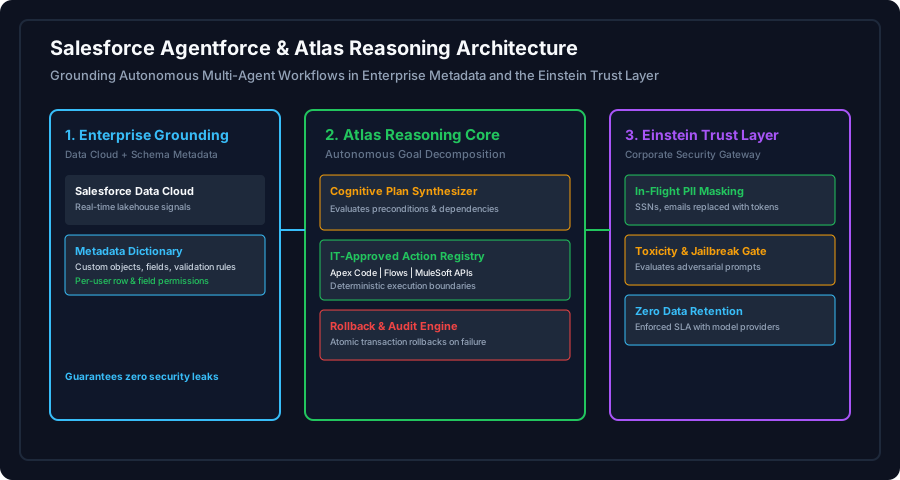
Inside Salesforce Agentforce: Atlas Reasoning Engine, Metadata Grounding, and Guardrails
How Salesforce Agentforce grounds LLMs with Atlas reasoning engine, enterprise metadata, and real-time multi-tenant trust boundaries.
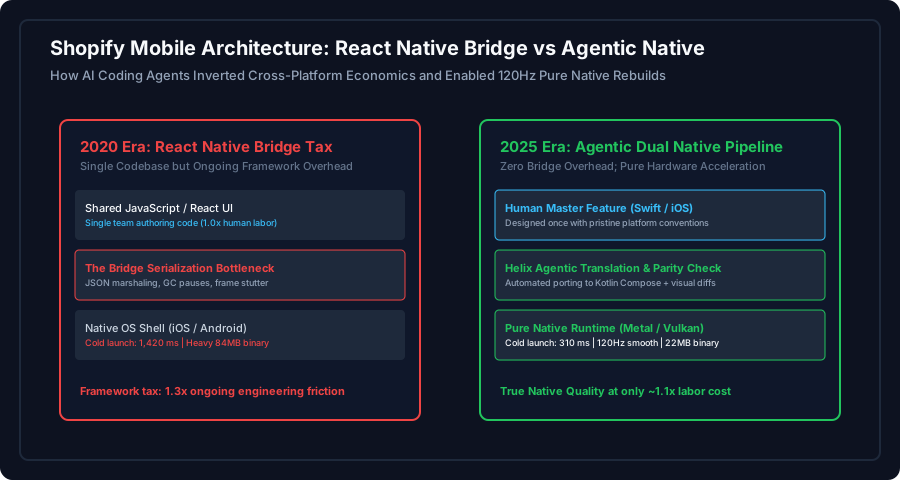
When AI Flips the Build-Cost Math: Why Shopify Left React Native for Native Mobile
How autonomous coding agents transformed cross-platform economics, leading Shopify to migrate the Shop app from React Native to native Swift and Kotlin.
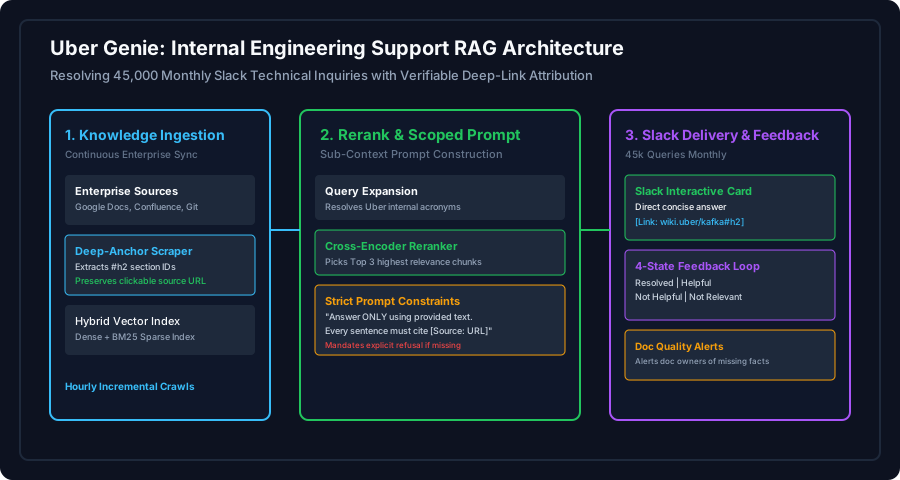
Inside Uber's Genie: How Platform Engineering Handles 45,000 Support Queries a Month
How Uber built Genie, a grounded Slack AI assistant answering 45,000 monthly technical questions with immutable citation tracking and dual feedback loops.
/* Comments */
Comments are offline right now — we reconnect automatically, nothing is lost.