
Inside Uber's Genie: How Platform Engineering Handles 45,000 Support Queries a Month
How Uber built Genie, a grounded Slack AI assistant answering 45,000 monthly technical questions with immutable citation tracking and dual feedback loops.
On this page
At an engineering organization the scale of Uber: spanning thousands of distributed microservices, dozens of internal platforms, and tens of thousands of developers, internal support channels are an operational nightmare. Platform engineering teams (infrastructure, data platform, mobile platform) were drowning under a relentless deluge of repetitive questions in internal Slack channels:
- “How do I provision a Kafka topic in the staging cluster?”
- “What is the deployment canary threshold for driver-dispatch-v2?”
- “Why is my pipeline failing with schema validation error 404?”
Every month, senior platform engineers spent over 15,000 collective hours acting as human search engines, context-switching away from critical roadmap projects to answer queries that were already documented in internal wikis, Google Docs, and past Slack threads.
To solve this, Uber’s platform engineering team built Genie: a grounded conversational Slack assistant that resolves over 45,000 engineering support questions per month, maintaining strict factual citation tracking and sub-second retrieval.
The Fine-Tuning vs RAG Architecture Decision
When designing Genie, Uber’s engineering team evaluated whether to fine-tune a specialized internal foundation model or deploy an advanced Retrieval-Augmented Generation (RAG) system:
+-----------------------------------------------------------------------------+
|                     GENIE: FINE-TUNING VS RAG EVALUATION                    |
+-----------------------------------------------------------------------------+

 Criteria               Supervised Fine-Tuning (SFT)   Enterprise RAG Pipeline
 -----------------------------------------------------------------------------
 Time-to-Launch         4 to 6 months                  3 weeks
 Knowledge Freshness    Stale (Requires retraining)    Live (Continuous CDC Sync)
 Citation Verification  Zero (Black-box generation)    100% (Verifiable URLs)
 Data Governance        Extremely difficult            Native ACL filtering
 Hallucination Risk     High                           Constrained to retrieved docs
The decision was clear: RAG was the only viable architecture. Platform documentation changes daily. An infrastructure deployment policy updated at 9:00 AM must be reflected in the assistant’s answers by 9:05 AM. Fine-tuning cannot accommodate that velocity, and cannot provide developers with clickable, authenticated links to the source documentation.
The Ingestion Architecture: Preserving URL Attribution
The core requirement of Genie is that every single assertion must carry an immutable citation link to the exact internal document it came from.
If a source URL is lost or corrupted during document parsing, the chunk is dead on arrival:
+-----------------------------------------------------------------------------+
|                         GENIE INGESTION DATA PIPELINE                       |
+-----------------------------------------------------------------------------+

 [Internal Sources: Confluence, Google Docs, GitHub Markdown, Phabricator]
                               |
                               | (Incremental Daily / Hourly CDC Scrapers)
                               v
             [Document Normalizer & Metadata Extractor]
             - Injects: Document UUID, Canonical URL, Last_Updated, ACL Scopes
                               |
                               v
             [Structural Header-Aware Chunking Engine]
             - Splits along H1, H2, H3 hierarchy
             - Preserves full URL anchor tag: "https://wiki.uber.internal/p/104#h2"
                               |
                               v
             [Embedding Generation (Dense Vectors + BM25 Sparse Index)]
                               |
                               v
             [Hybrid Search Vector Index (Milvus / OpenSearch)]
Preserving Granular Deep Links
Standard scrapers extract the document URL (https://wiki.internal/kafka-guide). When an answer references an obscure parameter buried 4,000 words down the page, developers are forced to manually read the whole document to verify the claim.
Genie’s parser preserves header anchors: it extracts section IDs and synthesizes deep fragment links (https://wiki.internal/kafka-guide#retention-policies), allowing the user to click directly to the exact paragraph that verified the assistant’s answer.
Serving Path: Sub-Context Prompting and Citation Injection
When an engineer asks a question in a monitored Slack support channel (e.g., #ask-data-platform):
 [User Slack Query]
         |
         v
 [Query Rewriter & Semantic Expansion]
         | - Expands internal Uber acronyms (e.g., "uCharge", "Cherami")
         v
 [Hybrid Retrieval: Dense Vector + BM25 Lexical Keyword Search]
         |
         v
 [Cross-Encoder Reranker] ---> Selects Top 3 Highly Relevant Chunks
         |
         v
 [Sub-Context Prompt Construction]
   System Prompt: "You are Uber Genie. Answer ONLY using the provided snippets.
                   Every factual sentence MUST end with [Source: URL_ANCHOR]."
         |
         v
 [Frontier LLM Streaming Generation]
         |
         v
 [Slack Bot Interactive Delivery]
To prevent context contamination, Genie does not dump dozens of raw search results into the prompt. It enforces Sub-Context Scoping:
- Only the top 3 highest-scoring reranked passages are included.
- The prompt explicitly mandates: “If the provided context does not explicitly contain the answer, reply that the documentation does not specify, and provide the link to the platform on-call roster.”
The Dual Human Feedback Taxonomy
A naive thumbs-up / thumbs-down button fails to provide actionable signal to platform engineers. Genie implements a four-state feedback taxonomy:
+-----------------------------------------------------------------------------+
|                          GENIE FEEDBACK TAXONOMY                            |
+-----------------------------------------------------------------------------+

 Category        Meaning                                  Action Taken
 -----------------------------------------------------------------------------
 Resolved        Answer was correct; issue solved         Logged as successful deflection
 Helpful         Answer was useful but incomplete         Flagged for documentation expansion
 Not Helpful     Answer was confusing or hallucinated     Sent to model prompt tuning queue
 Not Relevant    Retrieved wrong docs entirely            Triggered retrieval & synonym tuning
The Document Quality Flywheel
When engineers mark an answer “Not Helpful” or “Not Relevant”, Genie does not just file a bug report against the AI team. In 70% of failure cases, the failure occurred because the underlying internal wiki page was outdated, contradictory, or missing! Genie automatically notifies the owning platform documentation team, highlighting the exact search query and missing knowledge gap. The documentation is updated, the pipeline re-indexes the document, and the assistant permanently learns the correct answer.
Architectural Takeaway
Enterprise internal support assistants are not toy chatbots; they are mission-critical knowledge routing systems. Lessons from Uber Genie:
- Use Enterprise RAG over fine-tuning to guarantee knowledge freshness and zero-cost updates.
- Preserve canonical document URLs and deep header anchors across every transformation in your ingestion pipeline.
- Implement hybrid search (Dense Vectors + BM25) and cross-encoder reranking to handle domain-specific internal enterprise acronyms.
- Deploy a granular four-state feedback taxonomy to turn assistant failures into automated documentation maintenance workflows.
Keep reading
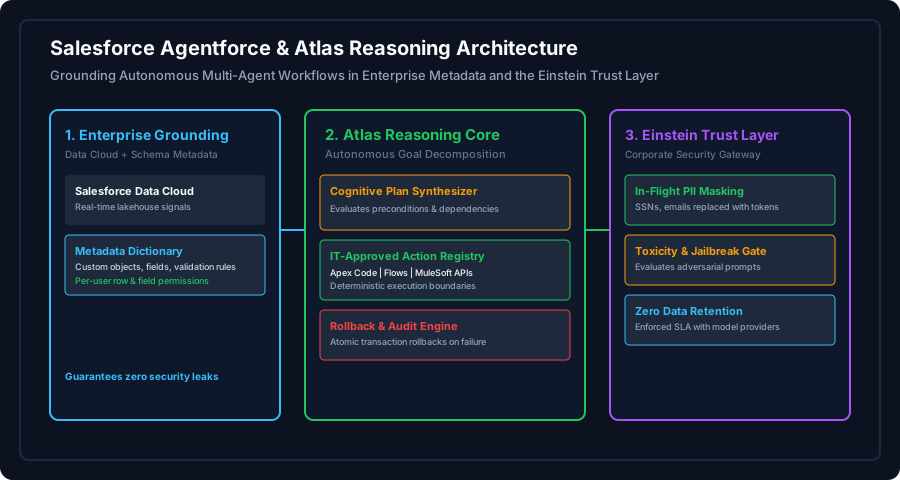
Inside Salesforce Agentforce: Atlas Reasoning Engine, Metadata Grounding, and Guardrails
How Salesforce Agentforce grounds LLMs with Atlas reasoning engine, enterprise metadata, and real-time multi-tenant trust boundaries.
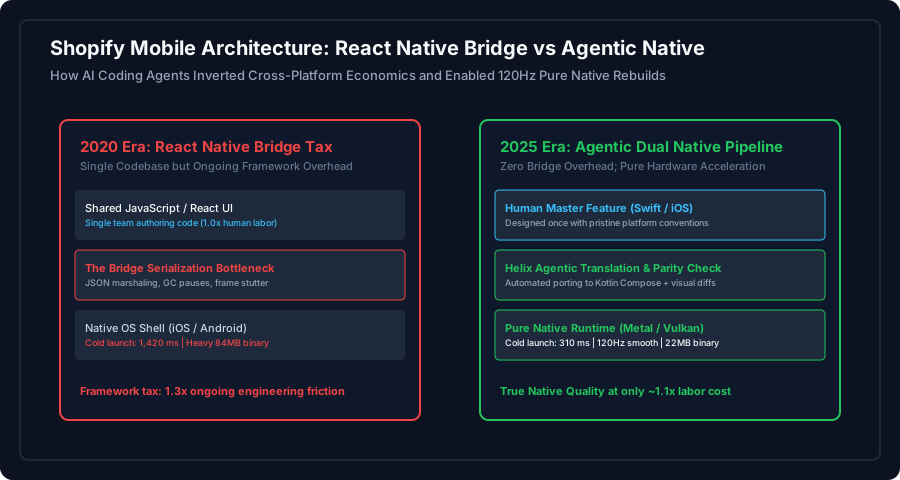
When AI Flips the Build-Cost Math: Why Shopify Left React Native for Native Mobile
How autonomous coding agents transformed cross-platform economics, leading Shopify to migrate the Shop app from React Native to native Swift and Kotlin.
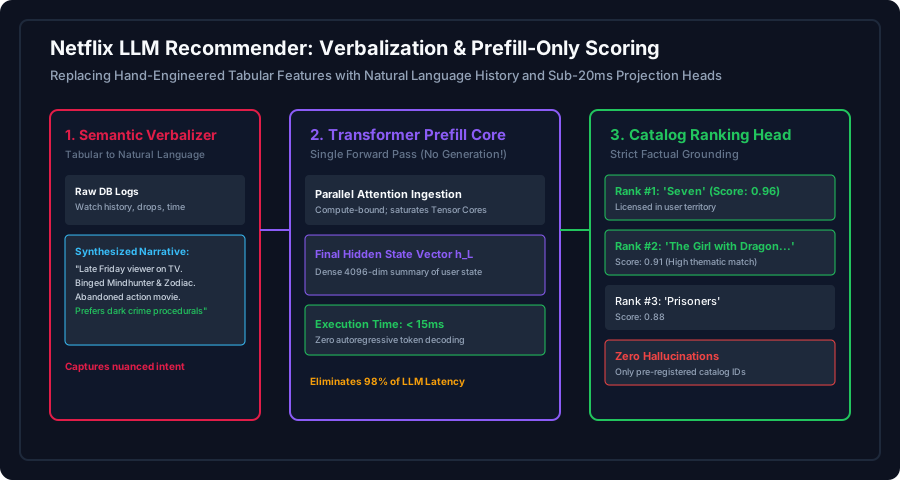
How Netflix Built an LLM-Native Recommender: Verbalization and Prefill-Only Scoring
How Netflix replaced feature-heavy recommendation pipelines by verbalizing viewing history, training catalog ranking heads, and prefill-only serving.
/* Comments */
Comments are offline right now — we reconnect automatically, nothing is lost.