
Inside Salesforce Agentforce: Atlas Reasoning Engine, Metadata Grounding, and Guardrails
How Salesforce Agentforce grounds LLMs with Atlas reasoning engine, enterprise metadata, and real-time multi-tenant trust boundaries.
On this page
When enterprise software giants attempt to add generative AI to their platforms, the initial impulse is often superficial: slap an API wrapper around a public model provider, call it an “AI copilot,” and insert a chat sidebar into the UI.
In complex enterprise environments with hundreds of custom database objects, sensitive HIPAA and SOC2 compliance restrictions, and bespoke workflow triggers, simple prompt wrappers fail completely. A public foundation model has no understanding of an enterprise’s custom CRM schemas (“What does Custom_Opportunity_Status__c mean?”), lacks visibility into per-user row-level access controls, and will happily hallucinate unauthorized actions.
Salesforce engineered Agentforce as an autonomous, multi-agent enterprise platform. At its core sits the Atlas Reasoning Engine: an orchestration system that completely bypasses rigid prompt chains, grounding foundation models natively in Salesforce’s proprietary enterprise metadata layer and the Einstein Trust Layer.
The Metadata Superpower: Why Raw LLMs Fail in the Enterprise
Salesforce’s decisive competitive advantage is not a custom proprietary LLM; it is the Salesforce Metadata Layer.
For 25 years, every table, field, validation rule, workflow trigger, and security permission created by a Salesforce customer has been recorded as structured metadata:
+-----------------------------------------------------------------------------+
|                     SALESFORCE ENTERPRISE METADATA MAPPING                  |
+-----------------------------------------------------------------------------+

 [Raw Database Row]
   ID: 0014W000023xYzA | Stage: 'Closed-Won' | Owner: 0054W000...
                                 |
                                 v
 [Salesforce Metadata Dictionary]
   - Field `Stage`: Enum with 6 strict legal states.
   - Trigger: Changing to 'Closed-Won' fires automated ERP billing webhook.
   - Sharing Rule: Account is visible ONLY to EMEA sales directors.
   - Validation Rule: Requires signed MSA PDF attachment before save.
If an autonomous agent does not understand this metadata, it will write invalid values to fields, bypass critical business triggers, and violate enterprise security policies.
The Atlas Reasoning Engine uses metadata to translate ambiguous human commands (“Help Alice close her biggest European deal”) into precise, policy-compliant execution graphs.
The Architecture of the Atlas Reasoning Engine
The Atlas Reasoning Engine replaces static hardcoded IF-THEN workflows with a dynamic cognitive loop:
+-----------------------------------------------------------------------------+
|                          ATLAS REASONING ENGINE TOPOLOGY                    |
+-----------------------------------------------------------------------------+

 [User Trigger / System Event (e.g. Inbound Support Email)]
                            |
                            v
 +---------------------------------------------------------------------------+
 |                         1. CONTEXT ASSEMBLY & GROUNDING                   |
 |  - Retrieves Real-Time Data from Salesforce Data Cloud (Lakehouse)        |
 |  - Injects Tenant-Specific Metadata (Custom objects, fields, workflows)   |
 |  - Filters by User Security Context (Row-level and field-level permissions)|
 +---------------------------------------------------------------------------+
                            |
                            v
 +---------------------------------------------------------------------------+
 |                         2. THE ATLAS PLANNER (BRAIN)                      |
 |  - Decomposes goal into multi-step execution graph                        |
 |  - Dynamically selects actions from curated Action Registry:              |
 |    * Apex Code Invocations       * Flow Automated Workflows               |
 |    * External MuleSoft APIs      * Prompt Templates                       |
 +---------------------------------------------------------------------------+
                            |
                            v
 +---------------------------------------------------------------------------+
 |                         3. EINSTEIN TRUST LAYER GATEWAY                   |
 |  - PII Masking & De-identification before model egress                    |
 |  - Toxicity & Prompt Injection Filtering                                  |
 |  - Zero-Data Retention Agreement Enforcement                              |
 +---------------------------------------------------------------------------+
                            |
                            v
 +---------------------------------------------------------------------------+
 |                         4. DETERMINISTIC EXECUTION                        |
 |  - Executes Apex / MuleSoft APIs within Salesforce Transaction Boundaries |
 |  - Validates business rules; triggers rollbacks on validation failures   |
 +---------------------------------------------------------------------------+
Step 1: Context Assembly and Security Grounding
Before invoking any reasoning model, Atlas performs Context Assembly:
- Data Cloud Integration: Pulls streaming real-time customer signals (past website clicks, telemetry, open support tickets) from the underlying data lakehouse.
- Permission Scoping: Atlas queries the user’s specific access profile. If the user does not have permission to view the
Credit_Score__cfield, that field is stripped from the context before the model ever sees it. - Metadata Translation: Custom field abbreviations are translated into human-readable descriptions based on the customer’s schema dictionary.
Step 2: The Dynamic Action Registry
Unlike naive agent frameworks that expose hundreds of arbitrary API endpoints, Agentforce structures agent capabilities around Enterprise Actions:
- Apex Code Blocks: Strongly typed, compiled enterprise business logic.
- Salesforce Flows: Declarative automated workflow rules.
- MuleSoft API Connectors: Secure integration pipelines to external SAP, Workday, or Snowflake instances.
Atlas does not execute arbitrary code; it selects from a curated, IT-approved catalog of actions. Each action defines strict JSON input schemas, execution preconditions, and rollback hooks.
Step 3: The Einstein Trust Layer
The biggest barrier to enterprise AI adoption is corporate governance: Will our customer PII leak to public models? Will training data be stolen?
The Einstein Trust Layer sits as an immutable security gateway between the Atlas Engine and external LLM providers:
- Zero Data Retention: Guarantees that neither prompts nor outputs are retained or used for training by model providers.
- In-Flight PII Masking: Automatically detects social security numbers, credit cards, and email addresses, replacing them with synthetic tokens before network egress, and de-masking them upon response return.
- Audit Trails: Every reasoning step, decision branch, tool invocation, and human override is recorded in an immutable compliance ledger.
Architectural Takeaway
Agentforce demonstrates the blueprint for modern enterprise AI:
- Models are commodities; enterprise metadata is the durable moat.
- Ground language models in structured schema dictionaries and strict per-user permissions before computing reasoning plans.
- Constrain agent execution to strongly typed, IT-governed enterprise actions (Apex, Flows, MuleSoft) rather than unconstrained arbitrary code.
- Enforce strict security gateways (PII masking, zero data retention) to satisfy enterprise compliance requirements.
Keep reading
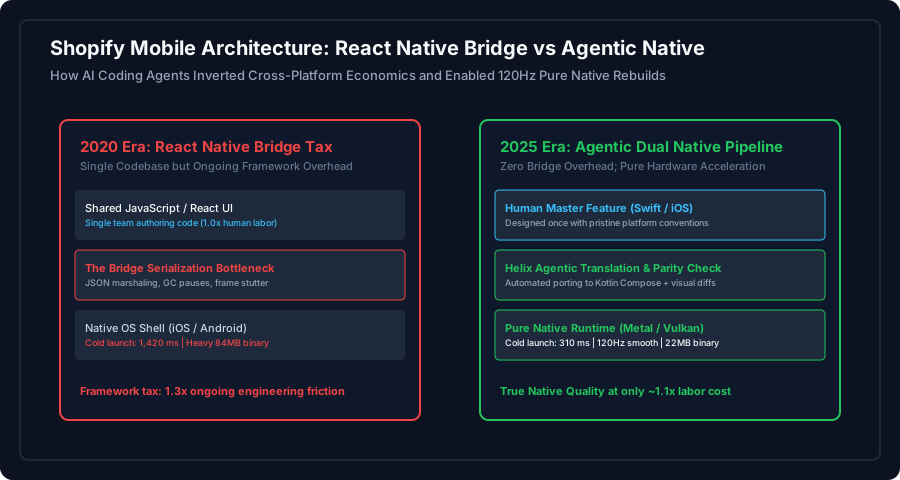
When AI Flips the Build-Cost Math: Why Shopify Left React Native for Native Mobile
How autonomous coding agents transformed cross-platform economics, leading Shopify to migrate the Shop app from React Native to native Swift and Kotlin.
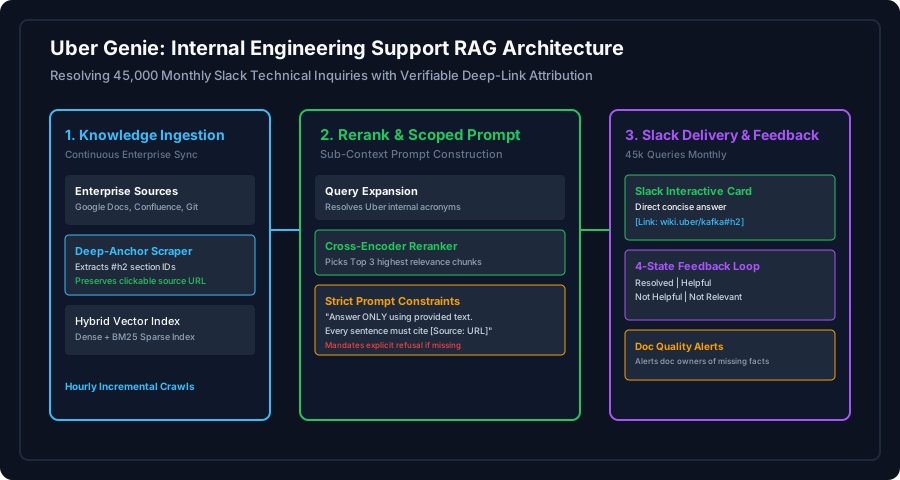
Inside Uber's Genie: How Platform Engineering Handles 45,000 Support Queries a Month
How Uber built Genie, a grounded Slack AI assistant answering 45,000 monthly technical questions with immutable citation tracking and dual feedback loops.
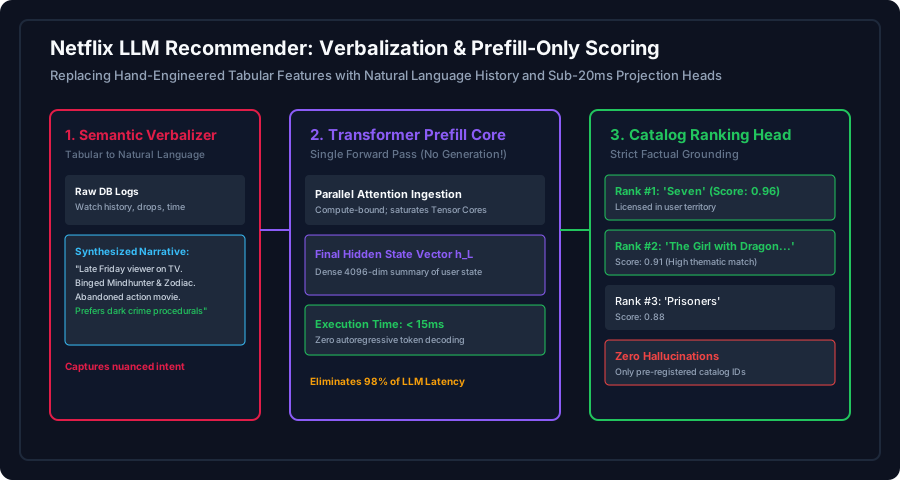
How Netflix Built an LLM-Native Recommender: Verbalization and Prefill-Only Scoring
How Netflix replaced feature-heavy recommendation pipelines by verbalizing viewing history, training catalog ranking heads, and prefill-only serving.
/* Comments */
Comments are offline right now — we reconnect automatically, nothing is lost.