
Why a Chip Company Publishes Models: Inside NVIDIA's Open Model Architecture Strategy
How NVIDIA trains and aligns open foundation models to drive silicon adoption, from synthetic pipelines to 4-bit NVFP4 hardware bets.
On this page
When software engineers consider the dominant open foundation model builders, names like Meta, Mistral, and DeepSeek immediately surface. But in recent release cycles, NVIDIA has steadily published state-of-the-art open weights: the Nemotron family, specialized reward models, and hybrid architectures that rival top frontier labs.
Why does the world’s most valuable semiconductor manufacturer invest hundreds of researchers and thousands of H100 clusters into training and open-sourcing foundational LLMs?
The answer lies in vertical hardware co-design. NVIDIA does not build models to monetize API tokens; it builds models to dictate the hardware requirements of the next silicon generation. By understanding NVIDIA’s training recipes, synthetic data pipelines, and low-precision quantization bets, engineering teams gain a masterclass in modern model engineering.
The Silicon Flywheel: Why NVIDIA Releases Open Weights
+-------------------------------------------------------------+
|               THE HARDWARE-MODEL FLYWHEEL                   |
|                                                             |
|  1. Design Future Silicon (Blackwell / Rubin) with NVFP4   |
|                            |                                |
|  2. Train Open Models directly targeting 4-bit primitives   |
|                            |                                |
|  3. Release Nemotron weights freely to enterprise developers|
|                            |                                |
|  4. Enterprises adopt weights -> Must buy Blackwell chips   |
+-------------------------------------------------------------+
Every major architectural choice in NVIDIA’s open model program serves three strategic commercial objectives:
- Showcase Enterprise Software (NeMo & TensorRT-LLM): Training recipes serve as production reference implementations for NVIDIA’s NeMo framework, validating that their software stack scales seamlessly across tens of thousands of GPUs without communication bottlenecks.
- Co-Design Ahead of Silicon Launches: Models are designed around future arithmetic instructions. When NVIDIA built Blackwell with native support for 4-bit floating point (NVFP4), they co-trained models from day one in low-precision representation. When hardware lands, enterprise clients already have models tuned specifically for those micro-architectures.
- Enterprise Defense Against Closed API Lock-in: If enterprise AI workloads remain trapped inside closed hyperscaler APIs, cloud providers can negotiate volume silicon discounts or substitute proprietary accelerators (like Google TPUs or AWS Trainium). By arming enterprises with competitive open-weight models, NVIDIA keeps workloads running on standard GPU clusters in private clouds and on-premises data centers.
The Synthetic Data Pipeline: Quality Over Web Scrapes
The days of pre-training models solely on raw, uncurated web scrapes (Common Crawl) are over. The industry has hit the “data wall”: high-quality human text on the public internet has been almost completely exhausted.
NVIDIA’s training methodology relies heavily on an automated, multi-stage synthetic data factory:
               [Raw Domain Corpus / Code / Papers]
                               |
                               v
                     +-------------------+
                     | LLM Prompt Engine |
                     +-------------------+
                               |
                   (Generates 100M Q&A Pairs)
                               |
                               v
                    +---------------------+
                    |   The Critic Loop   |
                    | (Rule + Model Check)|
                    +---------------------+
                               |
            +------------------+------------------+
            |                                     |
         (Pass)                                (Fail)
            v                                     v
   [Nemotron Train Set]                 [Synthetic Rejection]
1. Controlled Synthesis
Instead of harvesting noisy internet forums, frontier models generate targeted instruction sets, synthetic reasoning trajectories, and multi-turn conversational trees across niche technical domains (semiconductor physics, CUDA programming, distributed systems).
2. Rigorous Model-Based Critics
Generated text is passed through specialized reward and critic models trained to detect:
- Mathematical inaccuracies and logical drift
- Formatting non-compliance
- Sycophancy and repetitive phrasing Any sample that fails validation is either regenerated with targeted critique prompts or discarded.
3. Decontamination and Deduplication
NVIDIA applies MinHash LSH and dense embedding clustering to strip duplicate semantic concepts. This prevents the model from memorizing identical sentence structures, maximizing the entropy of every training token.
Alignment Innovation: The HelpSteer2 Framework
Instruction tuning and alignment often introduce what researchers call the alignment tax: fine-tuning a model to be polite and safe frequently degrades its raw mathematical reasoning and coding capabilities.
To resolve this, NVIDIA developed and open-sourced HelpSteer2, an open alignment dataset and methodology that decomposes human preference into explicit, decoupled reward dimensions:
- Helpfulness: Does the response directly solve the prompt?
- Correctness: Are factual assertions and code snippets provably true?
- Coherence: Is the explanation logically structured?
- Complexity: Does the output provide depth without gratuitous fluff?
- Verbosity Control: Penalizing models for unnecessary conversational padding.
By training multi-head reward models that score these attributes independently rather than combining them into a single opaque scalar score, NVIDIA allows engineers to tune steering vectors during Direct Preference Optimization (DPO) and Reinforcement Learning from Human Feedback (RLHF).
The Hardware Bet: NVFP4 Native Quantization
Historically, quantization was an afterthought: an engineering team trained a model in FP16 or BF16, and downstream developers applied post-training quantization (PTQ) to squash weights into INT8 or INT4, accepting a degradation in perplexity and reasoning.
NVIDIA inverted this sequence. In the NVFP4 standard, numbers are represented using only 4 bits:
- 1 sign bit
- 2 exponent bits
- 1 mantissa bit (E2M1)
        +-----+---------+----------+
        | Sign| Exponent| Mantissa |  = 4 Bits Total
        | (1) |   (2)   |   (1)    |
        +-----+---------+----------+
Because 4-bit floating point has an extremely narrow dynamic range (representing values between $-6.0$ and $+6.0$), naive quantization causes activation outliers to blow up, destroying model coherence.
NVIDIA solved this through Quantization-Aware Training (QAT) and fine-grained micro-scaling factors:
- Tensors are divided into small vector groups (e.g., 16 or 32 elements).
- Each group carries an 8-bit scale factor (E4M3), dynamically adjusting the 4-bit range to fit local activation magnitudes.
- Blackwell Tensor Cores execute these 4-bit dot products at double the throughput and half the memory bandwidth of FP8.
By publishing models that natively tolerate 4-bit execution without reasoning degradation, NVIDIA ensures that enterprise teams deploying their weights achieve unprecedented token-per-second economics, solidifying the hardware moat.
Keep reading
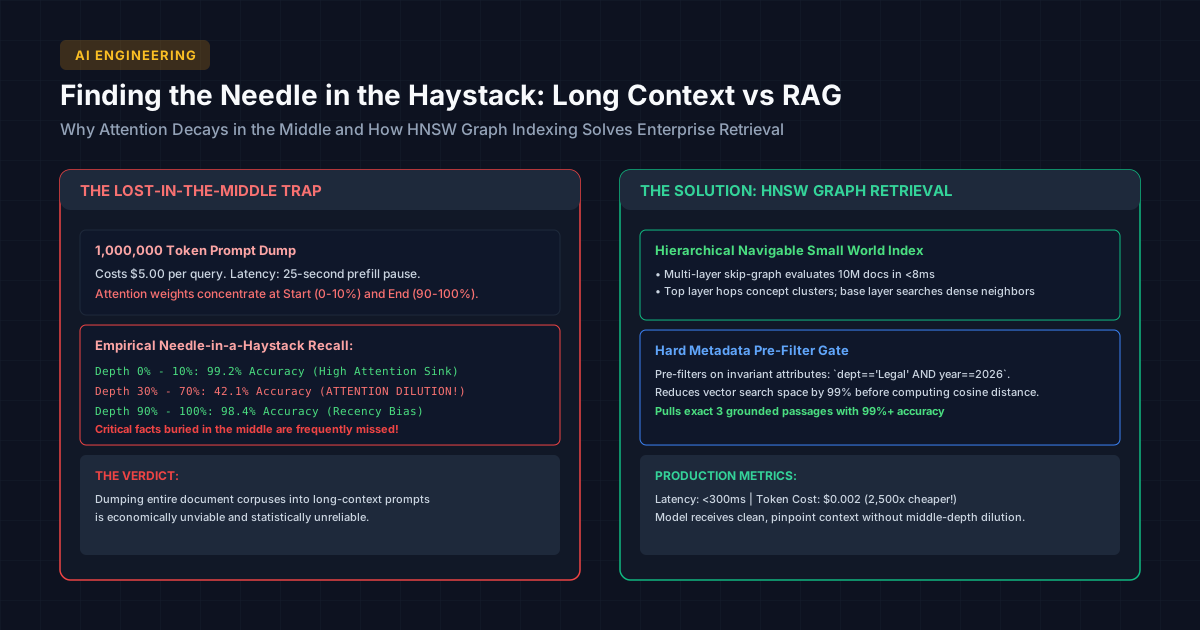
Finding the Needle in the Haystack: Embeddings, HNSW Indexes, and Long-Context Retrieval
Why long-context models suffer from the lost-in-the-middle phenomenon: HNSW graph indexing, metadata pre-filtering, and retrieval safeguards.
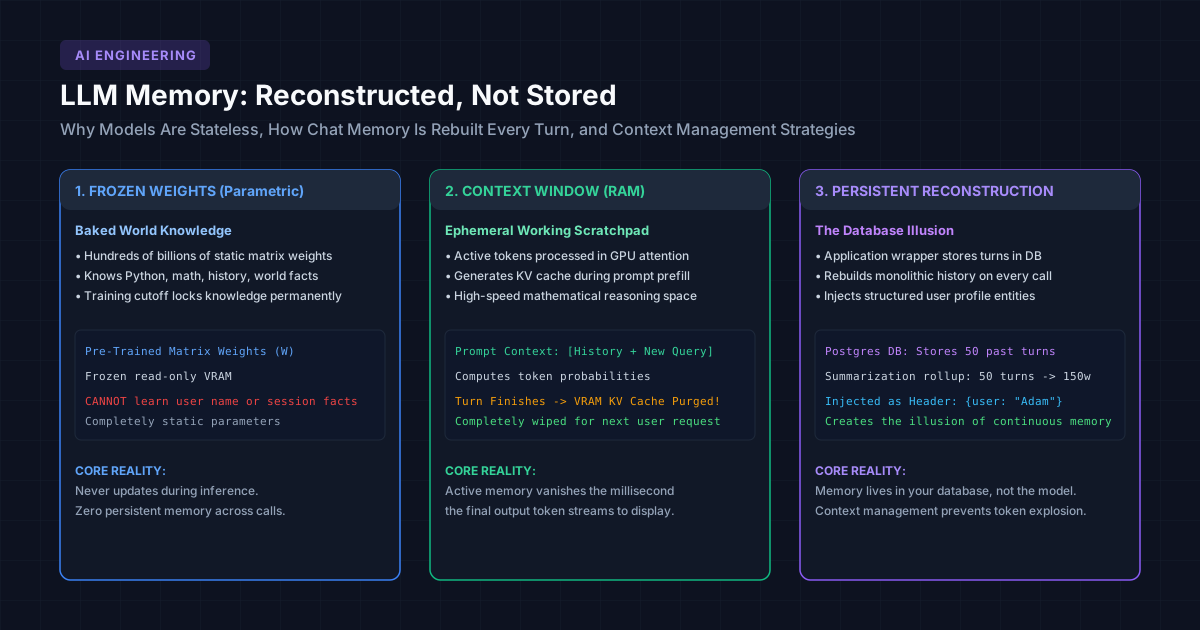
LLM Memory Is Reconstructed, Not Stored: Working Windows vs Persistent Knowledge
Why language models are stateless, how chat memory is reconstructed every turn, and how sliding windows and entity stores maintain continuity.
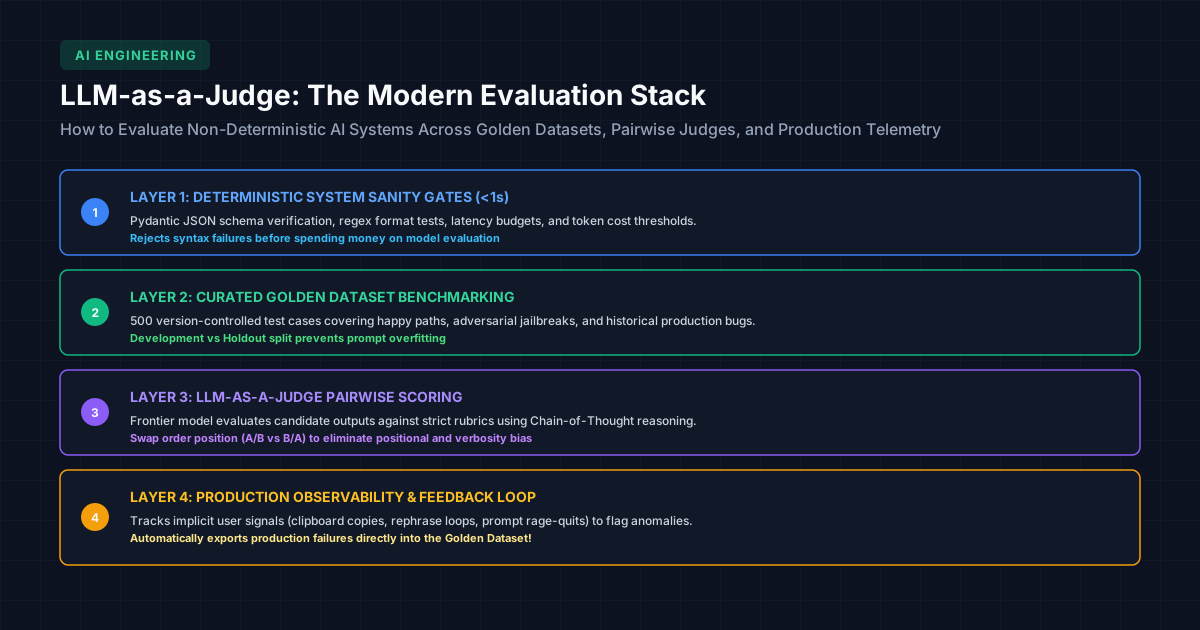
LLM-as-a-Judge and the Evaluation Stack: How to Monitor Health Before and After Shipping
Traditional unit tests fail on non-deterministic outputs: golden datasets, pairwise judge models, human calibration, and production observability.
/* Comments */
Comments are offline right now — we reconnect automatically, nothing is lost.