
topic: distributed-systems
author: Crashtech Editorial
published: Oct 15, 2026 · read: 3 min
---
Designing for Failure in Distributed Systems: Blast Radius, Timeouts, and Degradation
How senior systems architects design resilient infrastructure by assuming every component will fail, isolating blast radiuses, and enforcing idempotent retries.
On this page
In beginner software engineering courses, students are taught how to make code work when everything goes right: the network is instant, memory is infinite, servers never reboot, and third-party APIs never fail.
In real-world production engineering, everything is broken all the time. At any given millisecond across a large cloud fleet:
- A top-of-rack network switch is dropping 4% of packets.
- A disk drive is experiencing high I/O wait latency due to bad sectors.
- A downstream payment gateway is returning
HTTP 504 Gateway Timeout. - A background garbage collection pause is freezing a worker thread for 800 milliseconds.
Junior engineers write software with the goal of avoiding faults. Senior systems architects practice Fault Tolerance: assuming every component will fail catastrophically, scoping the blast radius, enforcing graceful degradation, and proving system recovery before shipping to production.
Fault Avoidance vs Fault Tolerance
Understanding the conceptual distinction between avoiding faults and tolerating them dictates how infrastructure is architected:
+-----------------------------------------------------------------------------+
|                     FAULT AVOIDANCE VS FAULT TOLERANCE                      |
+-----------------------------------------------------------------------------+

 Dimension             Fault Avoidance (Fragile)     Fault Tolerance (Resilient)
 -----------------------------------------------------------------------------
 Core Philosophy       "Make sure nothing breaks."   "Everything will break; contain it."
 Redundancy            Single points of failure      N+2 redundancy across AZs
 Network Calls         Unbounded blocking timeouts   Strict deadlines + circuit breakers
 Failure Behavior      Total cascading outage        Graceful degradation to read-only
 State Recovery        Manual human intervention     Deterministic automated reconciliation
You cannot avoid hardware failure; physics makes that impossible. A power supply will blow out, an optic cable will be severed by a backhoe, and an engineer will deploy a bad configuration. Resilient systems are designed to survive the inevitable failure of their constituent parts without degrading the primary user experience.
The Pillars of Fault Containment
Resilient architectures construct physical and logical bulkheads around failures:
+-----------------------------------------------------------------------------+
|                          FAULT CONTAINMENT HIERARCHY                        |
+-----------------------------------------------------------------------------+

 [Tier 1: Blast Radius Isolation (Bulkheading)]
   - Partitioning infrastructure into independent failure domains (Cells / AZs).
   - An outage in Cell A cannot bleed into Cell B.

 [Tier 2: Traffic Shedding & Circuit Breaking]
   - When downstream latency spikes, fast-fail immediately rather than
     queuing up thousands of blocked threads.

 [Tier 3: Graceful Degradation Fallbacks]
   - Serve stale cached data or static defaults when live backends are dead.

 [Tier 4: Idempotent Automated Self-Healing]
   - Replay failed messages through exponential backoff and Dead-Letter Queues (DLQ).
1. Bulkheading and Cell-Based Isolation
Borrowed from maritime architecture, where a ship’s hull is divided into watertight compartments so that a single hull breach does not sink the vessel, Bulkheading physically segregates resources:
- Thread Pool Bulkheading: Never allow an optional analytics call to share the same worker thread pool as the primary order checkout pipeline. If analytics hangs, checkout threads remain completely unblocked.
- Cell-Based Partitions: Divide users across isolated, self-contained infrastructure units (“cells”). If Cell #4 experiences a corrupted database migration, only 5% of users are affected; 95% of users experience zero disruption.
2. Circuit Breakers: Halting Cascading Failures
When a downstream microservice begins to slow down, upstream callers make the mistake of waiting for default 30-second timeouts. Incoming traffic accumulates, threads exhaust memory, and the upstream service crashes. The failure cascades backward until the entire platform collapses.
       [Closed: Normal Traffic Flow]
                     |
       (Downstream error rate exceeds 50% over 10 seconds)
                     v
       [OPEN: Immediate Fast-Fail]
         - Bypasses downstream network call entirely
         - Returns immediate fallback response (< 1ms)
         - Zero thread exhaustion upstream
                     |
       (Sleep window expires after 30 seconds)
                     v
       [Half-Open: Canary Probe]
         - Allows 5% of traffic through to test recovery
         - Recovers to CLOSED if successful; reverts to OPEN if failed
3. Graceful Degradation
When a dependency dies, an application should degrade gracefully rather than displaying an unformatted HTTP 500 Internal Server Error:
- If the personalized recommendation engine is down: serve the static top-10 global popular items.
- If the dynamic search pricing service is down: fall back to the last cached price quote from Redis with an informational notice.
- If the primary write database is partitioned: switch the application to read-only mode so users can still browse content.
Correctness in a Degraded State: Idempotency and Deadlines
Running safely in a degraded state requires that retried operations do not corrupt data:
Distributed Context Deadlines
Never pass a bare timeout like timeout = 5s to every internal microservice hop. Use Distributed Deadlines:
- The client gateway sets an absolute expiration deadline:
Deadline: T_now + 1200ms. - This deadline header propagates across every downstream RPC call.
- If Hop 1 consumes 1,100ms, Hop 2 observes that only 100ms remain. If Hop 2 knows its database query takes 250ms, it immediately drops the request without executing it, avoiding wasted CPU cycles on a request the user has already abandoned.
Enforcing Idempotency Keys
Whenever a network timeout occurs, the client does not know whether the failure happened before the server processed the write or after the server processed the write but before the response arrived.
Every mutating request must include a unique client-generated Idempotency Key:
INSERT INTO payments (idempotency_key, amount, status)
VALUES ('idem_9841a_uuid', 49.99, 'COMMITTED')
ON CONFLICT (idempotency_key) DO NOTHING;
When the client retries the timed-out request, the database recognizes the idempotency key and returns the cached result without charging the customer twice.
Architectural Takeaway
Designing for failure is an unbending engineering discipline:
- Assume every single network call will fail, hang, or return corrupted data.
- Enforce strict distributed deadlines and circuit breakers to prevent cascading thread exhaustion.
- Partition systems into isolated bulkheads and cells to limit the blast radius of outages.
- Design every write API to be strictly idempotent so that automated retries cannot double-execute state changes.
Keep reading
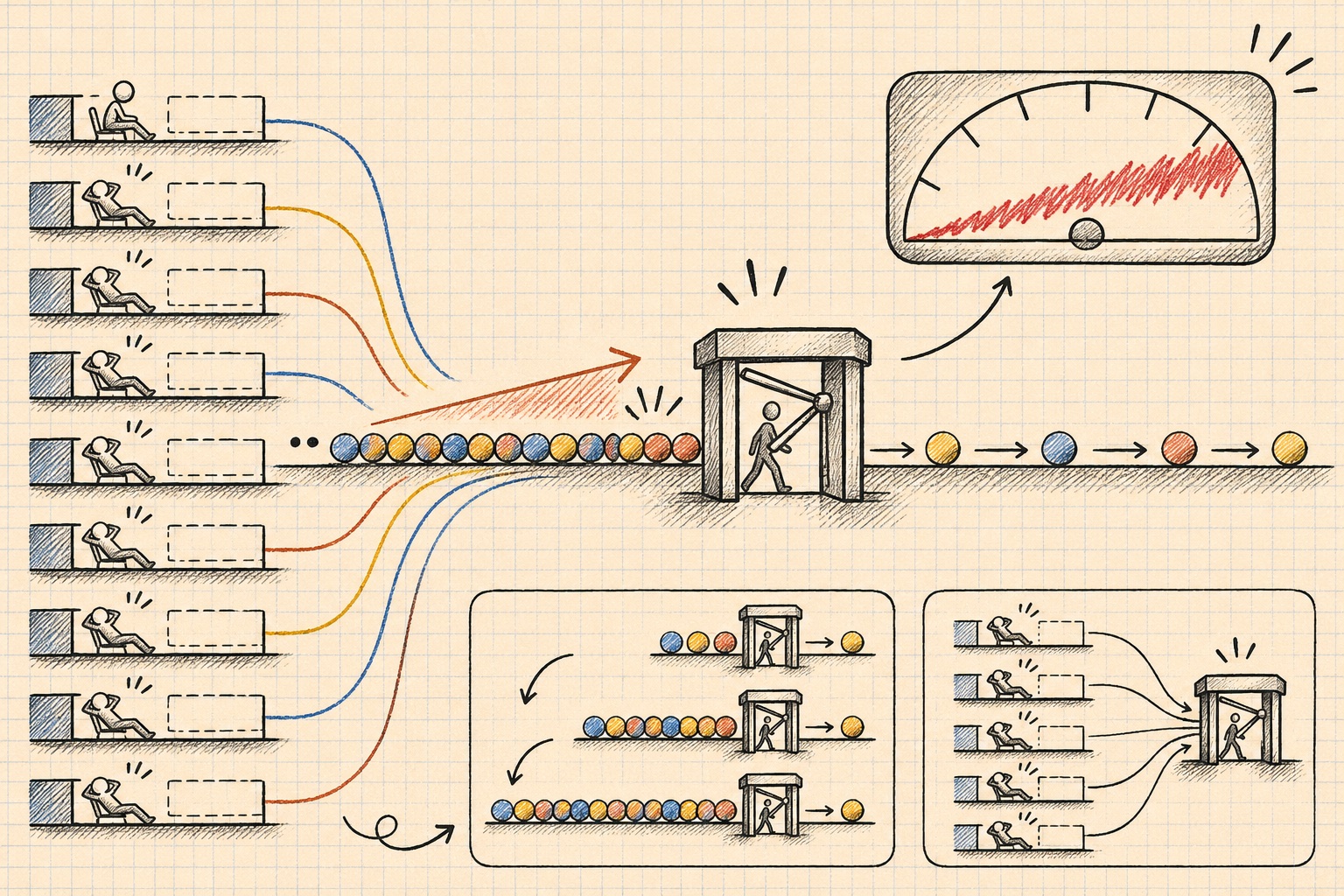
Inside the Microsoft 365 Gateway Failure: Lock Contention to Cascade
A technical reconstruction of how a gateway lock defect, shifted load and shrinking capacity can turn queued requests into fleet-wide failure.
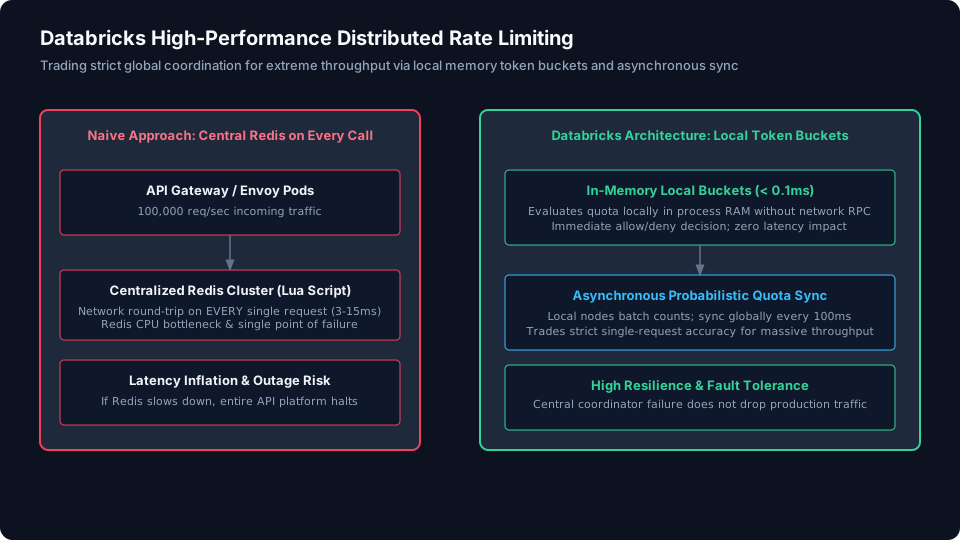
High-Performance Rate Limiting at Databricks: In-Memory Local Coordination
How Databricks engineered ultra-low-latency distributed rate limiting: trading strict atomic precision for microsecond in-memory evaluations.
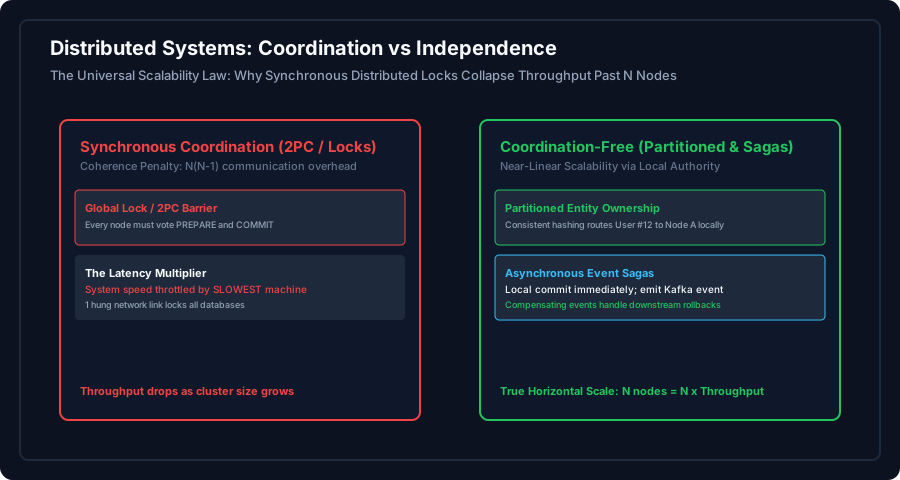
Why Distributed Systems Prefer Independence over Coordination: The Scalability Limit
How synchronous distributed locks, two-phase commits, and consensus quorums throttle throughput, and how to architect coordination-free systems.
/* Comments */
Comments are offline right now — we reconnect automatically, nothing is lost.