
topic: distributed-systems
author: Crashtech Editorial
published: Oct 22, 2026 · read: 3 min
---
Why Distributed Systems Prefer Independence over Coordination: The Scalability Limit
How synchronous distributed locks, two-phase commits, and consensus quorums throttle throughput, and how to architect coordination-free systems.
On this page
When software engineers design their first distributed system, they naturally attempt to replicate the familiar guarantees of a single-node database: every write is immediately visible everywhere, global locks prevent concurrent updates, and a transaction either succeeds across all five services or rolls back atomically.
In production at scale, this design philosophy collapses.
Coordination: requiring multiple independent servers, databases, or microservices to agree synchronously before proceeding, is the absolute enemy of horizontal scalability. Every synchronous lock wait, every two-phase commit (2PC), and every distributed consensus quorum turns the slowest machine on your network into the master bottleneck for the entire global system.
Senior distributed systems architects follow a foundational principle: Maximize component independence. The highest-throughput systems in computing history (Git, Amazon’s shopping cart, DNS, and Kafka) are designed so that nodes can make forward progress locally without waiting for permission from anyone else.
The Mathematical Math of Waiting: Universal Scalability Law
Why does coordination degrade performance so brutally? Neil Gunther’s Universal Scalability Law (USL) mathematically models system throughput $X(N)$ as a function of worker nodes $N$:
Throughput(N) = (gamma * N) / (1 + sigma * (N - 1) + kappa * N * (N - 1))Where:
- $\sigma$ (sigma) is the Contention penalty (waiting in line for a shared resource).
- $\kappa$ (kappa) is the Coherence penalty (the cost of cross-node coordination, consensus, and cache invalidation).
+-----------------------------------------------------------------------------+
|                     THROUGHPUT COLLAPSE UNDER COORDINATION                  |
+-----------------------------------------------------------------------------+

 Throughput |                /--- Ideal Linear Scaling (Zero Coordination)
            |               /
            |              /   /--- Amdahl's Law (Contention Only)
            |             /   /
            |            /   /   /--- Universal Scalability Law (Coordination)
            |           /   /   /     (Throughput actually DECLINES past N nodes!)
            |          /___/___/
            +-----------------------------------------------------------------
             1        10        100       1000      Nodes (N)
Notice the devastating impact of $\kappa$: the coherence penalty scales quadratically with $N(N - 1)$. If every node must check with every other node before committing a write:
- At 3 nodes: 6 communication round-trips.
- At 10 nodes: 90 communication round-trips.
- At 100 nodes: 9,900 communication round-trips.
Past a certain node count, adding more servers does not increase capacity; it actively decreases total system throughput because nodes spend 99% of their CPU time waiting for consensus heartbeats and lock acknowledgments.
The Three Lethal Coordination Traps
+-----------------------------------------------------------------------------+
|                      THE THREE LETHAL COORDINATION TRAPS                    |
+-----------------------------------------------------------------------------+

 1. Distributed Two-Phase Commit (2PC) Across Microservices
    - Coordinator prepares all services, then issues commit.
    - If ONE network link hangs, all database locks remain held indefinitely,
      halting the entire enterprise.

 2. Global Distributed Locks (Redis / ZooKeeper)
    - Serializing multi-node workers via distributed mutexes.
    - Turns a parallel cluster into a single-threaded bottleneck with
      network latency added to every tick.

 3. Synchronous RPC Call Chains (Temporal Coupling)
    - Service A calls Service B, which calls Service C, which calls Service D.
    - Overall availability is the product of individual availabilities:
      99.9% * 99.9% * 99.9% * 99.9% = 99.6% (10x higher downtime!).
Architectural Doctrines of Coordination-Free Design
High-scale systems eliminate coordination by redesigning how data is owned, partitioned, and reconciled:
+-----------------------------------------------------------------------------+
|                     COORDINATION-FREE ARCHITECTURAL PATTERNS                |
+-----------------------------------------------------------------------------+

 Pattern 1: Partitioned Local Ownership (Consistent Hashing)
   - Shard data so that all operations for Entity X (e.g., Account #8812)
     run on a single designated partition owner.
   - The owner writes to local memory/disk instantly with ZERO remote locks.

 Pattern 2: Conflict-Free Replicated Data Types (CRDTs)
   - Data structures designed so that concurrent writes on different nodes
     can be merged deterministically in any order without synchronization.
   - Examples: Collaborative doc editing, distributed counters, shopping carts.

 Pattern 3: Asynchronous Sagas over Two-Phase Commit
   - Replace synchronous 2PC with compensating event sagas.
   - Execute local ACID transactions immediately; emit events to Kafka.
   - If a downstream step fails, fire an asynchronous compensating transaction
     to unwind the state.
Git as the Masterclass in Independence
Consider Git: software engineers do not acquire a distributed lock on the repository every time they type a line of code.
- You commit locally on your laptop in complete isolation (zero network calls, zero coordination).
- You can work offline on an airplane for a week.
- You synchronize your append-only DAG (directed acyclic graph) with the remote repository asynchronously via a push/merge operation.
- Git scales to millions of developers because the fundamental write path is completely independent of the network.
Where Coordination Is Truly Mandatory
Independence is not a silver bullet. Some operations genuinely require synchronous coordination:
- Financial Account Overdraft Prevention: You cannot let two ATMs dispense the last $100 simultaneously.
- Unique Username Registration: Two users cannot claim
@johnon Twitter at the exact same second.
When synchronous agreement is non-negotiable:
- Scope It Aggressively: Keep the coordinated critical section as small and fast as possible (e.g., reserving a unique string in Redis in 2ms), and perform all remaining processing asynchronously.
- Use Consensus Protocols with Single Leaders: Deploy Raft or Multi-Paxos (via etcd or Spanner) rather than naive multi-master locks, ensuring deterministic majority quorums ($N/2 + 1$).
Architectural Takeaway
Scalability is not about how fast your servers communicate; it is about how much work they can accomplish without communicating at all:
- Measure and eliminate coherence penalties in your architecture.
- Replace synchronous 2PC distributed transactions with asynchronous event-driven Sagas.
- Partition state by entity key so nodes make authoritative updates locally without remote consensus.
- Embrace eventual consistency and CRDTs wherever business invariants tolerate temporary replication lag.
Keep reading
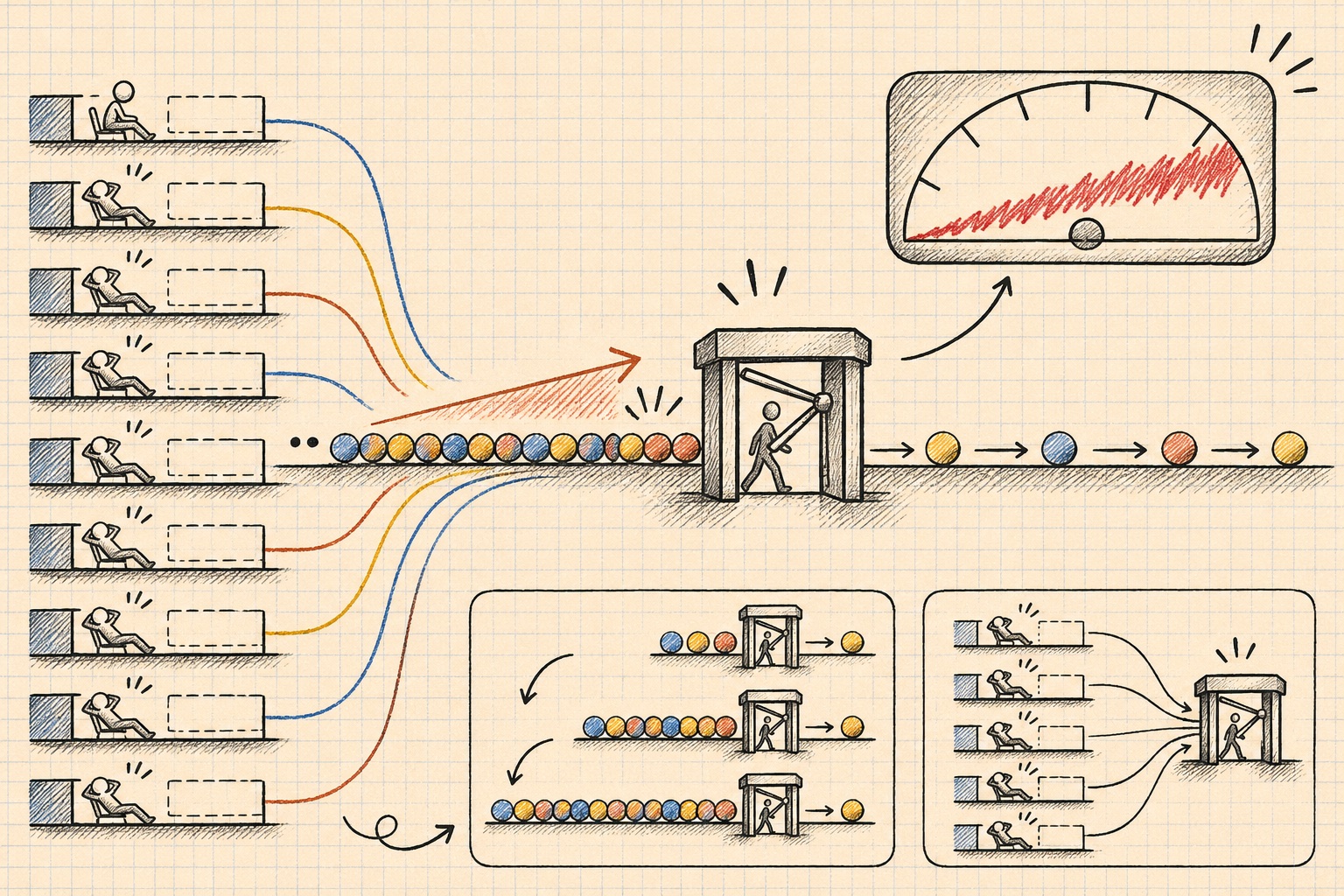
Inside the Microsoft 365 Gateway Failure: Lock Contention to Cascade
A technical reconstruction of how a gateway lock defect, shifted load and shrinking capacity can turn queued requests into fleet-wide failure.
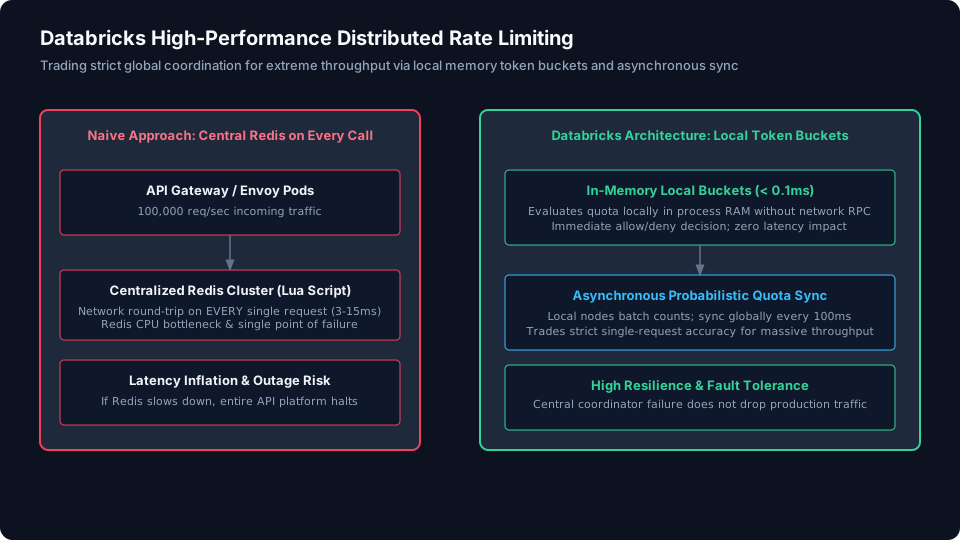
High-Performance Rate Limiting at Databricks: In-Memory Local Coordination
How Databricks engineered ultra-low-latency distributed rate limiting: trading strict atomic precision for microsecond in-memory evaluations.
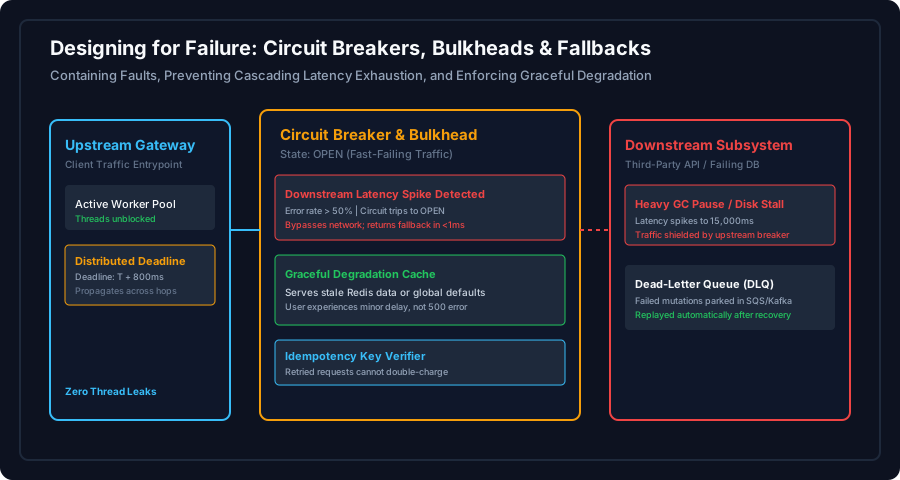
Designing for Failure in Distributed Systems: Blast Radius, Timeouts, and Degradation
How senior systems architects design resilient infrastructure by assuming every component will fail, isolating blast radiuses, and enforcing idempotent retries.
/* Comments */
Comments are offline right now — we reconnect automatically, nothing is lost.