
Inside an Open Foundation Model Built to Be Adapted: Sparse Experts and Modular Tuning
Architectural mechanics of modern open models: mixture-of-experts routing, hybrid attention, and low-rank adapter injection.
On this page
When open-source foundation models first emerged, they were essentially monolithic replicas of proprietary architectures: standard dense transformer blocks stacked 32 or 80 layers deep. Fine-tuning them required updating billions of dense parameters, which demanded multi-GPU clusters and massive VRAM footprints.
The newest generation of open-weights models (such as DeepSeek-V3, Qwen-2.5, and Llama 3) are engineered with a completely different objective: modular adaptivity.
Modern open models are designed from the ground up to be customized, sliced, and fine-tuned on modest enterprise hardware without catastrophic forgetting.
Understanding the internal mechanics of these architectures (Sparse Mixture-of-Experts, dynamic top-$k$ routing, hybrid attention, and low-rank adapter injection) reveals how engineering teams adapt frontier-grade intelligence to domain-specific workloads.
+--------------------------------------------------------------------------+
|                  THE MODULAR FOUNDATION MODEL ARCHITECTURE               |
|                                                                          |
|  [Input Tokens] ---> [Rotary Position (RoPE)]                            |
|                            |                                             |
|                            v                                             |
|  [Hybrid Attention Block] (Combines Sliding-Window + Full Multi-Head)    |
|                            |                                             |
|                            v                                             |
|  [Sparse MoE Router] ---> Dynamically routes token to Top-2 of 64 Experts|
|                            |                                             |
|                            v                                             |
|  [PEFT / LoRA Injection Layer] -> Injects low-rank domain adapter weights|
|                            |                                             |
|                            v                                             |
|  [Output Probability Logits]                                             |
+--------------------------------------------------------------------------+
Innovation 1: Sparse Mixture-of-Experts (MoE)
In a traditional dense model, every single parameter in the feed-forward networks (FFN) activates for every single token processed. If a model has 70 billion parameters, all 70 billion participate in calculating every comma, word, and digit.
In a Sparse Mixture-of-Experts (MoE) architecture:
- The standard dense feed-forward layer is replaced by a pool of $N$ specialized, smaller feed-forward networks called Experts (e.g., 64 or 256 experts).
- A lightweight Router (Gating Network) analyzes the incoming token representation and computes a softmax probability across all experts.
- Only the Top-$k$ experts (typically top-2 or top-8) are activated for that token:
y = sum_{i in Top-k} (g_i(x) * E_i(x))Where $g_i(x)$ is the routing probability weight and $E_i(x)$ is the output of expert $i$.
Token: "SELECT" ---> [MoE Router Gate] ---> Routes to: Expert 4 (SQL) + Expert 12 (Grammar)
Token: "def"    ---> [MoE Router Gate] ---> Routes to: Expert 9 (Python) + Expert 12 (Grammar)
Token: "patient"---> [MoE Router Gate] ---> Routes to: Expert 22 (Medical) + Expert 41 (Anatomy)
The Inference Advantage
An MoE model can possess 236 billion total parameters, but only activate 21 billion parameters per token.
This delivers the vast knowledge capacity and reasoning depth of a 200B+ model while executing with the token generation speed and computational cost of a lean 20B model.
Innovation 2: Hybrid Attention Mechanics
Attention calculation scales quadratically ($O(N^2)$) with sequence length. In standard transformer architectures, pushing context windows to 128,000 tokens causes severe compute and memory bottlenecks.
Modern open models use Hybrid Attention Strategies:
- Alternating Sliding-Window Attention (SWA): Every odd layer calculates attention only across a local neighborhood (e.g., the last 4,096 tokens). This operations runs in linear $O(N)$ time.
- Global Full Attention: Every even layer calculates standard full attention across the entire 128K history.
- Rotary Position Embeddings (RoPE) with Dynamic Scaling: Instead of absolute positional integers ($1, 2, 3$), RoPE encodes relative token distance by rotating query and key vectors in complex vector space. Dynamic YaRN (Yet another RoPE extensioN) scaling allows models trained on 8K context to seamlessly extrapolate to 128K tokens at runtime without retraining.
Innovation 3: Parameter-Efficient Fine-Tuning (LoRA and QLoRA)
Adapting an open-weights foundation model to an enterprise domain (such as internal legal contracts or medical records) historically required Full Parameter Fine-Tuning, which risks Catastrophic Forgetting (erasing general language capabilities while learning specific jargon).
Modern adaptation relies on Low-Rank Adaptation (LoRA):
        Original Frozen Pre-Trained Weights (W)       LoRA Low-Rank Matrices (A and B)
                 [ 4096 x 4096 ]                           [ 4096 x r ]  *  [ r x 4096 ]
             (Zero weights modified!)                         (Where rank r = 8 or 16)
                        |                                                |
                        v                                                v
               h_base = W * x                                  delta_h = (B * A) * x
                        \                                              /
\---> Final Output: h = h_base + delta_h <---/- The original multi-billion parameter base model weights ($W$) are completely frozen.
- Small, low-rank decomposition matrices ($A$ and $B$) are injected into the attention and MoE projection layers.
- If the weight matrix is $4,096 \times 4,096$ (16.7 million parameters), a rank $r = 16$ LoRA adapter requires only $(4,096 \times 16) + (16 \times 4,096) = 131,072$ parameters, a 99.2% reduction in trainable weights.
Multi-Tenant Adapter Swapping
Because LoRA adapters are tiny (typically 20 to 100 megabytes), an inference server can keep a single shared base model resident in GPU memory and swap specialized tenant adapters on the fly:
- Request 1 (Legal query): Ingests base model +
adapter_legal.safetensors - Request 2 (Code query): Ingests base model +
adapter_coding.safetensorsBoth requests execute on the exact same GPU cluster without reloading model weights.
The Adaptation Lifecycle
[1. Select Base Model]    : Choose MoE architecture for high-capacity / low-latency
[2. Quantize Base]        : Load in 4-bit / 8-bit precision via QLoRA (Saves 75% VRAM)
[3. Inject LoRA Adapters] : Train rank r=16 on curated domain instruction sets
[4. Evaluate Safety]      : Run automated benchmark suites to verify zero forgetting
[5. Dynamic Edge Serving] : Serve multiple lightweight adapters on 1 base instance
Open foundation models have evolved from rigid black-box monoliths into modular, reconfigurable compute fabrics, giving engineering teams the power to build proprietary domain intelligence on open standards.
Keep reading
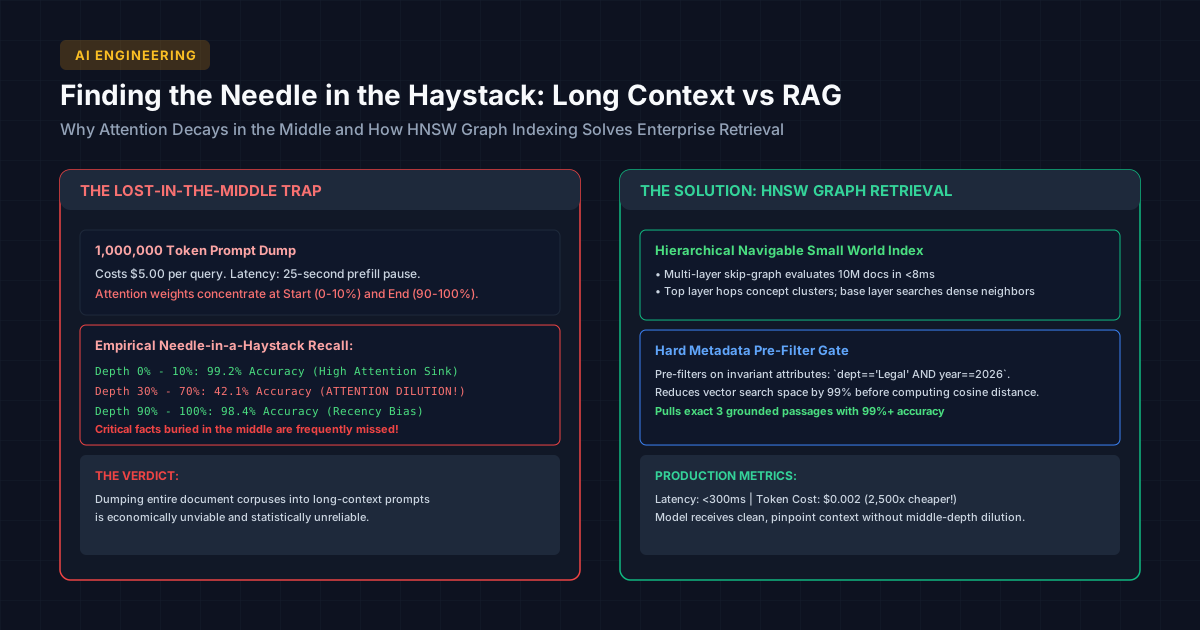
Finding the Needle in the Haystack: Embeddings, HNSW Indexes, and Long-Context Retrieval
Why long-context models suffer from the lost-in-the-middle phenomenon: HNSW graph indexing, metadata pre-filtering, and retrieval safeguards.
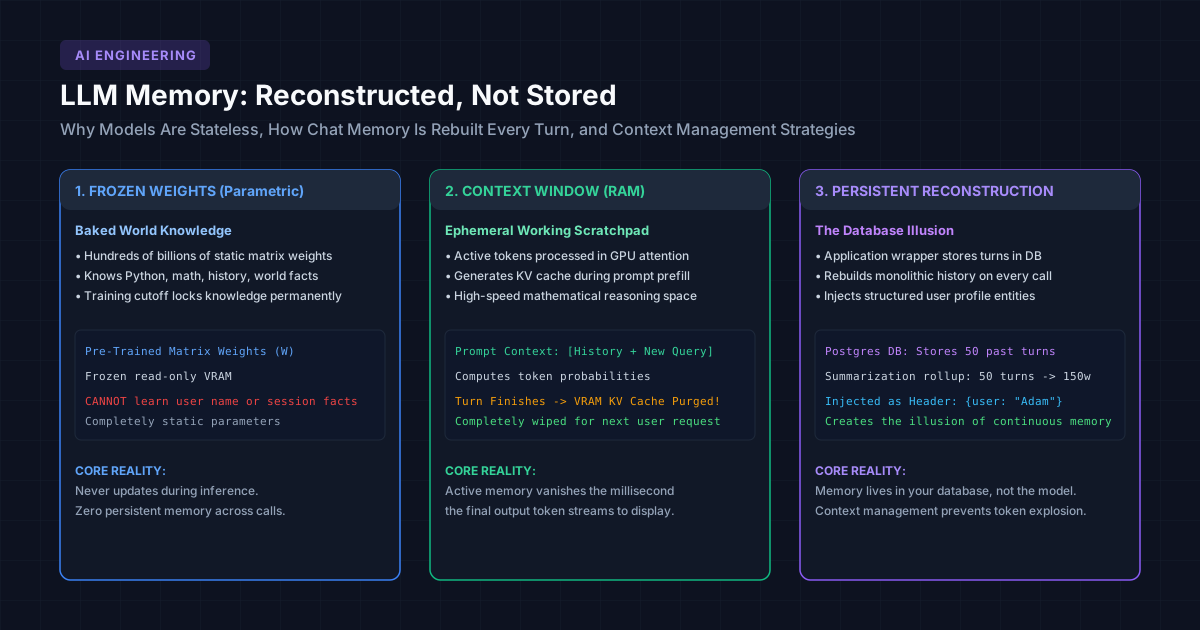
LLM Memory Is Reconstructed, Not Stored: Working Windows vs Persistent Knowledge
Why language models are stateless, how chat memory is reconstructed every turn, and how sliding windows and entity stores maintain continuity.
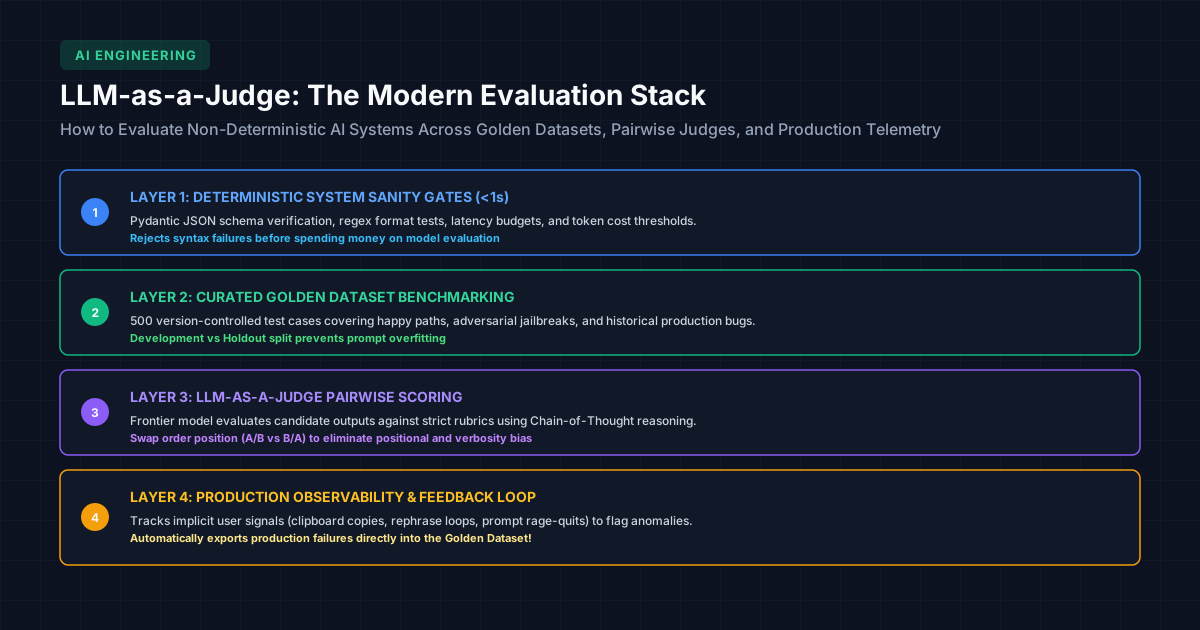
LLM-as-a-Judge and the Evaluation Stack: How to Monitor Health Before and After Shipping
Traditional unit tests fail on non-deterministic outputs: golden datasets, pairwise judge models, human calibration, and production observability.
/* Comments */
Comments are offline right now — we reconnect automatically, nothing is lost.