
Inside the Two Seconds: What Happens Between Pressing Enter and the First Token
The twelve stages between user message and streaming response: context assembly, safety classifiers, continuous batching, prefill, and decode.
On this page
When you type a message into an AI chat interface and press Enter, nothing appears to happen for one or two seconds. Then, words suddenly begin streaming onto the display in rapid succession.
To human intuition, that brief pause feels like dead network lag.
In reality, those two seconds represent a furious computational relay race. Between the instant your finger presses the Enter key and the moment the first token renders in your browser, your message travels through twelve distinct distributed systems stages spanning edge proxies, contextual assembly engines, safety classifiers, and massive GPU Tensor Core clusters.
Understanding what happens during this two-second window is fundamental to diagnosing latency, optimizing token costs, and engineering production AI applications.
+--------------------------------------------------------------------------+
|                  THE TWO-SECOND INFERENCE TIMELINE                       |
|                                                                          |
|  [0ms - 150ms]    : Edge TLS Handshake + Auth + Rate Limiting            |
|  [150ms - 400ms]  : Context Assembly (RAG, System Prompt, Tool Schemas)  |
|  [400ms - 600ms]  : Tokenization + Parallel Moderation Classifiers       |
|  [600ms - 800ms]  : Cache-Aware GPU Routing + Continuous Batch Scheduling|
|  [800ms - 1800ms] : GPU Prefill Phase (Full Context Matrix Multiplication)|
|  [1800ms+]        : First Token Emitted! Autoregressive Decode Streams   |
+--------------------------------------------------------------------------+
Stage 1 to 4: The Edge Gateway and Context Assembly
The model never receives your message as a raw, isolated string. Large language models are completely stateless: they possess zero memory of previous turns. Every single turn is an entirely new document constructed from scratch.
1. Ingestion and Edge Decryption (0 to 50 ms)
Your browser issues an encrypted HTTP/2 or WebSocket frame. A worldwide Anycast CDN terminates TLS at the edge, verifies your session JWT, and decrements your rate-limiting token bucket.
2. State Reconstruction from the Database (50 to 150 ms)
The API gateway queries an in-memory cache (Redis) or database to fetch the conversation’s historical message log. If the history spans 40 turns, the gateway retrieves all 40 turns.
3. Context Assembly (150 to 350 ms)
The gateway compiles the final monolithic prompt payload. It stitches together:
- System Instructions: The developer’s hidden instructions (“You are a helpful customer assistant…”).
- Tool Definitions: JSON schemas describing all available functions.
- RAG Injections: Grounding documents fetched from vector databases.
- User Memory: Profile preferences retrieved from persistent storage.
- Conversation History: Every previous user query and assistant response.
- The New Message: The exact string you just typed.
A 20-word question commonly expands into an 8,000-token prompt payload before touching an AI model.
4. BPE Tokenization (350 to 450 ms)
Computers do not process text characters; they process integers. The compiled text passes through a Byte-Pair Encoding (BPE) tokenizer running on gateway CPUs, converting the text into a dense array of token integers: [9921, 482, 12, 88201].
Stage 5 to 8: Safety, Scheduling, and the GPU Cluster
5. Asynchronous Moderation Filtering (450 to 550 ms)
Before feeding input into an expensive foundation model, the gateway runs small, specialized classification models (e.g., Llama Guard) to detect prompt injection, hate speech, or policy violations. In optimized architectures, this classifier runs concurrently with the GPU prefill to hide its latency.
6. Cache-Aware Routing (550 to 650 ms)
A cluster scheduler receives the tokenized sequence. Instead of routing randomly, it inspects the prefix fingerprint:
- Has this conversation’s system prompt and history already been computed by a specific GPU worker?
- The request routes to the specific GPU node holding the matching Key-Value (KV) cache blocks, transforming an expensive recalculation into an instant cache hit.
7. Continuous Batch Scheduling (650 to 750 ms)
The request enters the GPU engine’s priority queue (vLLM or SGLang). Under continuous batching, the scheduler waits for the current forward pass iteration to complete, dynamically allocating virtual memory pages in GPU VRAM to slot your new prompt into the running batch without waiting for other users to finish.
Stage 9 to 12: The GPU Arithmetic Explosion
This is where the physical computation happens on NVIDIA Tensor Cores or Google TPUs.
       PREFILL PHASE (Compute-Bound)          DECODE PHASE (Memory-Bound)
     Multiplies 8,000 tokens at once        Generates 1 token per forward pass
               [ 800ms pause ]                 [ 30 tokens/sec steady stream ]
8. The Prefill Phase (800 to 1,600 ms)
The prefill phase is the primary cause of the initial pause. The GPU must process all 8,000 tokens of the assembled prompt simultaneously:
- High-Bandwidth Memory streams model weights into Tensor Cores.
- The GPU performs massive parallel matrix multiplications across all 80 transformer layers.
- It computes the Key and Value vectors for all 8,000 tokens and caches them in VRAM (the KV cache).
- Finally, it computes the probability distribution for the very next token.
9. Output Sampling (1,600 to 1,700 ms)
The final softmax layer produces a vector of 128,000 floating-point numbers representing every word in the vocabulary. The engine applies temperature scaling, top-$p$ nucleus filtering, and repetition penalties, stochastically sampling the winning token ID.
10. Reverse Detokenization (1,700 to 1,750 ms)
The winning integer token is mapped back into human text characters (e.g., token ID 1829 becomes "The").
11. Edge Streaming (1,750 to 1,850 ms)
The server pushes the word over an active Server-Sent Events (SSE) or WebSocket connection as a chunk:
data: {"choices": [{"delta": {"content": "The"}}]}12. Browser Render and Transition to Decode (1,850 ms+)
Your browser receives the SSE packet and renders the word on your screen. The initial two-second pause is over.
From this point forward, the GPU transitions from the compute-heavy Prefill Phase to the memory-bound Decode Phase: generating one token at a time at a steady 30 to 50 tokens per second until an end-of-sequence token is reached.
The Latency Anatomy Summary
| Phase | What Happens | Typical Duration | Bottleneck |
|---|---|---|---|
| Network & Auth | TLS handshake, DNS, JWT decode, rate limits | 50 to 100 ms | Network latency |
| Context Assembly | Fetch history, RAG vectors, format tools | 100 to 250 ms | Database / Redis I/O |
| Tokenization & Safe | BPE encoding, Llama Guard moderation | 50 to 100 ms | CPU compute |
| GPU Scheduling | Cache-aware routing, PagedAttention slots | 50 to 150 ms | Queue contention |
| GPU Prefill | Parallel matrix multiplication across context | 500 to 1,200 ms | GPU Compute (FLOPs) |
| First SSE Emit | Detokenize, reverse proxy push, browser draw | 50 to 100 ms | Network bandwidth |
The two-second pause is not idle waiting. It is the coordinated execution of an entire distributed data pipeline engineered to deliver real-time intelligence.
Keep reading
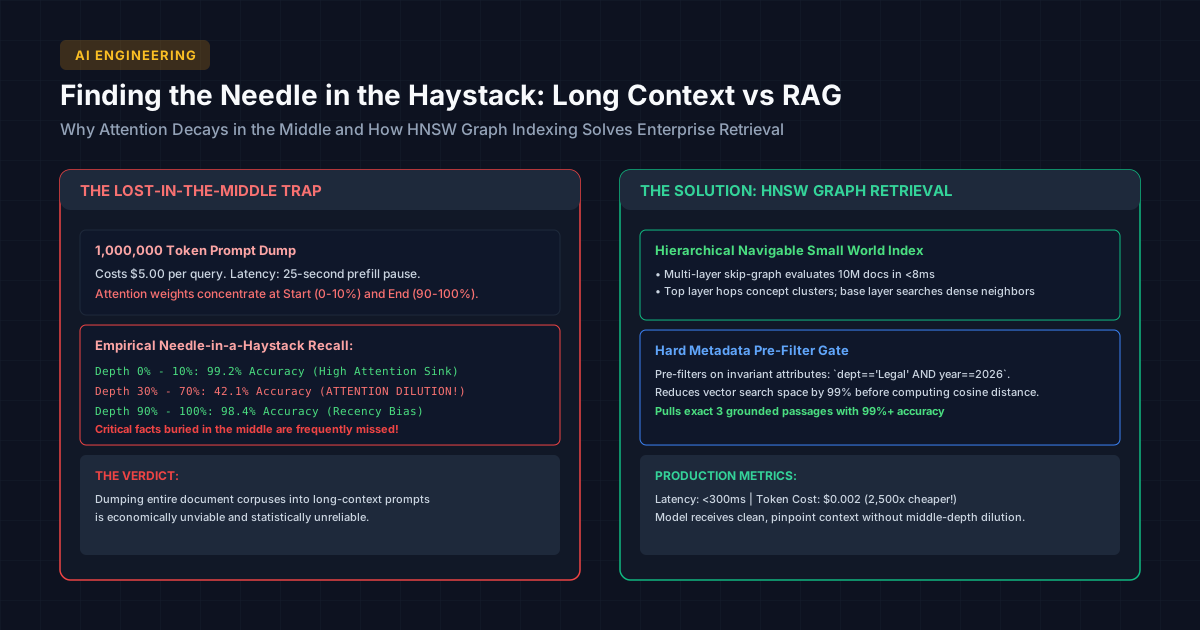
Finding the Needle in the Haystack: Embeddings, HNSW Indexes, and Long-Context Retrieval
Why long-context models suffer from the lost-in-the-middle phenomenon: HNSW graph indexing, metadata pre-filtering, and retrieval safeguards.
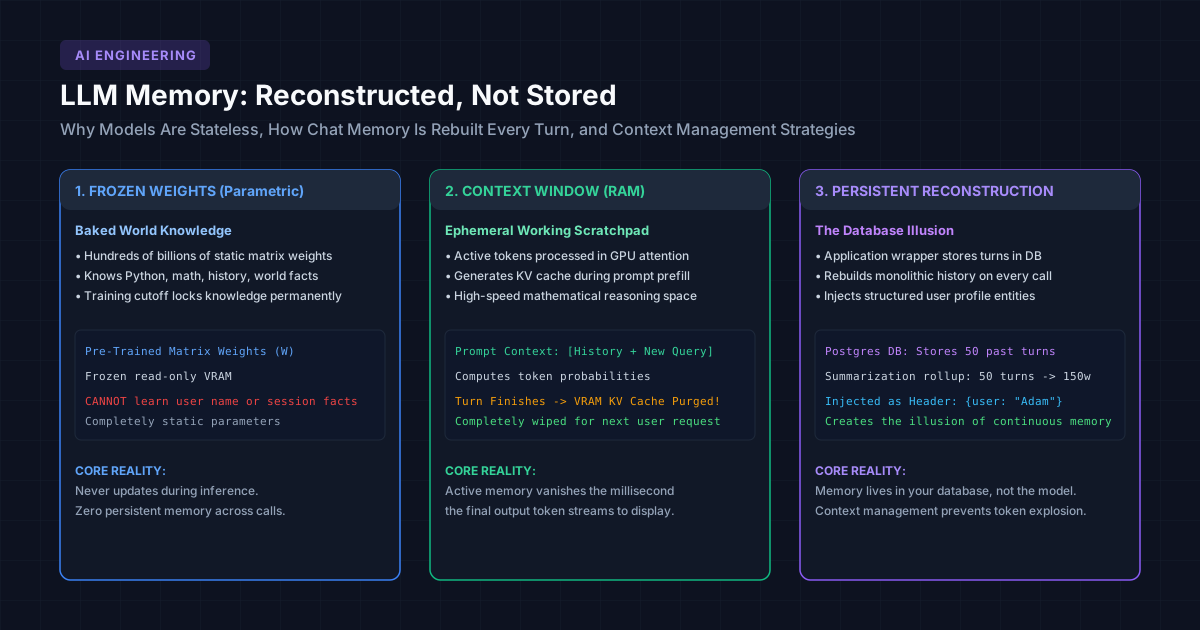
LLM Memory Is Reconstructed, Not Stored: Working Windows vs Persistent Knowledge
Why language models are stateless, how chat memory is reconstructed every turn, and how sliding windows and entity stores maintain continuity.
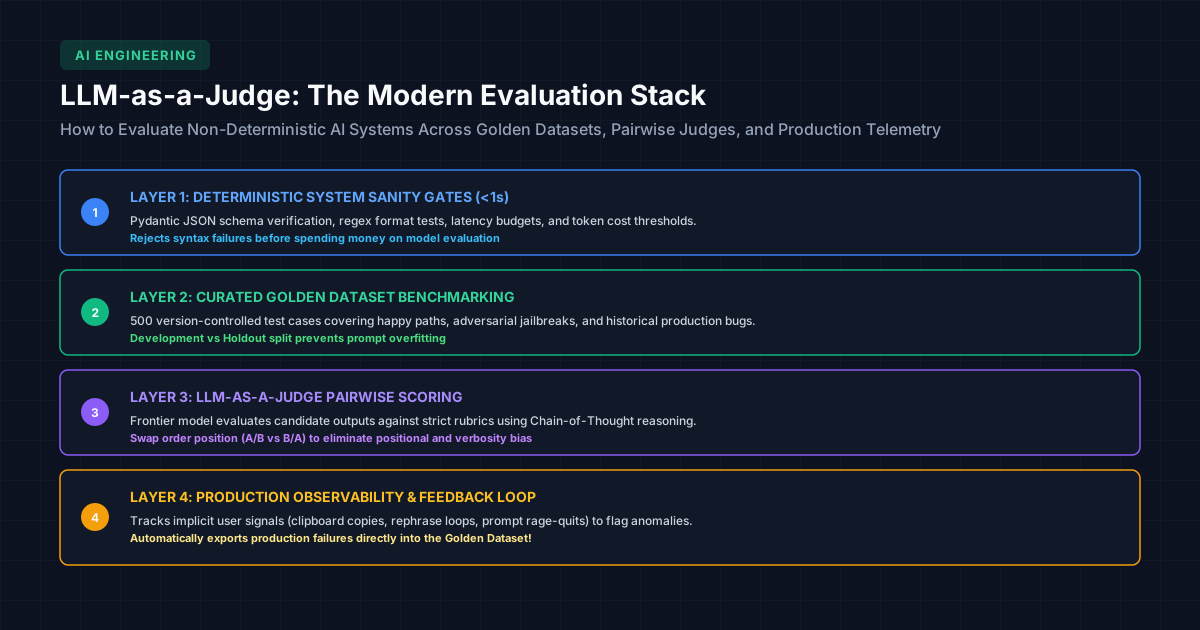
LLM-as-a-Judge and the Evaluation Stack: How to Monitor Health Before and After Shipping
Traditional unit tests fail on non-deterministic outputs: golden datasets, pairwise judge models, human calibration, and production observability.
/* Comments */
Comments are offline right now — we reconnect automatically, nothing is lost.