
Smart Model Routing: Cutting LLM Token Costs Tenfold Without Sacrificing Output Quality
Route queries dynamically between small draft models, mid-tier workhorses, and frontier reasoning engines to slash inference bills by 90%.
On this page
When enterprise engineering teams deploy generative AI features, they almost always begin by routing 100% of incoming user requests to the most powerful frontier model available: Claude 3.5 Sonnet, GPT-4o, or OpenAI o1.
In early production pilots with 100 users, this works beautifully.
When the feature scales to 500,000 active users, the financial bill arrives: the company is spending $80,000 every month on LLM API tokens.
When you audit production query logs, an alarming inefficiency emerges: over 70% of user queries are computationally trivial.
- Users say “Hello!” or “Thanks for the help.”
- Users ask simple factual lookups: “What is the capital of Oregon?”
- Users request basic JSON extractions: “Extract the phone number from this string.”
Paying frontier reasoning pricing ($5.00 to $15.00 per million tokens) to format a telephone number or say hello is economic malpractice.
Smart Model Routing fixes this imbalance: deploying an ultra-fast, intelligent classification proxy that dynamically inspects every incoming query and dispatches it to the cheapest model capable of solving it with 100% accuracy.
+--------------------------------------------------------------------------+
|                  THE MULTI-TIER ROUTING CASCADE                          |
|                                                                          |
|  [Incoming Query] ---> [Smart Classifier Router (<15ms, $0.00001)]       |
|                               |                                          |
|         +---------------------+---------------------+                    |
|         |                     |                     |                    |
|  (Simple Extraction)   (Standard Drafting)   (Deep Logic & Math)         |
|         v                     v                     v                    |
|  [Tier 1: 8B Model]    [Tier 2: 70B Model]   [Tier 3: Frontier o1]       |
|  Cost: $0.10 / 1M      Cost: $1.00 / 1M      Cost: $15.00 / 1M           |
|  Share: 65% Traffic    Share: 25% Traffic    Share: 10% Traffic          |
+--------------------------------------------------------------------------+
The Economic Math: The 10x Cost Reduction
To understand how routing slashes token costs, compare an unrouted system against a routed system handling 10 million queries per month:
Scenario A: Unrouted Monolithic System (100% Frontier)
- 10,000,000 requests $\times$ 1,000 tokens average = 10 billion tokens.
- At $5.00 per million tokens (blended input/output):
Monthly Bill = 10,000 * $5.00 = $50,000Scenario B: Three-Tier Smart Routed System
- Tier 1 (Small Model, e.g., Llama-3-8B / Claude 3.5 Haiku): Handles 65% of traffic at $0.20 per million tokens.
- Cost: 6,500 * $0.20 = $1,300
- Tier 2 (Workhorse Model, e.g., Qwen-2.5-72B / GPT-4o-mini): Handles 25% of traffic at $1.00 per million tokens.
- Cost: 2,500 * $1.00 = $2,500
- Tier 3 (Frontier Reasoning, e.g., o1 / Claude 3.5 Sonnet): Handles 10% of traffic at $10.00 per million tokens.
- Cost: 1,000 * $10.00 = $10,000
- Routing Classifier Overhead: 10 million evaluations at $0.02 per 10k queries = $20.
Total Monthly Bill = $1,300 + $2,500 + $10,000 + $20 = $13,820Result: A massive 72.4% net cost reduction with zero observable drop in user satisfaction.
How the Routing Decision Engine Works
A routing proxy cannot use an expensive LLM to decide which LLM to call. If the router takes 500 milliseconds and costs $0.01 per decision, the latency and cost savings disappear.
Production routers use three ultra-fast classification mechanisms:
[User Query Arrives at Gateway]
                 |
                 v
   +---------------------------+
   | Heuristic & Regex Rules   | ---> Matches greetings, simple keywords (<1ms)
   +---------------------------+
                 | (Unmatched)
                 v
   +---------------------------+
   | Classical Embedding / SVM | ---> Linear SVM on 256-dim embeddings (<5ms)
   +---------------------------+
                 | (Unmatched)
                 v
   +---------------------------+
   | Speculative Cascade Check | ---> Small model drafts; verifies confidence
   +---------------------------+
1. Heuristic and Structural Gateways (Under 1 ms)
Before touching any machine learning models, evaluate deterministic rules:
- Length and Token Count: A query under 10 tokens with greeting keywords (“Hi”, “What can you do?”) automatically routes to Tier 1.
- Explicit Schema Constraint: If the request specifies a simple regex extraction or JSON conversion without ambiguity, route to Tier 1.
2. Fast Embedding-Based Classifiers (Under 5 ms)
Train a simple, lightweight Support Vector Machine (Linear SVM) or logistic regression head on top of a compact embedding model (e.g., bge-small-en-v1.5):
- Queries are classified into difficulty categories:
[Conversational, Factual_Lookup, Creative_Draft, Complex_Reasoning, Code_Synthesis]. - The linear classifier runs on CPU memory in under 5 milliseconds, consuming negligible energy.
3. The Speculative Cascade (Draft-and-Escalate)
For borderline queries where difficulty is uncertain, deploy a Cascade Pattern:
- Dispatch the query to the fast Tier 1 model first.
- Evaluate the Tier 1 response using a deterministic validator:
- Did the model output valid JSON?
- Is the token log-probability confidence score high ($P > 0.85$)?
- If Tier 1 produces a high-confidence, valid output, return it immediately (delivering blazing-fast sub-200ms latency to the user).
- If Tier 1 expresses hesitation, outputs malformed formatting, or fails validation, escalate the query to Tier 3.
Architectural Tradeoffs: Latency vs. Complexity
Deploying a model router introduces specific engineering considerations:
| Dimension | Monolithic Frontier | Smart Routed Fleet |
|---|---|---|
| Financial Cost | Extremely High (100% frontier bill) | Low (70% to 90% savings) |
| System Complexity | Low (Single API key & client) | Medium (Router proxy, multiple keys) |
| Time-to-First-Token | Slower (Frontier prefill lag) | Blazing (Small models stream in 100ms) |
| Routing Error Risk | Zero (Always uses top model) | Minor (Edge cases routed to weaker model) |
Implementation Checklist
- Log and Cluster Your Production Queries: Do not guess your traffic distribution. Extract 50,000 real historical user queries and cluster them by complexity.
- Implement Fallback Escalation: Ensure that if a user clicks “This answer didn’t help,” the retry automatically routes to the Tier 3 frontier model.
- Continuous Benchmarking: Run weekly automated evaluation suites (using LLM-as-a-judge) to verify that your Tier 1 small model maintains 98%+ parity on its designated query slice.
Smart routing transforms generative AI from an uncontrollable financial liability into a highly optimized, tiered production infrastructure.
Keep reading
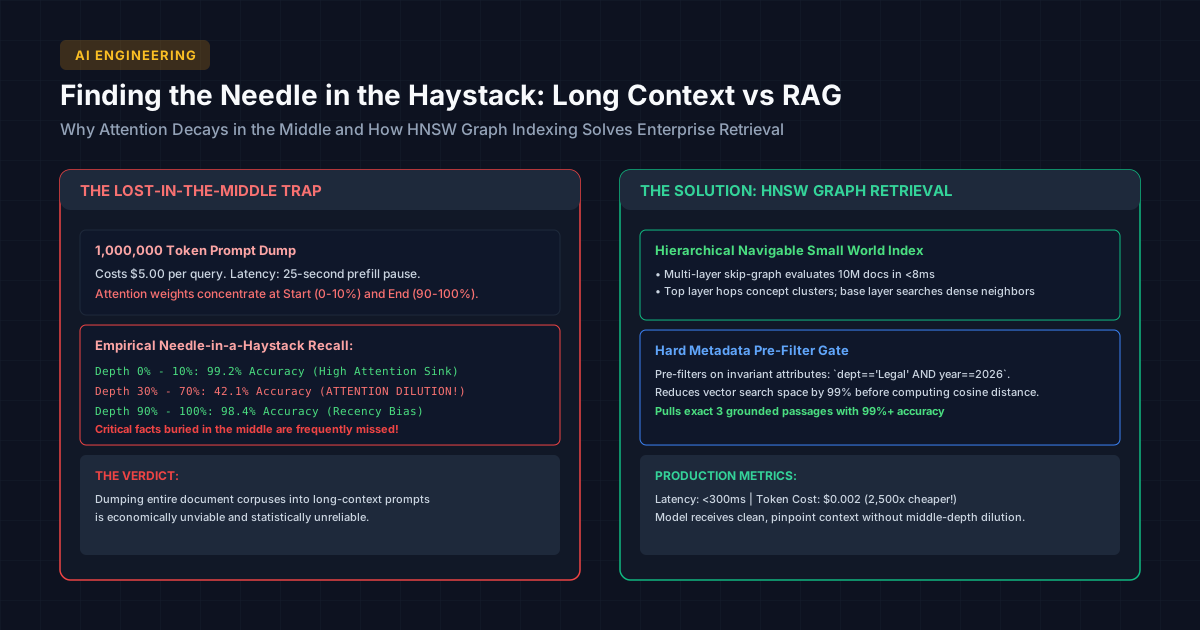
Finding the Needle in the Haystack: Embeddings, HNSW Indexes, and Long-Context Retrieval
Why long-context models suffer from the lost-in-the-middle phenomenon: HNSW graph indexing, metadata pre-filtering, and retrieval safeguards.
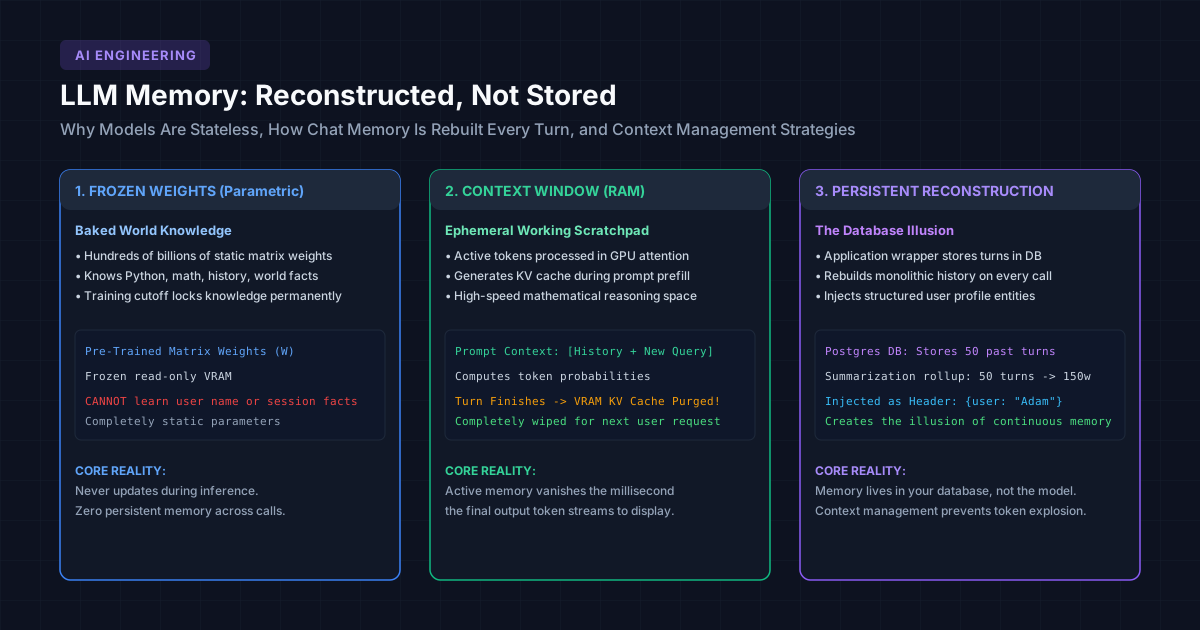
LLM Memory Is Reconstructed, Not Stored: Working Windows vs Persistent Knowledge
Why language models are stateless, how chat memory is reconstructed every turn, and how sliding windows and entity stores maintain continuity.
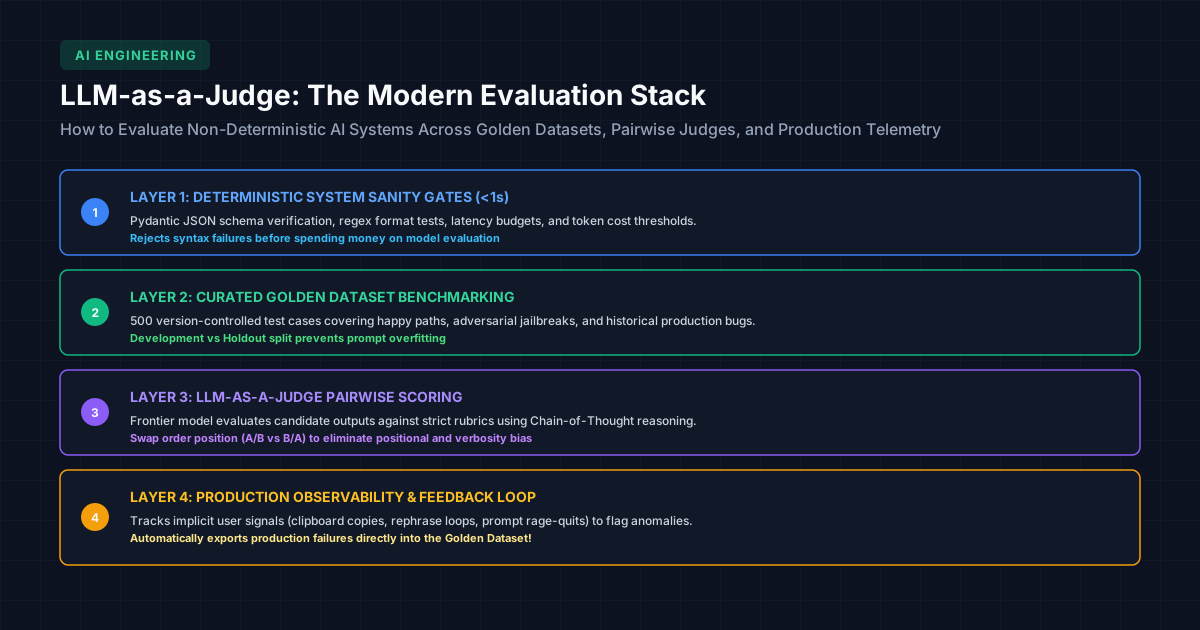
LLM-as-a-Judge and the Evaluation Stack: How to Monitor Health Before and After Shipping
Traditional unit tests fail on non-deterministic outputs: golden datasets, pairwise judge models, human calibration, and production observability.
/* Comments */
Comments are offline right now — we reconnect automatically, nothing is lost.