
A Model Can Pass the Test and Still Fail the Task
Google DeepMind’s Humanity’s First Exam tests repeatability on ordinary tasks, revealing why one-shot benchmark scores can hide operational inconsistency.
On this page
A model reads a picture correctly on Monday, then misreads the same kind of picture on Tuesday. A prompt that worked in a demo fails when a user adds one clarifying phrase. The model may still have an impressive average score; the person using the tool sees the failure. HFE is designed to make that gap visible by asking not only whether a system can solve a simple task, but whether it can do so consistently. [2]
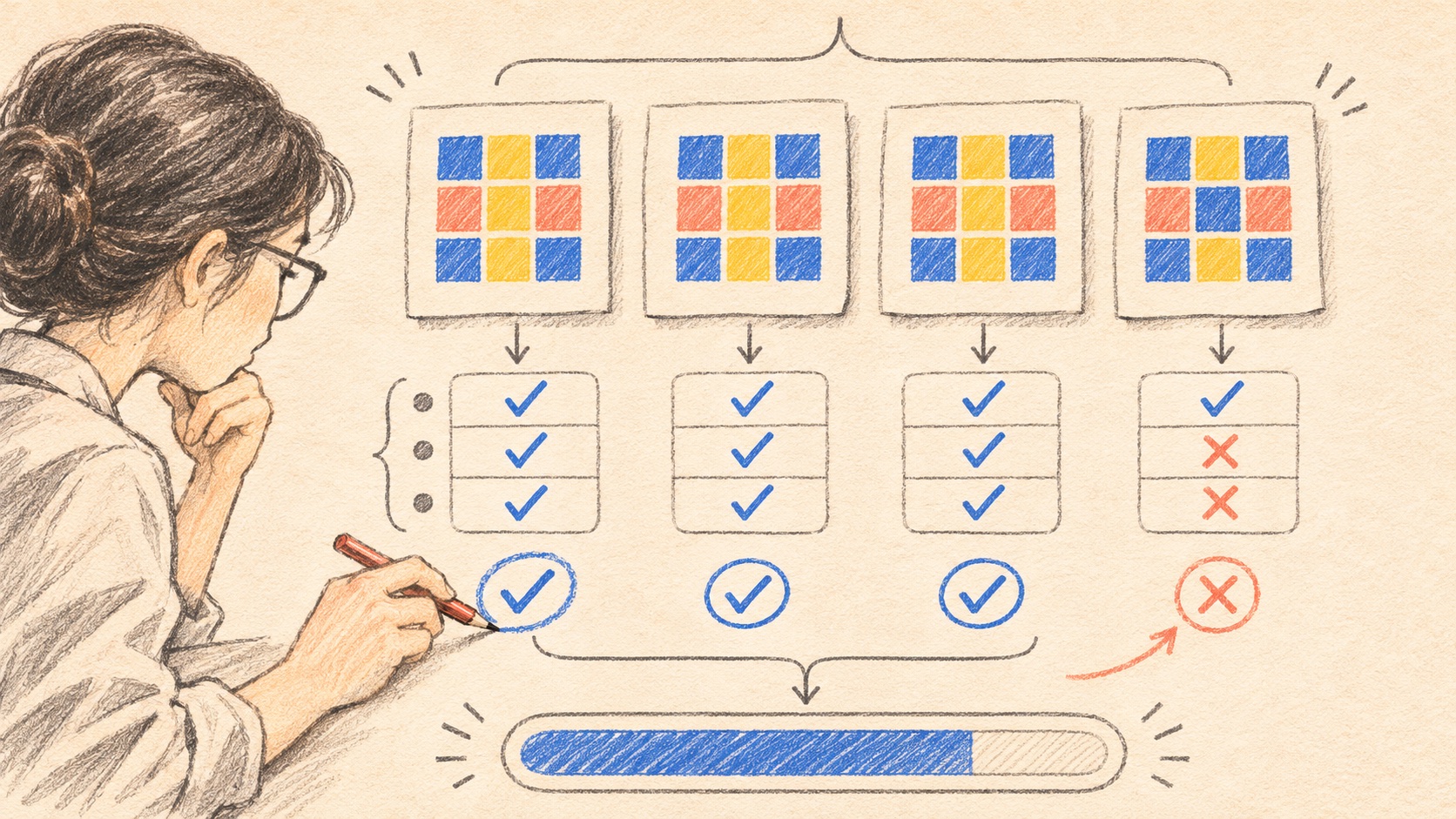
The difference between a ceiling and a floor
Most benchmark headlines report a capability ceiling: among one or more attempts, did the model get the answer right? In the common pass@k framing, the score rises when a system has more opportunities to produce at least one correct response. That can answer whether the model has the capability somewhere in its behavior. A product often needs a different answer: how likely is it to be correct on the call that the user actually sees? [2]
HFE adds a reliability floor. The report groups related prompts into families: one seed question and three variants intended to preserve the underlying task. It then asks what happens over repeated model runs on those prompts. A family only counts as reliable when the model continues to answer the variants correctly across the sampled attempts. Small per-call error rates compound when the system must handle every variation, so a model can look strong on a one-shot score and leave more room for inconsistency on the stricter measure. [2]
This is not a claim that every real user asks the same question four ways. It is a way to probe whether apparently small changes expose brittle behavior. In a production workflow, the analogous variations might be different image crops, unfamiliar layouts, regional wording, missing context, or a second attempt after a tool timeout.
What the benchmark contains
Google DeepMind says HFE includes 544 elementary text and multimodal prompts across 20 foundational subcategories. The paper evaluates 18 models, with six sampled responses per prompt under the reported settings. The team says human raters checked candidate seed questions without tools; a separate reviewer resolved ambiguous or problematic items. The model responses were scored by a deterministic language-model judge against reference answers or rubrics, and the paper describes a cross-provider audit of failed answers. [2]
The report’s notable result is not a simple ranking. It says top models scored 96–98% on single-shot accuracy, while the strictest family-level reliability measure for those models ranged from 80.5% to 92.4%. It also reports that visual perception accounted for 73% of wrong answers in its evaluation. Those are Google’s results on this benchmark, with the paper’s particular prompts, sampling, model configurations and grader; they do not predict how any specific product will perform on its own data. [2]
That visual result offers a useful engineering question: does “more reasoning” help the failure mode? If a system misses a tiny indicator in a chart or confuses spatial relationships in a diagram, asking it to think longer may not fix the perception bottleneck. A useful evaluation should break failures down by task type and inspect the examples, rather than assume one generic model upgrade will improve every weak spot.
How to use a reliability score without overreading it
HFE’s public leaderboard is a starting point for inspection, not a procurement shortcut. The full paper distinguishes capability from consistency and reports model settings alongside the results. A score from one model snapshot, reasoning mode and benchmark cannot establish the behavior of a different release, tool harness, prompt, or product environment. The leaderboard is also maintained over time, so save the evaluation date and the exact model configuration when comparing results. [1] [3]
The benchmark authors hold out most of the task families from the public partition: the paper describes a 112-prompt public set and 432 private prompts. This can make it harder to tune directly to every test item, although the work still comes from the model provider and is not an independent end-to-end deployment study. HFE asks narrow, deliberately elementary questions. It does not measure whether an entire agent can safely use tools, whether a clinical answer is appropriate, or whether a system behaves well under adversarial inputs. [2]
For a team evaluating a model, start from the user-visible job. Pick examples that reflect the data and failure cost. Run each task several times, and make a few controlled variants that preserve the user’s intent. Record exact model version, settings, tools, and grader. Separate perception errors, reasoning errors, refusals, missing answers and tool failures. Then decide which errors demand a deterministic check, a second source, human review, or a clear abstention.
A pass on a reliability suite is still only one piece of evidence. For agent systems, pair model-level checks with repeatable application-level evaluations such as the regression checks used for AI coding agents. For a broader guide to choosing evaluation methods, see how to test LLMs beyond a single benchmark.
The practical takeaway
HFE is useful because it changes the question from “Can the model answer this?” to “How stable is the answer when the task is repeated or rephrased?” That difference matters whenever users need a dependable action rather than a lucky sample.
The benchmark cannot tell a team what reliability threshold is acceptable. A low-stakes brainstorming helper and a system that routes a payment or summarizes a clinical record have different error budgets. Product owners still need to define what happens when the answer is wrong, and engineers need to test the exact workflow that ships. A model’s strongest answer is a ceiling; the behavior users experience is bounded by its floor.
Frequently asked questions
What does Humanity’s First Exam measure?
Humanity’s First Exam measures how consistently models answer elementary text and image prompts across repeated runs and small, meaning-preserving prompt variations. It complements capability benchmarks that ask whether a model can solve a task at least once.
Does a high pass@1 score prove a model is reliable?
No. Pass@1 is a single-draw accuracy estimate. A model may score well once and still vary across repeated attempts or equivalent phrasings. Reliability tests should match the consequences and repetition pattern of the intended product task.
Is Humanity’s First Exam an independent evaluation?
No. Google DeepMind authored the benchmark paper and reports the model evaluation. The work includes human review of seed tasks and an external audit of some grading, but readers should treat the results as a vendor-reported benchmark rather than an independent product trial.
Sources & further reading
Keep reading

AMD’s Ray 2.59 Beta Brings vLLM 0.29 to Instinct GPUs
ROCm 10.1 and Ray’s AMD beta preserve familiar distributed APIs, but the supported stack is tightly versioned and still needs workload testing.

MCP Tasks Let Agent Jobs Pause, Resume, and Ask for Input
Anthropic’s MCP update makes long-running jobs and user prompts practical, while client support and action permissions remain explicit responsibilities.

OpenAI’s Healthcare API Adds Clinical Search; PHI Still Needs Separate Approval
Healthcare configurations pair Responses API models with a medical search index, but developers must verify BAA coverage, retention and clinical oversight.
/* Comments */
Comments are offline right now — we reconnect automatically, nothing is lost.