
A Light-Based AI Experiment Shows What Optical Computing Still Needs
A Tokyo team trained a physical learning system with optical dynamics. The result is promising, but it has not run today’s largest language models.
On this page
Optical computing promises to use light’s speed and parallelism for some forms of computation. A new University of Tokyo study takes a more specific step: it uses optical dynamics as part of the learning process, with a simplified architecture and a technique called state-skipping training. The team demonstrated the approach in an optical system. It also says a crucial next question remains unanswered: how it behaves on today’s largest language and multimodal models.
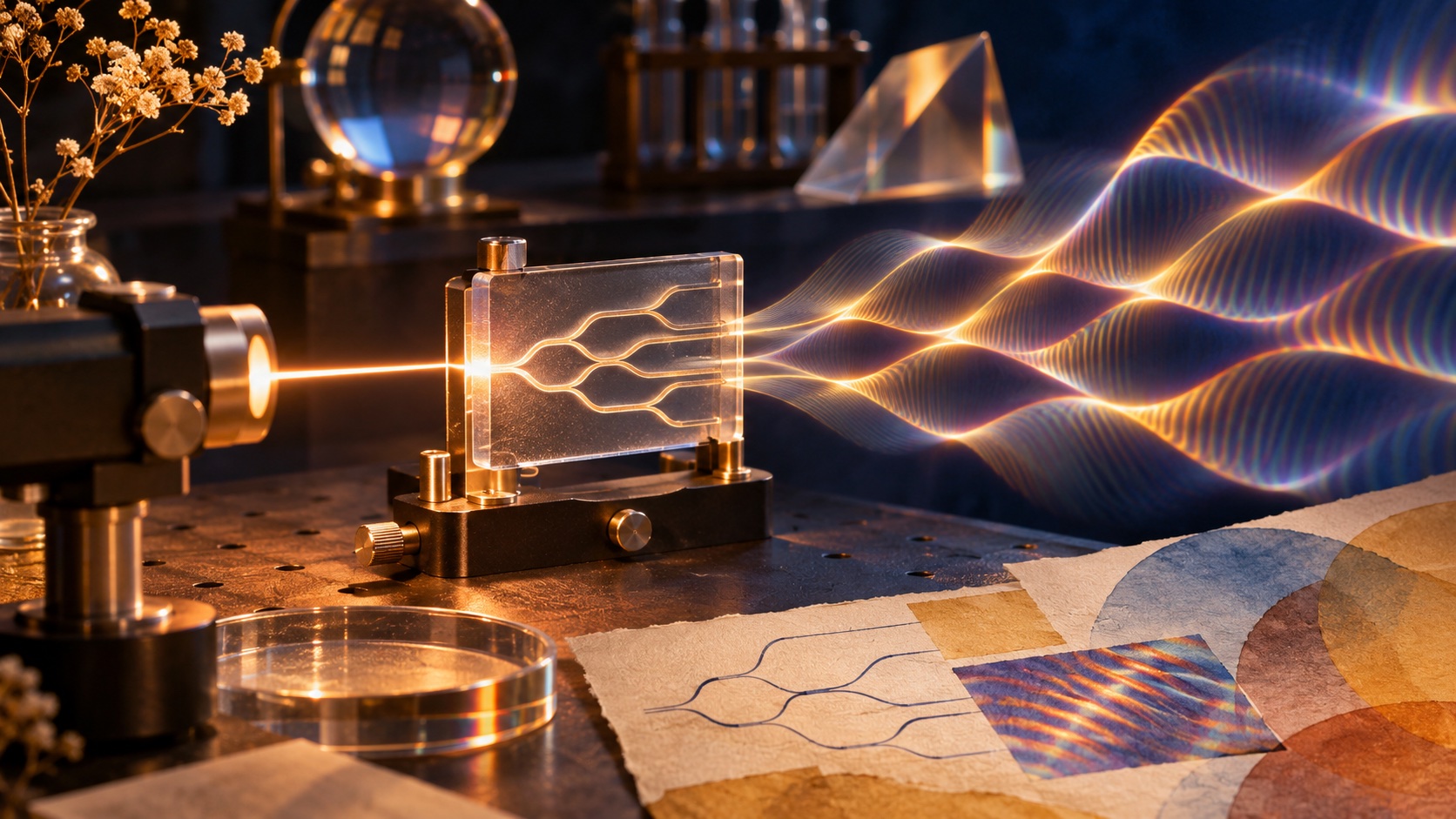
In conventional deep learning, software updates model parameters over repeated calculations. Physical deep learning instead tries to make the material system perform useful transformations itself. The researchers’ paper describes a scalable method using optical dynamics, state-skipping training and a single-map architecture. The university’s account says the goal is to reduce the amount of computation needed to train such physical systems. [1] [2]
That distinction matters because “runs on light” can suggest much more than a laboratory demonstration supports. The paper does not establish that a general-purpose optical computer can train or serve a large foundation model at lower total cost than GPUs. The university explicitly notes that the system has not yet been tested on today’s largest AI models, particularly language and multimodal systems. [1]
Letting the hardware do part of the work
An optical system can transform information through propagation, interference and other physical effects. A learning algorithm can adjust the system and measure how its output changes. The promise is that the physics itself can implement operations that would otherwise require a series of digital calculations. If a task maps well to the system, the physical process may offer parallelism or reduce energy for that portion of the workload.
But a full computing system is more than the portion where light travels. Data has to be encoded into an optical signal, the physical elements have to be tuned, results must be detected, and signals may need to convert back to electronics for memory, control or later computation. Those surrounding steps can dominate latency, power use or complexity. A fast optical matrix operation does not guarantee an efficient end-to-end application.
That is why the study’s claims should be read at the scale of its experiment. The team reports a framework and demonstration in an optical computing system, while listing large modern language and multimodal models as future work. The honest achievement is a method for simplifying the training of physical systems—not a new production accelerator already ready for general AI workloads. [1] [2]
Scaling adds costs that a single experiment can hide
Reviews of photonic neural networks describe several possible scaling strategies, including expanding spatial, temporal or spectral channels. Each creates different trade-offs. Larger networks can accumulate errors and lose signal quality; analog optical operations have finite precision; and optical-to-electronic conversion can erode projected energy savings. These are engineering questions, not reasons to dismiss the field. They are the factors that make a small, controlled demonstration different from a useful datacenter system. [3] [4]
For an energy comparison to be meaningful, researchers need a clear workload and system boundary. It should count the lasers or light sources, modulators, detectors, calibration and control electronics, data movement, and any digital layers around the optical core. It should also compare accuracy and throughput at equivalent quality. A claim about energy per optical operation is not automatically a claim about energy per completed task.
The same principle applies to speed. Optical propagation can be fast, but an application may spend more time loading data, configuring the device, measuring output or handing results to a conventional processor. Sustained throughput and repeatability matter more than a best-case isolated operation.
What to watch in the next experiments
The most revealing follow-up work will show whether the method scales to larger and more representative tasks, how stable its results are across repeated runs, what precision it reaches, and how much of the process remains digital. It should make the system’s energy and latency boundary explicit and compare with an appropriate electronic baseline. Independent replication would help separate a promising method from a platform-specific result.
The research also points to a broader design choice: future AI infrastructure may not be one kind of processor. Optical, electronic and other specialized systems could each handle workloads that fit their physical strengths. But heterogeneous computing only helps when software can divide work without making data transfer and orchestration more expensive than the acceleration.
For now, this optical-learning result is best understood as a focused advance in physical machine learning. It makes the field’s next question clearer: can the same efficiency survive the move from a well-designed experiment to a workload people actually need? The answer will depend on complete-system measurements, not the speed of light alone.
That distinction between computing and moving data also appears in our look at optical I/O for GPU clusters: optical links can improve communication between processors without making the computation itself optical.
Frequently asked questions
Did the Tokyo research run a large language model on an optical computer?
No. The university says the method was demonstrated in an optical computing system but has not yet been tested on today’s largest AI models, especially language and multimodal models.
What does physical deep learning mean?
It uses a physical system’s dynamics, such as light propagating through an optical setup, to perform part of the computation or learning process. The system’s physical response becomes part of the model rather than every operation being simulated digitally.
Does optical computing automatically use less energy than GPUs?
No. Light can process signals in parallel, but a complete system also needs to create, control, detect and often convert optical signals. Reviews of photonic neural networks identify precision, scaling and optoelectronic conversion as important practical costs.
Sources & further reading
- University of Tokyo: Let there be light—novel AI framework runs on optical hardware (November 5, 2026)
- Nature Computational Science: Scalable physical deep learning using optical dynamics
- Nature Reviews Physics: Scaling strategies for photonic neural networks
- Nature Reviews Electrical Engineering: Integrated photonic neuromorphic computing—opportunities and challenges
Keep reading
Deepgram's Trainium Port Shows Why Inference Cost Depends on the Whole Stack
Deepgram and AWS report 11–70% more offline transcription per dollar on one Trainium2 setup. The kernels, runtime and workload explain the narrow result.

Why LLM Serving Teams Are Turning KV Cache Transfer Into a First-Class Design Choice
Two new vLLM transfer techniques target first-token latency by overlapping movement and reusing multi-turn context. See where each helps and what it costs.
CodeQL 2.27.4 Fixes Specific False Positives and Tightens Pack Publishing
CodeQL 2.27.4 updates query behavior, metadata and pack handling. Learn how security teams can assess the changes without assuming every alert is solved.
/* Comments */
Comments are offline right now — we reconnect automatically, nothing is lost.