
MCP vs RAG vs AI Agents: Three Different Jobs an LLM Application Can Delegate
Disentangling modern AI architecture: tool protocols (MCP), query-time knowledge retrieval (RAG), and autonomous decision loops (Agents).
On this page
In modern enterprise software discussions, three acronyms are constantly conflated: MCP, RAG, and AI Agents.
Engineering leads frequently ask confused architectural questions:
- “Should we replace our RAG pipeline with MCP?”
- “Can we use AI agents instead of RAG to read our customer documentation?”
- “Does MCP make autonomous agents obsolete?”
These questions represent a fundamental category error. MCP, RAG, and AI Agents are not competing alternatives. They are complementary architectural layers that solve three completely distinct engineering challenges:
- RAG (Knowledge Retrieval): Where does fresh, proprietary domain truth come from?
- MCP (Tool Standardization): How does an AI connect to external systems and APIs?
- AI Agents (Autonomous Control Flow): Who decides what actions to take, and in what order?
Treating them as substitutes leads to broken architectures. Understanding how they interlock is the foundation of modern production AI systems design.
+--------------------------------------------------------------------------+
|                  THE THREE PILLARS OF MODERN AI SYSTEMS                  |
|                                                                          |
|  [RAG: The Memory]        [MCP: The Hands]          [Agent: The Brain]   |
|  - Ingests documents      - Standard JSON-RPC       - Evaluates state    |
|  - Embeds into vectors    - Standardizes tools      - Multi-step loops   |
|  - Grounding in truth     - Interacts with APIs     - Recovers on error  |
+--------------------------------------------------------------------------+
Layer 1: RAG (The Knowledge Grounding Engine)
A base language model’s knowledge is permanently frozen at its training cutoff date. Furthermore, it knows nothing about your company’s private customer contracts, Jira tickets, or internal documentation.
Retrieval-Augmented Generation (RAG) is an information retrieval pattern:
- How it works: At query time, a search engine (vector database, BM25 keyword index, or graph database) retrieves the top 5 most relevant paragraphs from your proprietary data and injects them directly into the LLM’s prompt.
- The Core Job: Grounding. It prevents hallucination and answers questions about private or fast-changing facts.
- What RAG cannot do: RAG is fundamentally passive and read-only. RAG cannot send an email, close a GitHub issue, or execute a SQL update.
Layer 2: MCP (The Universal Integration Protocol)
Before Anthropic open-sourced the Model Context Protocol (MCP), connecting an LLM to external tools was a maintenance nightmare:
- Every developer wrote custom JSON schemas for every single API.
- If you supported GitHub, Slack, and PostgreSQL across three different agent frameworks, you had to write and maintain nine custom integration wrappers.
MCP is a standardized client-server protocol (JSON-RPC over stdio or SSE):
- An MCP Server exposes tools, data resources, and prompt templates.
- Any MCP-compliant Client (Cursor, Claude Desktop, autonomous worker agents) can connect to the server and discover available tools dynamically.
- The Core Job: Standardization. Write the integration once (e.g., a Jira MCP server), and every agent in your enterprise can interact with Jira through a universal interface.
- What MCP cannot do: MCP does not make decisions. It is simply a standardized wire protocol. It does not decide when to invoke a tool; it merely executes the tool when told to do so.
+-----------------------+      JSON-RPC over stdio      +-----------------------+
|  LLM Application Host | ----------------------------> | MCP Server (Postgres) |
|  (Claude / Cursor)    | <---------------------------- |                       |
|                       |        Tools: ["query_sql"]   | - Handles DB Pooling  |
|                       |                               | - Enforces Read-Only  |
+-----------------------+                               +-----------------------+
Layer 3: AI Agents (The Autonomous Decision Loop)
A standard chatbot is a single request-response exchange: the user asks a question, the model responds, and the thread terminates.
An AI Agent is a stateful software system that operates in a Reasoning and Action Loop:
- Given an open-ended goal (“Find why the billing worker crashed and fix it”), the agent evaluates its current state, formulates a plan, selects an action, inspects the result, and iterates autonomously until the goal is achieved.
- The Core Job: Autonomous Agency. Decomposing complex problems into multi-step execution plans and adapting when tools return errors.
How All Three Interlock in Production
To see how these three layers cooperate, trace an enterprise incident response system:
[User Goal: "Customer 441 reported an unexpected $50 charge. Investigate and resolve."]
                                      |
                                      v
+-------------------------------------------------------------------------------+
|                           THE AI AGENT ORCHESTRATOR                           |
|  Maintains state machine, iteration limits, error handling, and budget bounds |
+-------------------------------------------------------------------------------+
       |                                                           |
       | Step 1: Query Knowledge (RAG)                             | Step 2: Invoke Action (MCP)
       v                                                           v
+-----------------------------+                             +-----------------------------+
|        RAG RETRIEVAL        |                             |         MCP SERVERS         |
| - Retrieves Refund Policy   |                             | - Stripe MCP: Get Charge    |
| - Finds that Overcharge     |                             | - Postgres MCP: Read Ledger |
|   qualifies for auto-refund |                             | - Zendesk MCP: Update Ticket|
+-----------------------------+                             +-----------------------------+
                                      |
                                      v
[Agent Synthesizes Verified Resolution]- The Agent acts as the Brain: It reads the goal, parses customer details, and plans the investigation steps.
- The Agent calls RAG: It queries the internal knowledge base to check: “What is our refund authorization policy for double billing?” RAG returns the exact legal clause confirming refunds under $100 are auto-approved.
- The Agent calls MCP: Through the Stripe MCP Server, it inspects the transaction history. Through the PostgreSQL MCP Server, it reads the internal audit ledger.
- The Agent executes the Fix: Through the Stripe MCP Server, it invokes
issue_refund(charge_id="ch_9921")and updates the customer ticket via the Zendesk MCP Server.
The Architectural Comparison
| Dimension | RAG | MCP | AI Agent |
|---|---|---|---|
| Primary Job | Inject fresh, private facts | Universal tool integration | Autonomous multi-step execution |
| Analogy | The System’s Memory | The System’s Hands | The System’s Brain |
| Mutability | Read-only | Read & Write (Executes tools) | Stateful / Decision-making |
| Failure Mode | Bad retrieval = Hallucination | Network timeout / Schema mismatch | Runaway loops / Compounding errors |
| Core Tech | Vector DBs, BM25, Embeddings | JSON-RPC, stdio, SSE | State Machines, DAGs, LLM Loops |
Do not try to make RAG do an agent’s job, and do not expect MCP to magically ground your model in truth. Build clean boundaries: use RAG for knowledge, MCP for tools, and deterministic agents for orchestration.
Keep reading
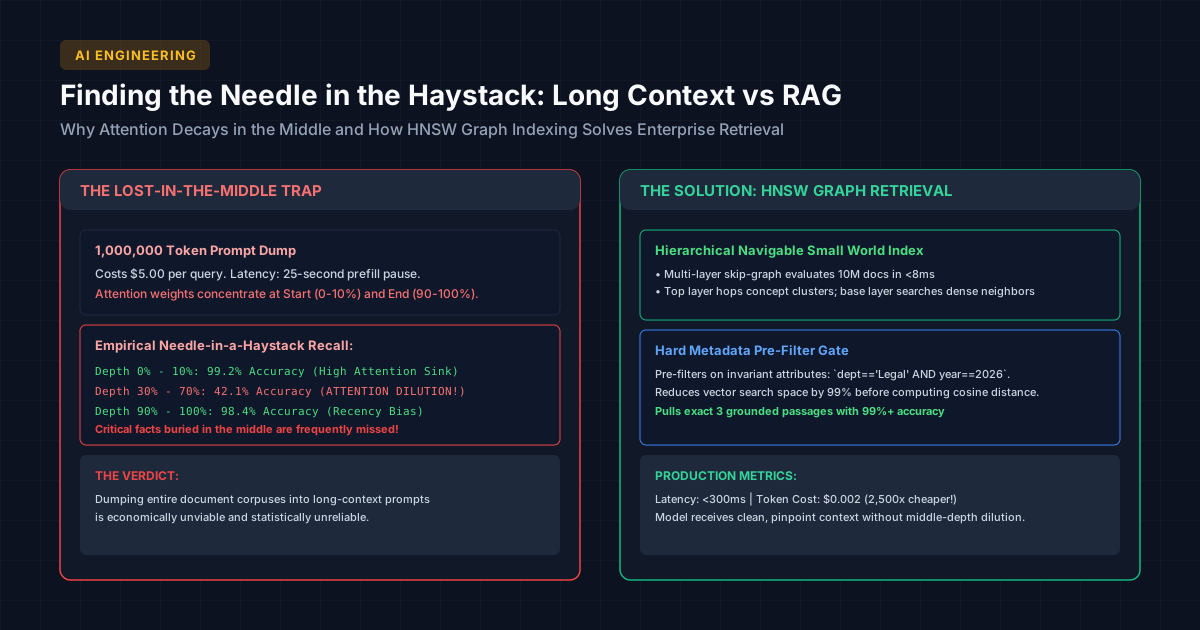
Finding the Needle in the Haystack: Embeddings, HNSW Indexes, and Long-Context Retrieval
Why long-context models suffer from the lost-in-the-middle phenomenon: HNSW graph indexing, metadata pre-filtering, and retrieval safeguards.
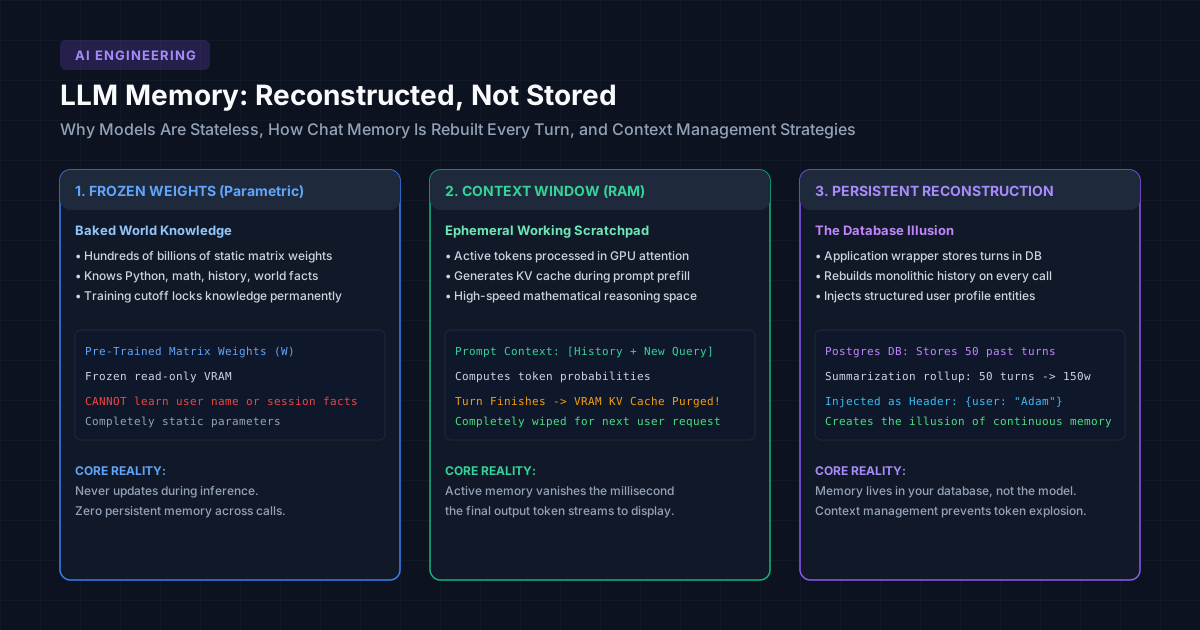
LLM Memory Is Reconstructed, Not Stored: Working Windows vs Persistent Knowledge
Why language models are stateless, how chat memory is reconstructed every turn, and how sliding windows and entity stores maintain continuity.
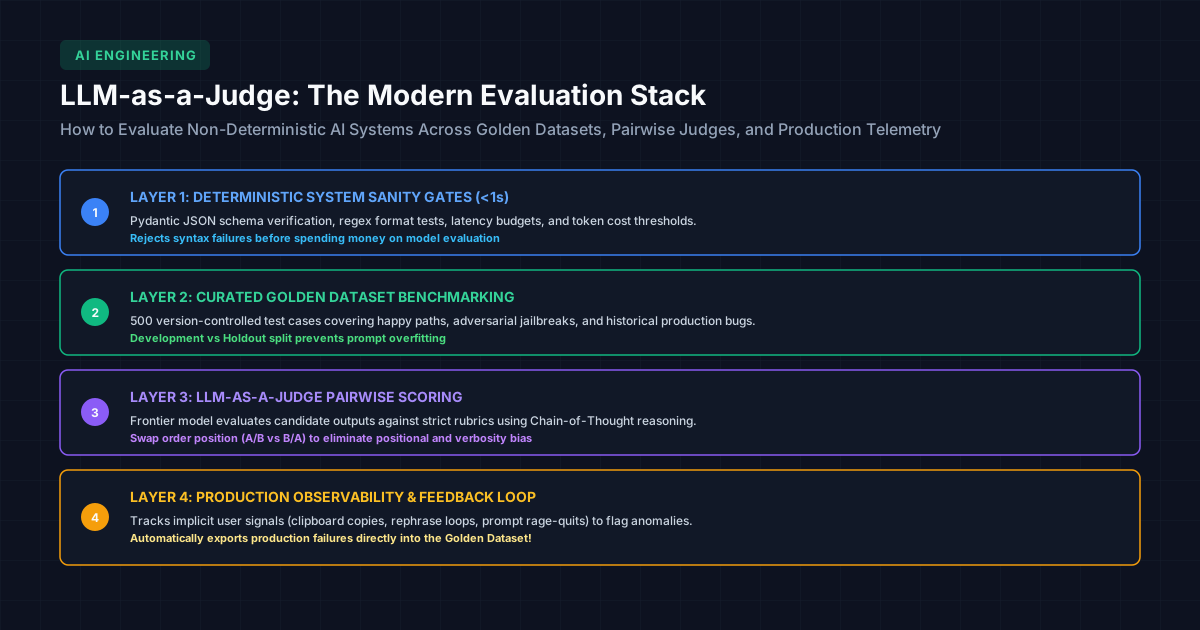
LLM-as-a-Judge and the Evaluation Stack: How to Monitor Health Before and After Shipping
Traditional unit tests fail on non-deterministic outputs: golden datasets, pairwise judge models, human calibration, and production observability.
/* Comments */
Comments are offline right now — we reconnect automatically, nothing is lost.