
On this page
A camera can see that an egg is between two grippers. It is much harder to tell whether the shell is starting to slip, whether a fingertip has caught an edge, or whether a small adjustment will crush the object. Touch gives the controller a faster signal about the contact that vision sees only after it changes.
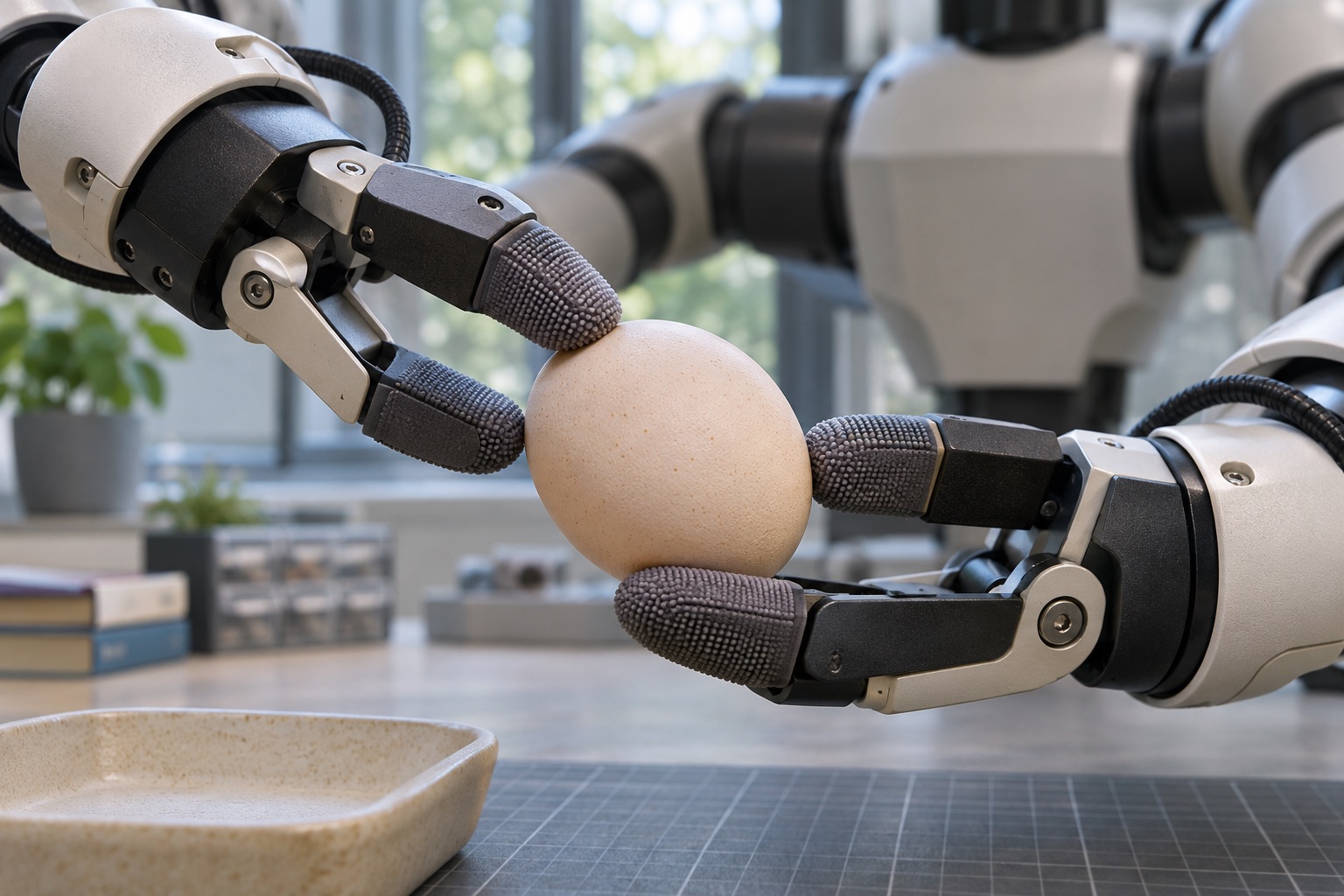
Panasonic’s November 5 announcement describes T-Rex, a tactile-reactive system for dexterous robot manipulation. The research combines a vision-language action policy that produces higher-level actions at 5 Hz with a tactile loop that can make corrections at 20 Hz. The slower loop plans from a broader visual scene; the faster one responds to contact as the task unfolds. [1]
That division of labor is the architectural idea. A robot does not have to ask its visual planner to re-interpret the entire room every time a card shifts a few millimeters. It can use touch to make a small local correction, then request a broader adjustment when the task itself changes.
The hard part happens after contact
The project reports training on 7,700 episodes, about 100 hours of robot interaction, and a set of 22 basic actions. Its benchmark covers 12 contact-rich tasks and more than 200 objects. On that evaluation, the authors report a 65 percent macro-average success rate, compared with about 35 percent for the strongest baseline they selected. The project also notes that simply adding tactile input to a baseline can make performance worse; the policy has to learn how and when to use it. [2] [3]
Those details help explain why tactile robotics is not just a sensor upgrade. Contact signals are noisy and depend on material, fingertip geometry and force. The robot needs a controller that connects a tactile change to an action that improves the grasp. An untrained sensor can add more ambiguity instead of resolving it.
A 20 Hz correction loop sounds fast, but speed alone is not dexterity. The robot still needs a useful representation of pressure and slip, a safe range for corrective force and a way to stop if the signal does not make sense. Delicate tasks depend on how well those pieces work together under varied objects and contact conditions.
A benchmark is a map of what was tested
The paper and project page report results across tasks such as handling small objects, turning pages, manipulating containers and inserting or extracting items. The experiments provide evidence that the architecture improves performance in the tested setup. They do not tell us how it will behave with an unfamiliar fragile object, worn sensor pads, a moving person nearby or a task that combines multiple skills over a longer shift.
The paper is a research preprint published in June, while the Panasonic announcement came in November. That timing is useful context: the company release explains the work’s current presentation; the paper provides the technical account and evaluation details. The numbers are still the authors’ results on their benchmark, not independent validation or evidence of a product deployment. [2]
Before an organization relies on a tactile manipulation system, it needs to test more than average task success. Measure breakage and damage, recovery after a missed grasp, consistency across object batches, sensor drift, safety-stop behavior and performance after repeated use. The system should know when a contact pattern is unfamiliar and ask for help rather than keep applying force.
The useful promise is local correction
T-Rex makes a compelling case for giving robot hands their own fast feedback path. Vision is good at setting a goal and understanding a scene; touch can notice when a grasp begins to deviate before the camera catches up. The architecture offers a practical way to connect those strengths without asking one model to reason at one speed about every part of the task.
What remains is the hard deployment work: robust sensors, repeatable calibration, transfer to new objects, safety limits and long-run maintenance. T-Rex’s benchmark is a promising research signal. The next question is whether the same quick correction remains gentle and reliable when the objects and conditions stop looking like the test setup.
Frequently asked questions
What is Panasonic T-Rex?
T-Rex is a research system for tactile-reactive dexterous manipulation. It combines a slower vision-language action process with a faster tactile correction loop.
What does the 65 percent result mean?
The project reports a 65 percent macro-average across 12 contact-rich tasks in its benchmark setup, compared with about 35 percent for its strongest baseline. This is an author-reported lab result, not a deployment guarantee.
Does adding touch always improve robot performance?
No. The project reports that naively adding tactile inputs to an existing policy can reduce performance. The tactile signals need to be integrated with an appropriate control architecture and training data.
Sources & further reading
Keep reading

Kodiak’s New Driverless Trucks Expand a Specific Industrial Route
Two Western Star 49X trucks with Kodiak’s Gen7 system entered Atlas’s Permian fleet. The deployment is industrial and route-bound, not a general highway launch.
MIT’s Robot Memory Knows When It Should Look Again
UQ-DAAAM helps a robot revisit uncertain object memories. Its benchmark reduces uncertainty under a view budget, not proving every memory true.
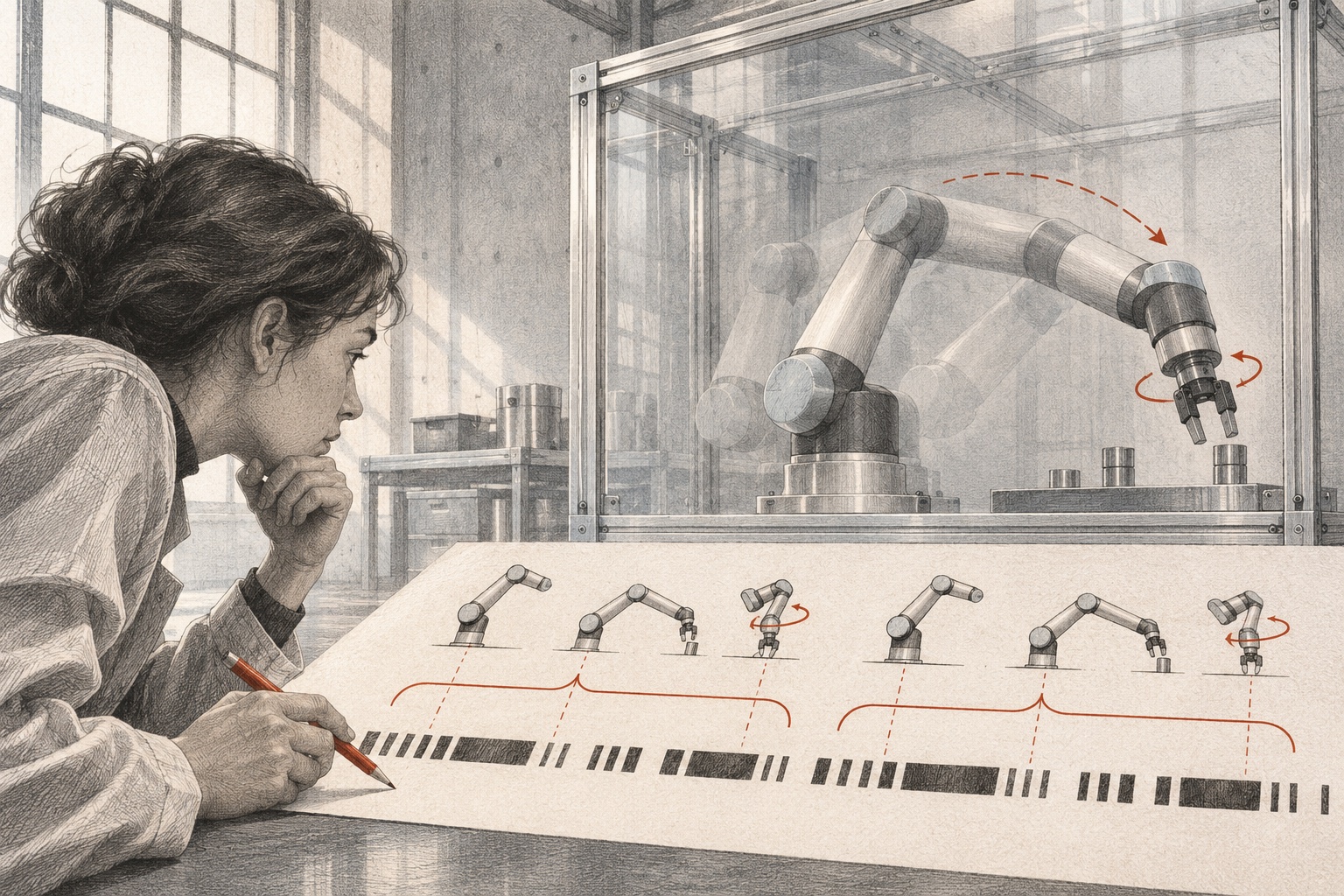
Encrypted Robot Commands Can Still Leave a Readable Rhythm on the Network
A 2026 study found robot actions could be inferred from encrypted traffic metadata, exposing a privacy gap between payload secrecy and behavioral privacy.
/* Comments */
Comments are offline right now — we reconnect automatically, nothing is lost.