
Nemotron 3.5 Transcribe brings instruction-led speech work on-device
NVIDIA’s open-weight speech model transcribes, translates and attributes speakers offline. Its hardware demands make local ownership a tradeoff.
On this page
A journalist transcribing a sensitive interview may want a capable speech tool without uploading the recording to a cloud service. NVIDIA’s Nemotron 3.5 Transcribe is an open-weight speech-augmented language model designed for offline transcription and audio understanding, with instructions that can steer style, vocabulary, translation and speaker attribution.
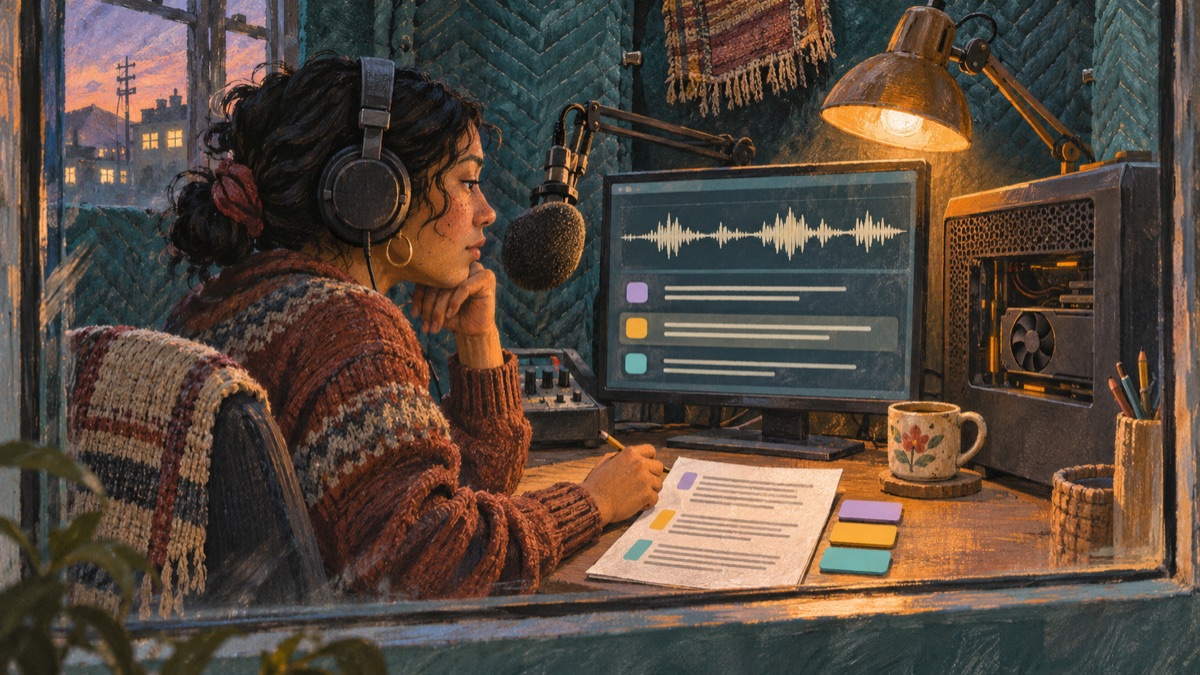
NVIDIA’s research page lists BF16 and FP8 weights, a Blackwell-oriented NVFP4 build and a GGUF variant for NeMo-Speech.cpp. NVIDIA’s documentation says the model supports 40 languages, recordings up to one hour, and a 65,536-token context. These are manufacturer specifications, not an independent evaluation of accuracy across accents, noisy rooms or specialist vocabularies.
The distinctive idea is to treat transcription as an instruction-following task rather than just converting sound to words. The prompt can request a style, provide vocabulary context, translate speech, attribute speakers or ask questions about audio. That makes one model family potentially useful for several steps in an audio workflow, but it also means teams must validate that instructions do not silently change what they need preserved verbatim.
Offline is a data-flow choice, not a free privacy guarantee
Running the model locally can keep recordings inside an organization’s controlled environment. It does not, by itself, guarantee privacy. Logs, temporary files, model downloads, backups, access controls and the machine’s network behavior still matter. Teams handling confidential interviews should map those paths and test the actual deployment configuration.
Local use also carries substantial setup costs. NVIDIA’s example BF16 serving path uses Linux, a dedicated NeMo Speech and vLLM environment, and targets an H100 with 80 GB of memory. Other quantized variants change the hardware requirements, but introduce their own quality and compatibility checks. A “downloadable model” is not the same as a lightweight desktop app.
Keep humans in the review loop
For a first pilot, choose a short, consented recording with known ground truth. Measure word errors on the language and acoustic conditions that matter to your work. Check names, numbers, speaker changes and punctuation separately; a fluent-looking transcript can still misattribute a speaker or normalize an important phrase incorrectly. Use a consistent prompt and retain the raw audio alongside edits where policy allows.
The model’s open-weight availability is useful for organizations that need control over inference and adaptation. NVIDIA says its release uses the OpenMDW-1.1 license, so teams should read that license and their deployment obligations rather than equating “open weight” with unrestricted use. The best fit is a workflow where local control, supported hardware and review effort justify the operational burden.
Nemotron 3.5 Transcribe makes private, instruction-guided speech processing more attainable for teams with capable GPU infrastructure. Its practical promise should be judged on the recording, language and environment a team actually has—not a model card’s headline capabilities alone. Speech systems also need careful review of what gets transcribed and how users are affected; our articles on voice-agent transaction design and speech evaluation limits explore those adjacent questions.
Sources & further reading
Keep reading

When an AI Agent Visits Your Website, Who Is Accountable?
Personal agents can hide the person behind a request. Learn what site owners can measure today and what identity, consent, and accountability still require.

Intel's Cognitive-City Pitch Has a Hard Test: Who Gets to Act?
Intel’s city AI vision moves beyond sensors to action. Interoperability and public accountability determine whether the shift serves residents.
Mistral's Le Chonk Is Open Weight. Running It Is the Next Test
Mistral released Large 4 weights with coding and security claims. Infrastructure, licensing and evaluation are part of the decision.
/* Comments */
Comments are offline right now — we reconnect automatically, nothing is lost.