
Ollama vs vLLM vs SGLang: Picking a Local Inference Engine by Request Pattern
Comparing local LLM serving: FIFO desktop execution in Ollama, high-concurrency PagedAttention in vLLM, and RadixAttention prefix caching in SGLang.
On this page
When deploying open-weight foundation models (such as Llama 3, DeepSeek, Mistral, or Qwen) on your own hardware, three open-source inference engines dominate the developer ecosystem: Ollama, vLLM, and SGLang.
Too often, engineering teams pick an engine based on brand familiarity or documentation aesthetics.
In production, that approach leads to severe performance degradation. These three engines are not interchangeable wrappers around a GPU. They implement fundamentally different request queuing, memory allocation, and KV cache reuse algorithms.
The correct engine is dictated entirely by your request traffic pattern: single-user desktop prototyping, multi-tenant high-throughput REST APIs, or multi-turn agentic tool loops.
+--------------------------------------------------------------------------+
|                  THE INFERENCE ENGINE SELECTION SPECTRUM                 |
|                                                                          |
|  [Ollama]             [vLLM]                     [SGLang]                |
|  - Desktop / Dev      - Production API Cluster   - Complex Agent Loops   |
|  - Serial FIFO Queue  - Continuous Batching      - Radix Tree KV Cache   |
|  - GGUF Quantization  - PagedAttention (Virtual) - Structured Regex / JSON|
+--------------------------------------------------------------------------+
Engine 1: Ollama (The Desktop Local Developer Standard)
Ollama is built on top of the C/C++ llama.cpp runtime. Its primary design goal is developer ergonomics and frictionless local execution.
Architectural Characteristics
- GGUF File Packaging: Models are distributed as single-file GGUF binaries containing both model metadata and quantized tensor weights (e.g., Q4_K_M, Q8_0).
- CPU/GPU Layer Offloading: If a model requires 16 GB of memory but your graphics card has only 12 GB, Ollama automatically splits the model: loading 24 transformer layers onto the GPU and the remaining 8 layers onto system RAM, running them via CPU SIMD instructions.
- Serial FIFO Execution: Ollama processes requests sequentially in a first-in, first-out queue. If three users send queries simultaneously, Request 2 and Request 3 block until Request 1 finishes generating tokens.
When to Pick Ollama
Ollama is the premier tool for local developer workstations, CLI terminal utilities, offline desktop applications, and rapid prototyping. It is not designed to serve high-concurrency production web APIs.
Engine 2: vLLM (The High-Concurrency Production Workhorse)
Developed by researchers at UC Berkeley, vLLM is the industry standard for high-throughput multi-tenant production serving.
Traditional Serving (Padded Batches):
Req 1: [Tok 1][Tok 2][Tok 3][Pad][Pad][Pad] (Waits for longest req!)
Req 2: [Tok 1][Tok 2][Tok 3][Tok 4][Tok 5][Tok 6]

vLLM Continuous Batching (Iteration-Level Scheduling):
Step 1: [Req 1 Tok 1] [Req 2 Tok 1]
Step 2: [Req 1 Tok 2] [Req 2 Tok 2]
Step 3: [Req 1 Finish!] -> [Req 3 Tok 1 slots in immediately!]
Architectural Innovations
- Continuous (Iteration-Level) Batching: Traditional engines batch requests statically: if Request 1 finishes in 20 tokens while Request 2 requires 500 tokens, the GPU sits partially idle waiting for Request 2. vLLM schedules at the iteration level: the instant Request 1 emits an end-of-sequence token, a brand-new incoming request slots into the batch on the very next token iteration.
- PagedAttention: Manages Key-Value (KV) cache memory using virtual memory page tables. Eliminates 60% to 80% of internal and external memory fragmentation, allowing 2x to 4x higher concurrent batch sizes on identical GPU hardware.
When to Pick vLLM
vLLM is ideal for centralized enterprise API clusters: high-concurrency endpoints where hundreds of independent users submit distinct, non-overlapping prompts.
Engine 3: SGLang (The Agent and Structured Output Specialist)
Developed by the LMSYS team, SGLang was engineered specifically for the explosive growth of AI agents, multi-turn reasoning chains, and constrained JSON generation.
In an AI coding agent or multi-step reasoning system, consecutive requests share massive prompt prefixes: system prompts, tool schemas, and growing conversation history.
       Root Context: [System Prompt + 30 Tool Definitions]
                                |
                +---------------+---------------+
                |                               |
       Turn 1: [User: "Fix Bug A"]     Turn 2: [User: "Fix Bug B"]
                |                               |
       (Reuses Root KV Block)          (Reuses Root KV Block)
Architectural Innovations
- RadixAttention (Radix Tree KV Cache Reuse): While vLLM discards KV caches once a request finishes, SGLang retains KV cache blocks inside an in-memory Radix Tree (prefix tree).
- If a new request arrives that shares an identical 10,000-token system prompt and tool manifest, SGLang matches the prefix in the radix tree and skips 100% of the prefill computation.
- Time-to-First-Token (TTFT) drops from 400 ms to under 5 ms for cached turns.
- Fast Constrained Decoding: SGLang integrates compressed finite-state machines directly into the GPU sampling kernel, guaranteeing that JSON and regex outputs strictly adhere to Pydantic schemas with zero parsing retries and minimal latency penalty.
When to Pick SGLang
SGLang is the uncontested winner for AI agents, multi-turn chatbots, and complex tool-calling loops where prompt prefixes repeat across interactions.
Architectural Comparison Matrix
| Feature / Metric | Ollama | vLLM | SGLang |
|---|---|---|---|
| Primary Target | Local Dev / Workstation | Enterprise API Serving | Agent Loops & Tool Chains |
| Underlying Core | llama.cpp | Custom C++ / CUDA | Custom CUDA + Radix Tree |
| Model Format | GGUF Single Binary | Safetensors / HuggingFace | Safetensors / HuggingFace |
| Concurrency Model | Serial FIFO Queue | Continuous Batching | Continuous + Radix Scheduling |
| KV Cache Manager | Static Allocations | PagedAttention (Paging) | RadixAttention (Radix Tree) |
| Prefix Caching | Basic / Session file | Block-level prefix cache | Automatic Dynamic Radix Tree |
| Constrained JSON | Grammars (Slower) | Outlines / Guided (Good) | Native Compressed FSM (Fastest) |
| VRAM Utilization | Modest (Offloads to CPU) | Aggressive (Fills GPU RAM) | Aggressive (Caches Radix Blocks) |
The Decision Rule
- Developing on a Mac or PC laptop? Use Ollama. It sets up in two minutes and handles mixed memory offloading effortlessly.
- Serving an API for 500 concurrent corporate users asking random questions? Use vLLM. Continuous batching and PagedAttention will maximize throughput per GPU dollar.
- Building an autonomous AI coding agent with tool calls, deep thinking traces, or strict JSON outputs? Use SGLang. RadixAttention will cut your latency and prefill costs by up to 80%.
Keep reading
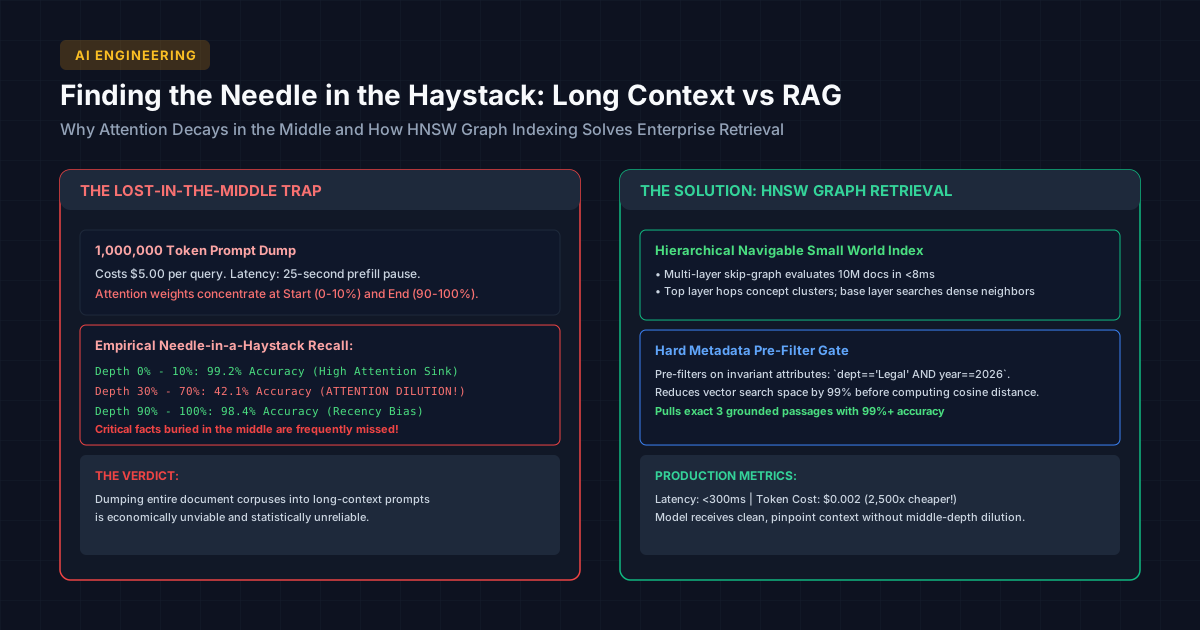
Finding the Needle in the Haystack: Embeddings, HNSW Indexes, and Long-Context Retrieval
Why long-context models suffer from the lost-in-the-middle phenomenon: HNSW graph indexing, metadata pre-filtering, and retrieval safeguards.
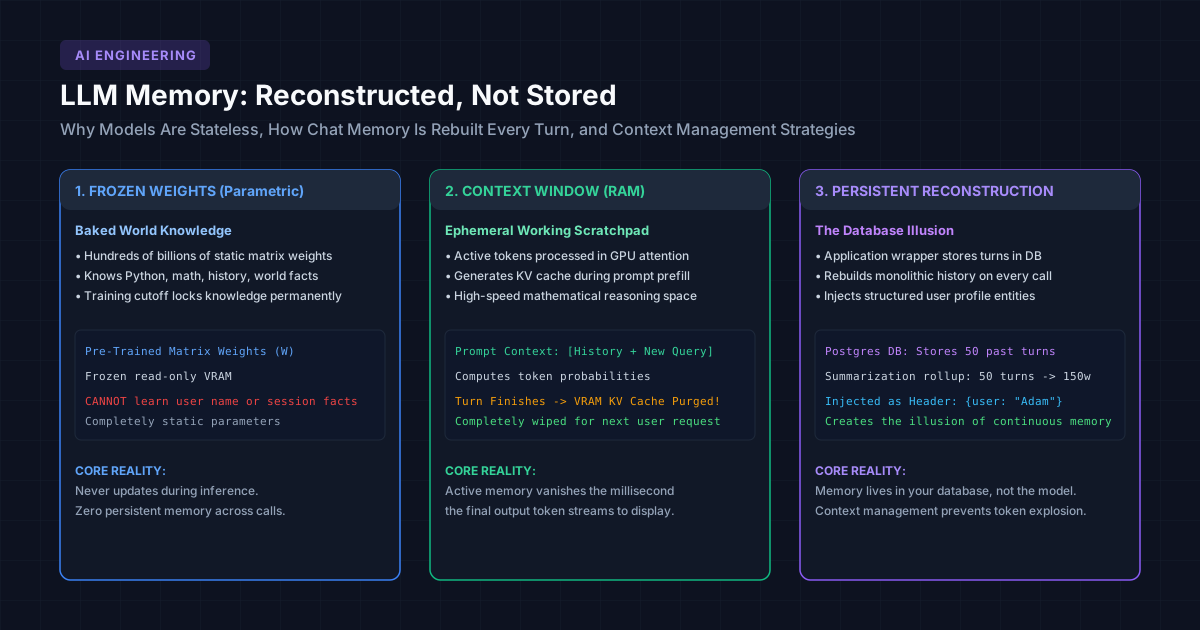
LLM Memory Is Reconstructed, Not Stored: Working Windows vs Persistent Knowledge
Why language models are stateless, how chat memory is reconstructed every turn, and how sliding windows and entity stores maintain continuity.
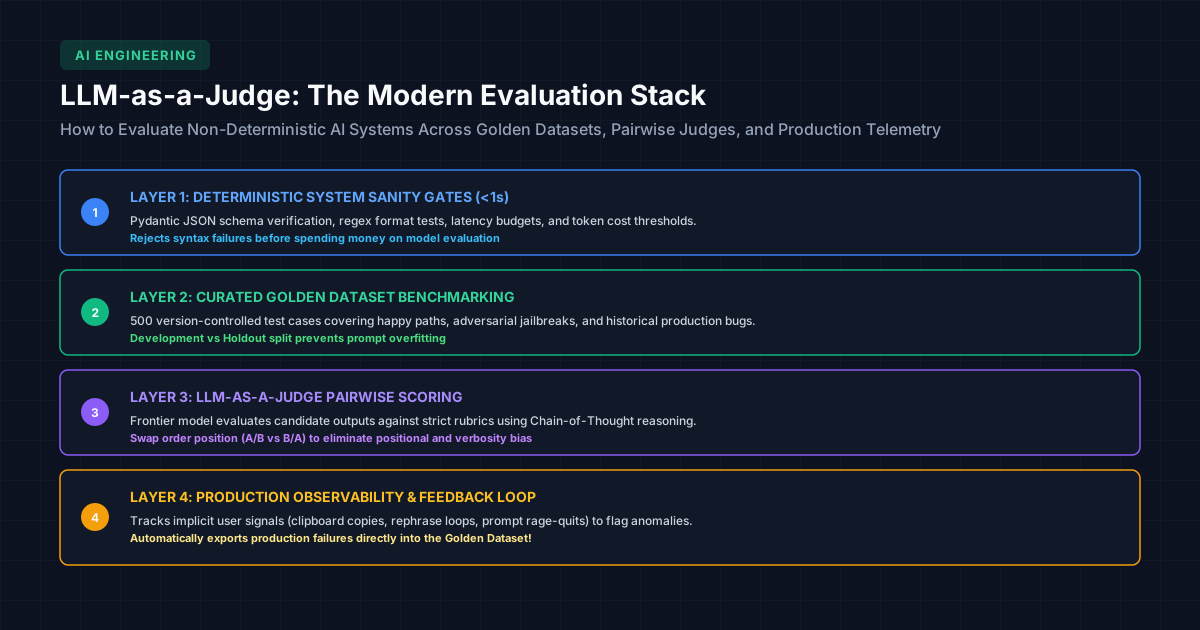
LLM-as-a-Judge and the Evaluation Stack: How to Monitor Health Before and After Shipping
Traditional unit tests fail on non-deterministic outputs: golden datasets, pairwise judge models, human calibration, and production observability.
/* Comments */
Comments are offline right now — we reconnect automatically, nothing is lost.