
Shirudo’s Live Linux Shields Are a Pre-release, Not a Patch Replacement
OpenAI and Cisco’s Shirudo offers temporary eBPF shields, but its pre-release status and custom kernel requirements limit where it fits today.
On this page
A patch gap is not always avoidable. A service may need to remain online while teams reproduce a vulnerability, validate a fix and schedule deployment. Shirudo proposes a temporary runtime layer for that window, but its actual value depends on whether a narrow mitigation can be trusted and whether the target system meets its requirements.
The problem is temporary protection without service interruption
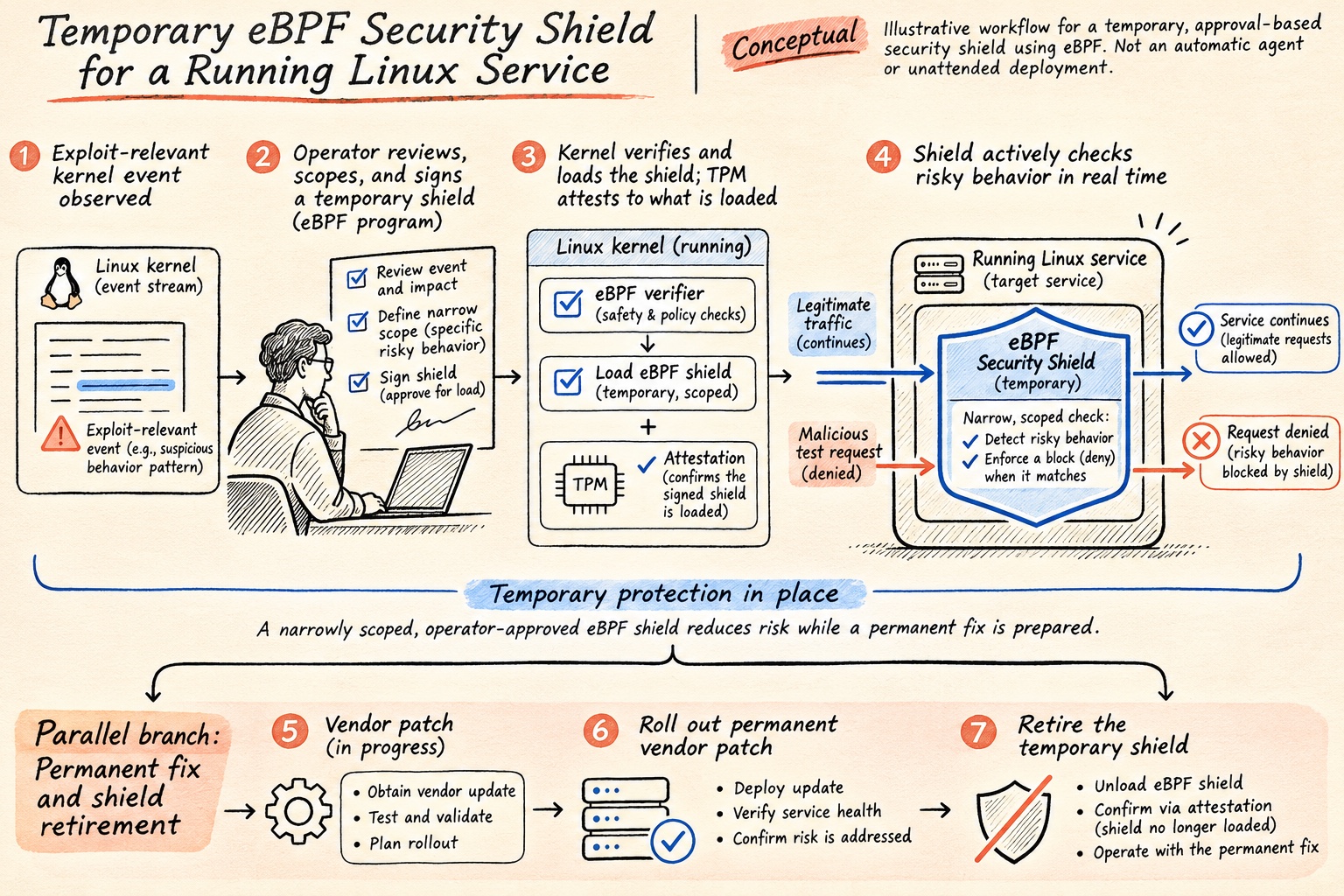
OpenAI and Cisco’s November 23 announcement frames Shirudo around the interval between vulnerability discovery and a permanent fix reaching a system. The announcement says teams can test a temporary safeguard, or shield, against vulnerable behavior while checking that legitimate requests continue. It describes eBPF programs observing or changing selected behavior inside the Linux kernel without restarting the workload. [1]
A separate Isovalent explanation says Shirudo has roots in Tetragon and uses signed packages to deliver eBPF or application-bytecode mitigations. In the public example, the team used a generated Java bytecode check against a Java4Shell exploit attempt on a running Elasticsearch instance. This is a vendor-described controlled test; it does not establish broad protection across applications, kernels or attack variants. [2]
That distinction is critical. A shield that blocks an exploit path can be a bridge to a patch. It is not necessarily a complete correction of the underlying defect, and a narrow test cannot prove it has no false positives in a different workload.
What the trust chain is meant to provide
The project’s stated design combines operator-side package building and signing, target-side verification and a TPM measurement of loaded protections. The repository says production targets require Shirudo’s signed-loader ABI, kernel patches and a TPM 2.0. It labels the project pre-release. The system requirements document further lists the kernel features and boot configuration needed for target initialization. [3] [4]
These constraints are more than an installation footnote. A specialized kernel changes the operational scope: a team must be able to build, test and maintain the kernel, verify boot integration, preserve signing keys and recover a host if an update fails. A standard Linux distribution kernel should not be assumed compatible. Current documentation should be checked against the exact target kernel before any pilot.
A useful trust chain has distinct questions:
- Did a reviewer approve the exact mitigation and target scope?
- Was the package signed by an authorized key?
- Did the target enforce the intended loader and kernel checks?
- Can an operator independently verify which shield is loaded?
- Does the service still pass its normal health, latency and correctness checks?
TPM evidence can help attest to recorded system state; it does not prove that the mitigation logic is correct or that an application remains behaviorally sound. That requires independent tests and monitoring.
Treat generated shields like production code
OpenAI says its approach gives agents programmable controls to investigate vulnerabilities and develop candidate shields, with security teams controlling deployment. Isovalent’s technical description also presents an agentic workflow that may be configured with different levels of autonomy. The safe operational default is to keep generation, validation, signing and deployment as separate gates, with named human ownership for production changes. [1] [2]
For a pilot, use a disposable environment that mirrors the target kernel and application. First run a shield in observe or test mode if supported, then exercise legitimate traffic and the known failure case. Include regression tests for adjacent behavior, performance monitoring and an explicit removal path. Record the package hash, signer, target inventory, test evidence and expiration condition.
A shield should have a bounded purpose and lifetime. Define which vulnerability behavior it addresses, which service versions it covers, which behaviors it might block and what event retires it. Once the vendor patch is deployed and verified, remove the temporary shield and confirm the expected state through the project’s attestation mechanism. Do not let emergency mitigations become undocumented permanent policy.
What a responsible evaluation needs
The announcement’s Java4Shell example is a useful demonstration that a targeted safeguard can reject one test exploit attempt while an Elasticsearch process continues running. It is not an independent benchmark. Teams evaluating the project should ask for reproducible tests across kernel versions, workload behavior, false-positive rates, failure recovery and the signing and key-revocation lifecycle.
Measure both security and availability. A control that blocks a vulnerable path but also rejects valid traffic may create an outage. Capture application errors, latency, resource use and attack-path coverage before and after loading the shield. Keep the normal patch process moving in parallel: identify affected versions, prepare the vendor fix, schedule rollout and validate the patched service.
The right role is a controlled bridge
Shirudo points toward a useful capability: targeted, verifiable runtime protections can create additional response options when patching takes time and restarting is costly. Its open-source code and technical documentation make the design inspectable. Its pre-release status and kernel requirements mean evaluation must start with compatibility and recovery planning, not a quick production install.
The enduring security measure remains a tested permanent fix. Use a temporary shield only when its scope is clear, its behavior is independently validated, its package and target are verifiable, and its removal is part of the plan. That is the difference between a useful patch-gap control and a new critical dependency with unclear failure modes.
Frequently asked questions
Can Shirudo replace a vendor security patch?
No. OpenAI and Cisco describe temporary shields as protection while a permanent patch is prepared and deployed. Operators should remove the shield after the permanent fix is verified.
Can Shirudo run on an ordinary Linux server today?
The public repository labels Shirudo pre-release and says production targets need a Linux kernel with its signed-loader ABI and kernel patches, plus TPM 2.0. Teams should check the current system requirements rather than assume compatibility with a standard distribution kernel.
Sources & further reading
Keep reading
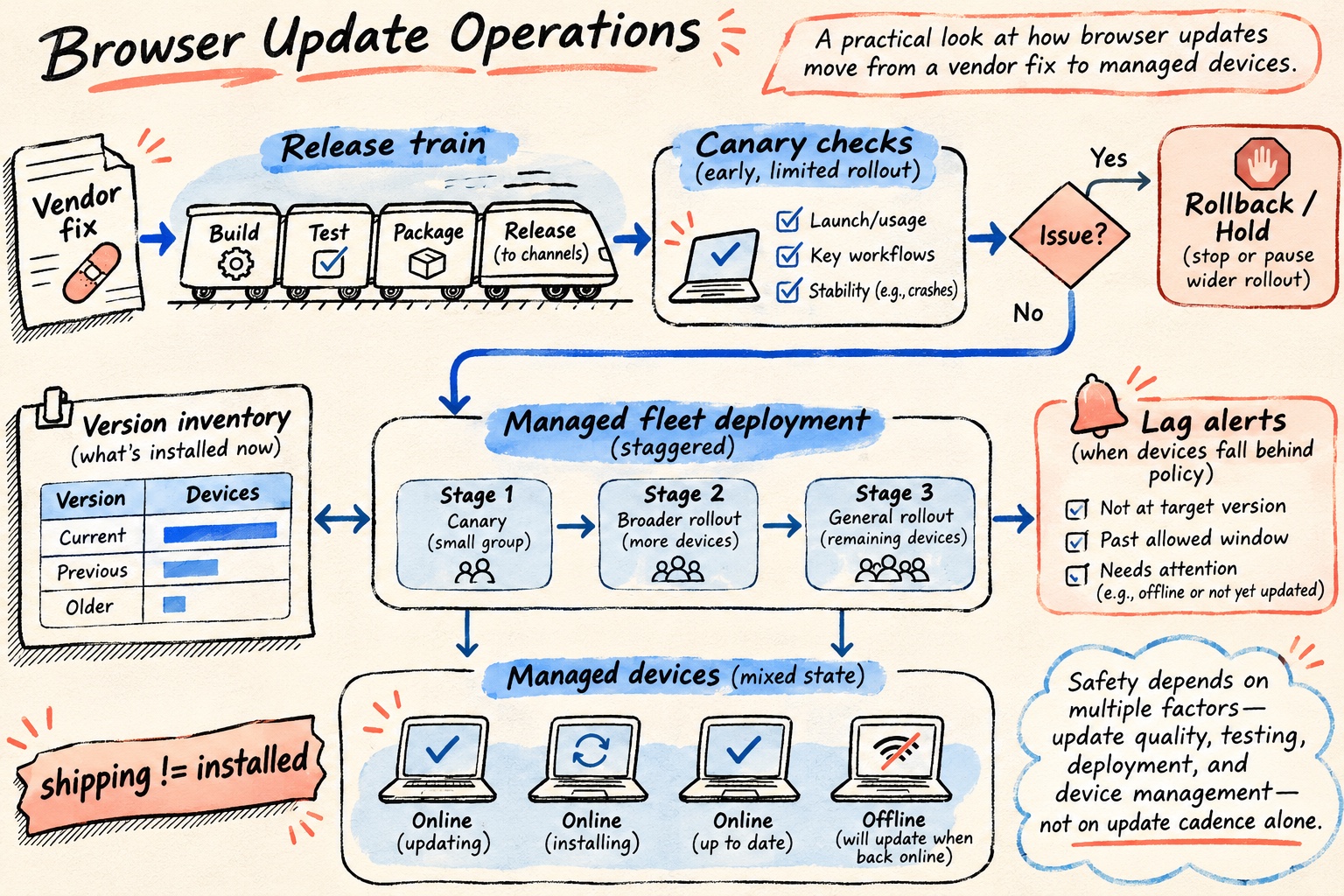
Chrome’s Patch Gap Is Now a Restart Problem
Chrome is piloting two security releases weekly, but patches still wait for browser restart. See how rollout and relaunch affect the patch gap.
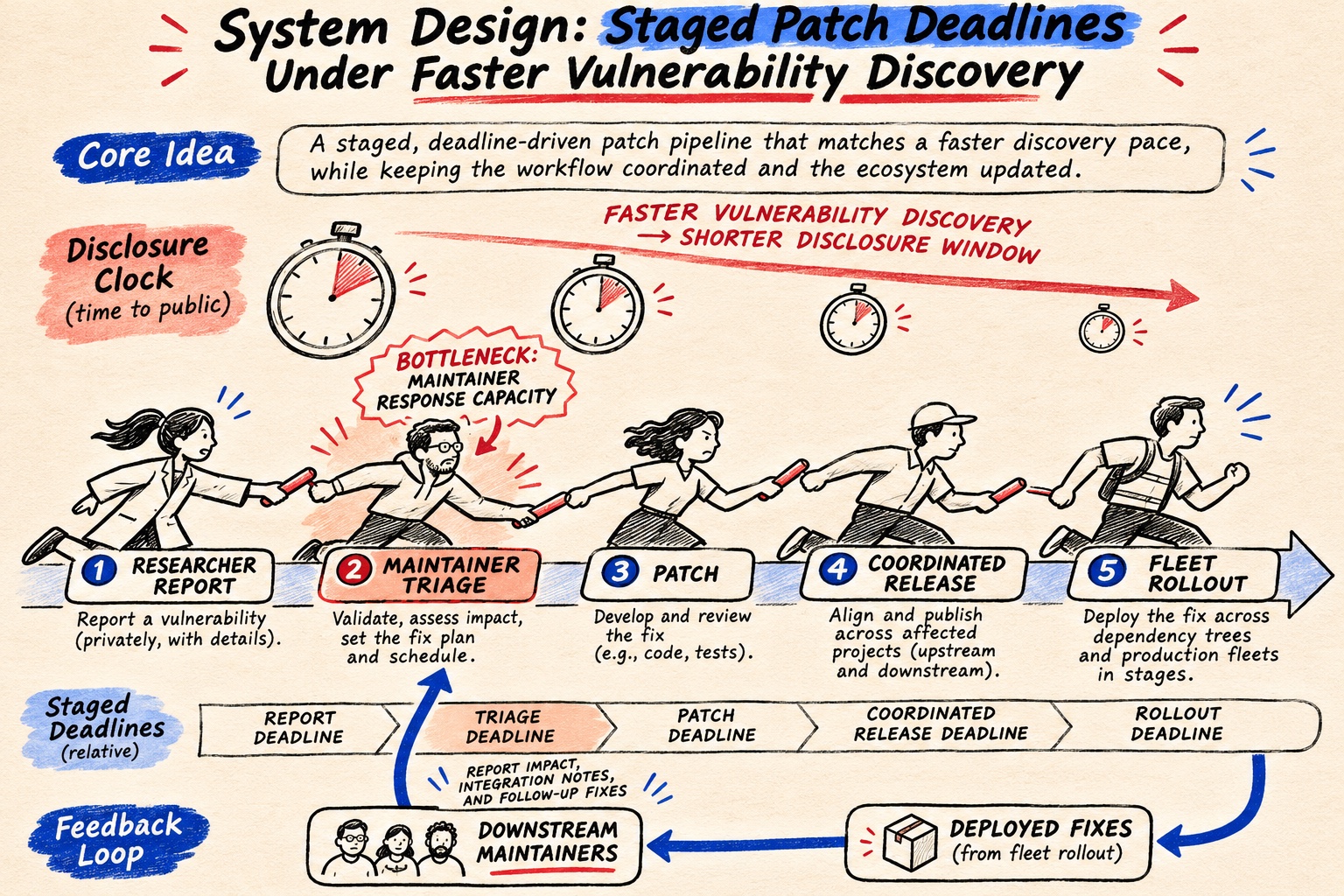
Shorter Vulnerability Deadlines Shift the Bottleneck to Maintainers
Anthropic’s revised disclosure targets begin in 2027. Learn what the change means for maintainer triage and downstream patch rollout.
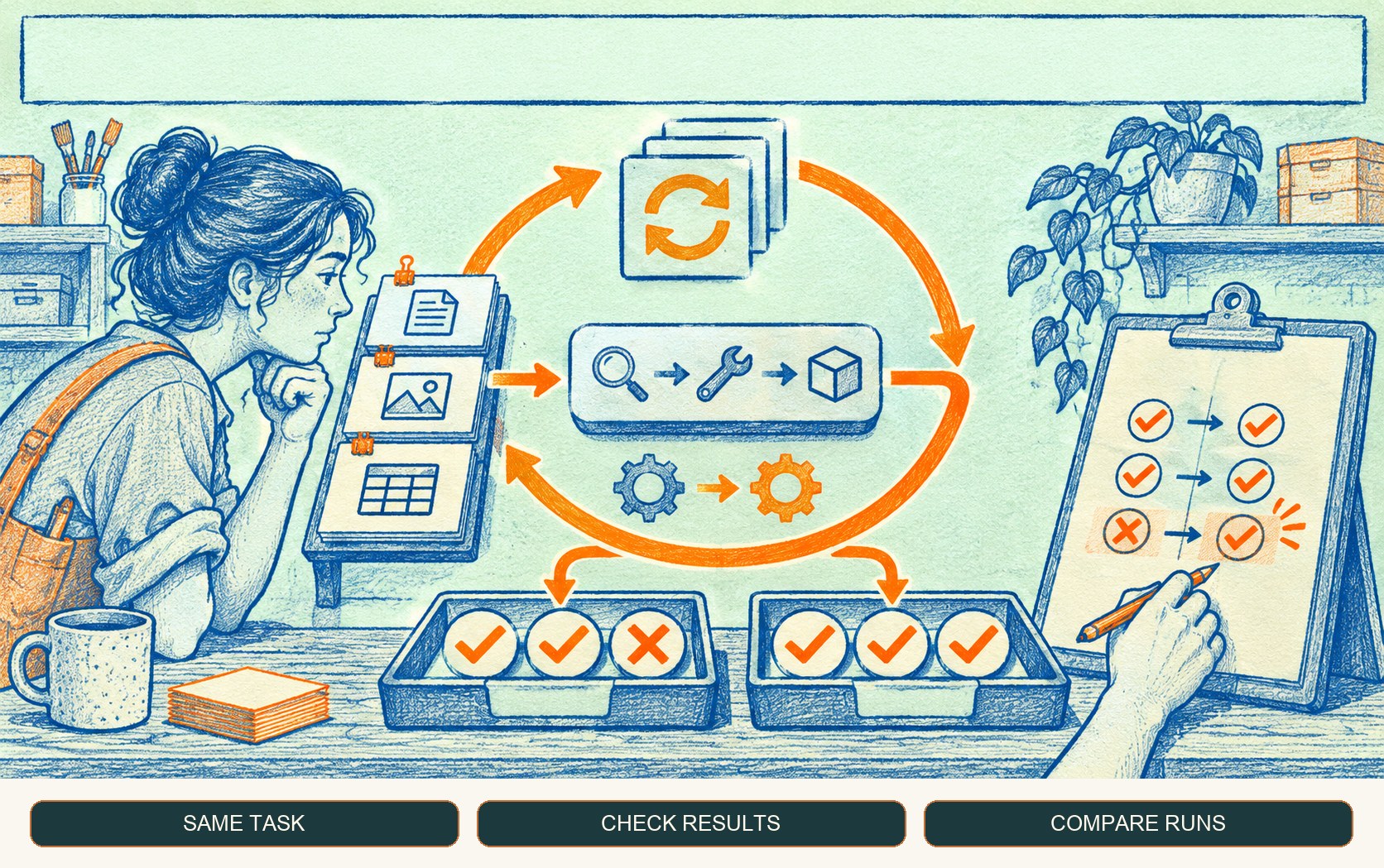
GitHub Copilot Evals Turns Agent Changes Into Repeatable Checks
GitHub's Copilot Evals preview replays realistic tasks against skills, agents and MCP tools. Treat it as a regression aid, not a universal quality score.
/* Comments */
Comments are offline right now — we reconnect automatically, nothing is lost.