
Shorter Vulnerability Deadlines Shift the Bottleneck to Maintainers
Anthropic’s revised disclosure targets begin in 2027. Learn what the change means for maintainer triage and downstream patch rollout.
On this page
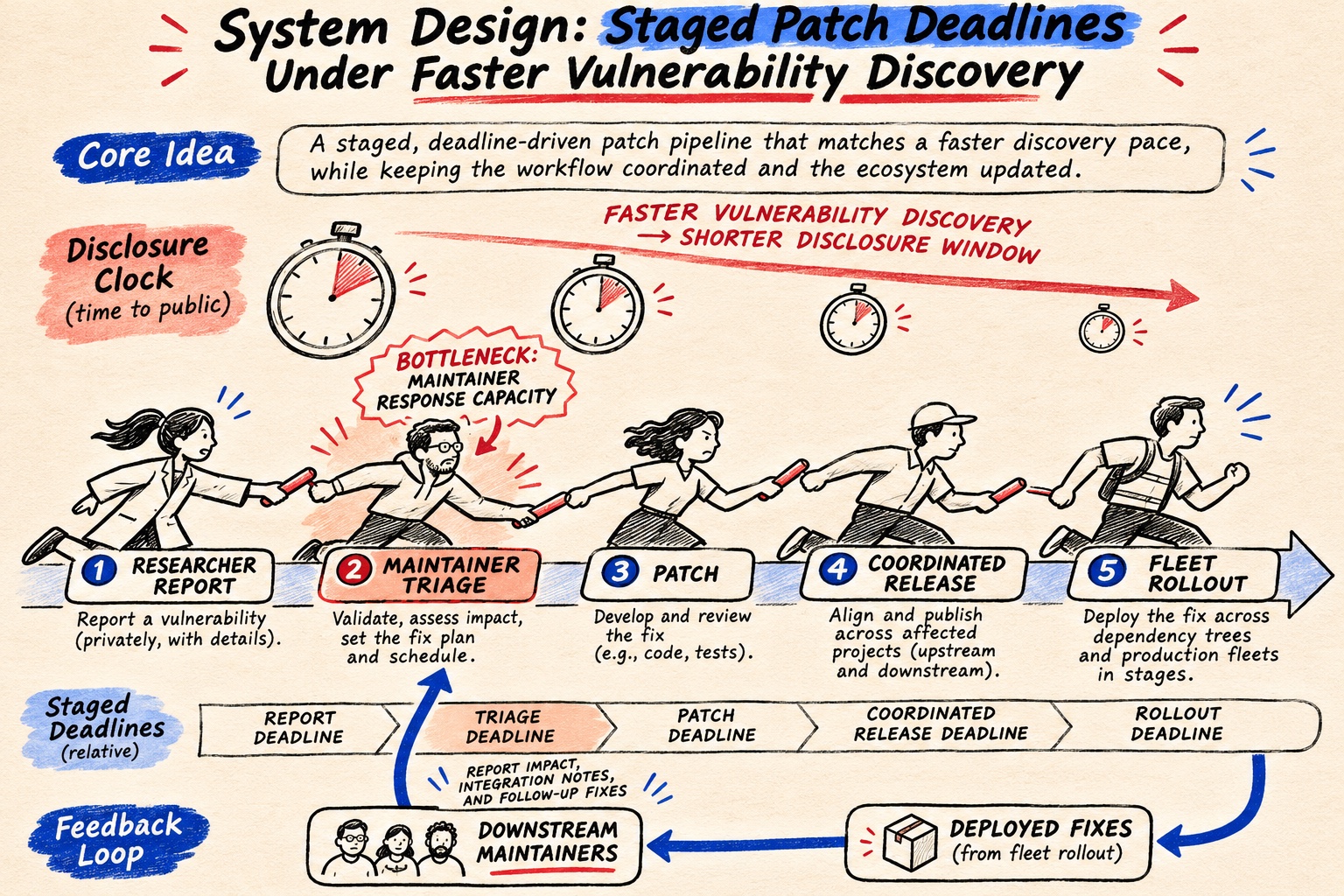
A disclosure clock is only one part of remediation. A short window can reduce the time a flaw remains privately known, but it also compresses the time maintainers have to reproduce it, assess affected versions, build a fix and help downstream users deploy it.
What changed—and what did not
Anthropic’s November 16 policy update changes its target window from 90 days to 30 days for high- and critical-severity findings, and to 45 days for other findings. It aims to escalate to an external coordinator after 15 days without an initial maintainer response. Once a patch exists, it generally plans to wait 30 days before publishing full technical details. Active exploitation remains on a seven-day disclosure window. The new targets apply to reports sent from January 1, 2027; reports already in progress then keep their earlier deadlines. [1] [2]
That last distinction matters for teams building calendars or response automation. This is not an instruction to publish every existing private report on a new date. Nor is it a claim that every defect can be resolved in a month. Anthropic explicitly recognizes cases involving hard-to-deploy systems, critical infrastructure, or specification changes that may need a negotiated remediation schedule. [1]
The reason offered is that vulnerability discovery and rediscovery are speeding up, in part through AI-assisted work. That rationale is plausible, but the announcement is a policy statement by one research organization; it does not establish a universal measured time-to-exploit curve or prove that all maintainers can meet the same clock.
As of this research refresh on November 24, Google Project Zero’s policy page says it plans to move from Full 90 to Full 60 on February 2, 2027, and then to Full 30 on January 3, 2028; it keeps a seven-day policy for vulnerabilities exploited in the wild. That is a separate policy with different mechanics from Anthropic’s severity-based 30/45-day targets. The comparison shows that disclosure programs are changing, but teams should track each reporter’s actual policy and effective date rather than assume one industry-wide clock. [3]
The queue is the product problem
For maintainers, the meaningful unit is not “days until disclosure” alone. It is the end-to-end queue: receive a credible report, acknowledge it, establish a reproducer, identify versions and downstream consumers, determine severity, review a patch, coordinate releases and communicate mitigations. A deadline compresses each stage without adding reviewer hours or release engineering capacity.
The first practical control is a monitored intake path. Security reports should land somewhere with an owner and an on-call backup, even when the project is volunteer-maintained. An acknowledgement can establish contact and collect safe details without prematurely confirming impact. Public issue trackers are often a poor place to ask a reporter for an exploit trace; maintainers should point to a private channel and preserve a timeline.
Second, maintainers need a pre-agreed triage template: affected versions, environment, reproducibility, security impact, proposed fix, test evidence and any known exploit status. A report with a tested patch can save time, but suggested patches still need review for regressions, compatibility and maintenance burden. AI-generated findings should be human-reviewed before they become actionable reports; Anthropic says its updated policy does not apply to findings that have not received human review. [1]
A release needs downstream time too
A fix in the upstream repository does not immediately protect users. Libraries are vendored, distributions backport patches, managed services roll forward on their own schedules, and operators may need a maintenance window. The 30-day post-patch buffer recognizes some of that deployment lag, but a calendar buffer cannot tell maintainers whether affected populations have actually updated.
A useful response plan therefore pairs the disclosure date with a dependency map. Identify release branches, supported versions, package owners and security contacts before an incident. Prepare a patch advisory and upgrade path in parallel with code review. If a coordinated disclosure coordinator becomes involved, make the handoff explicit: who owns severity, who contacts downstream projects, and who decides whether an exception is justified?
Project Zero’s long-standing public policy is a useful comparison point for how disclosure deadlines and exceptions can be documented, but policies differ in scope and detail. Teams should follow the policy that governs the specific report rather than combine the shortest clause from several policies into a fictional universal rule. [3]
A maintainer-ready checklist
- Publish a security contact and monitor it; name a backup for vacations and handovers.
- Acknowledge privately, record the report date and clarify the governing disclosure policy.
- Reproduce the issue and map affected releases before promising a fix date.
- Keep patch review, release preparation and downstream notification moving in parallel where safe.
- Record exceptions with the reason, owner, next update and agreed date.
- After release, track whether supported packages and deployments have actually received the fix.
Shorter clocks make a weak intake process visible. They do not make patch review or deployment instantaneous, and they should not reward rushed, unreviewed changes. The strongest response is operational readiness: a reliable contact path, a maintained release matrix and a clear escalation owner. That is how a disclosure target can shorten real exposure instead of merely moving a date on a spreadsheet.
Frequently asked questions
When do Anthropic’s shorter vulnerability disclosure timelines take effect?
The revised targets apply to reports sent on or after January 1, 2027. Anthropic says in-progress reports on that date keep their existing deadlines, so the change is not retroactive.
Does a 30-day disclosure deadline mean every vulnerability can be fixed in 30 days?
No. Anthropic says complex cases, including critical infrastructure or specification changes, may require a negotiated remediation timeline. The policy describes target disclosure windows, not a universal guarantee that fixes are simple or ready.
Sources & further reading
Keep reading
Chrome’s Patch Gap Is Now a Restart Problem
Chrome is piloting two security releases weekly, but patches still wait for browser restart. See how rollout and relaunch affect the patch gap.
Shirudo’s Live Linux Shields Are a Pre-release, Not a Patch Replacement
OpenAI and Cisco’s Shirudo offers temporary eBPF shields, but its pre-release status and custom kernel requirements limit where it fits today.
GitHub Copilot Evals Turns Agent Changes Into Repeatable Checks
GitHub's Copilot Evals preview replays realistic tasks against skills, agents and MCP tools. Treat it as a regression aid, not a universal quality score.
/* Comments */
Comments are offline right now — we reconnect automatically, nothing is lost.