
topic: ai-technology
author: Crashtech Editorial
date: Oct 7, 2026 · read: 2 min
updated: October 8, 2026
---
In-Package Optical I/O: Where Photonics Changes AI Networking
Co-packaged optics shortens electrical signal paths and moves conversion closer to chips. Copper, optical links and network protocols still have distinct roles.
On this page
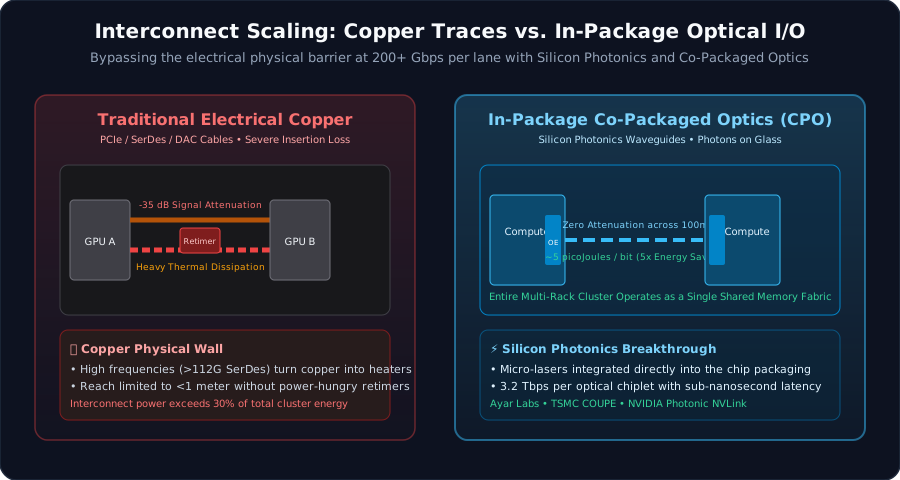
Conceptual architecture; arrows show relationships, not measured latency, energy or safety guarantees.
Where conversion happens matters
A conventional optical network port carries electrical signals from a switch ASIC across a board to a pluggable transceiver. The transceiver converts them to light for the fiber link. The optical connection already exists; co-packaging changes where the electrical-to-optical boundary sits.
NVIDIA’s 2025 photonics announcement concerns networking switches using co-packaged optical technology. Its technical discussion describes a system involving photonics, electronic ICs, packaging, fiber connectors and laser sources. That is more specific than a claim that ordinary GPU packages have universally replaced copper with lasers. [1] [2]
The physical tradeoff
High-speed electrical channels face insertion loss, crosstalk and equalization requirements. Moving the optical engine closer to the ASIC shortens that electrical channel. Optical links can extend reach while changing the power, density and serviceability tradeoffs.
Energy figures must identify their boundary: a SerDes, optical engine, transceiver or complete network may be measured differently. One component’s efficiency improvement is not the same percentage reduction in rack or facility power.
Copper remains useful for short connections. NVIDIA’s own interconnect portfolio includes passive and active copper alongside optical products. [4]
Compute optical I/O is a related frontier
Ayar Labs describes optical I/O technology intended to bring optical connectivity closer to compute. Such chiplet and packaging work addresses related bandwidth and reach challenges. Integration status, supported protocols and deployment conditions must be checked for the particular product. [3]
Fiber does not erase latency. Even an idealized 100-meter fiber route has propagation delay on the order of half a microsecond one way, before conversion, switches and endpoint processing. It cannot provide zero-delay local-memory access across a building.
Reliability belongs in the comparison
A complete design must account for laser placement, thermal behavior, fiber attachment, connector loss, testing and replacement procedures. Co-packaging can shorten electrical paths while making some components harder to service independently.
Compare useful delivered bandwidth, power at a stated measurement boundary, fault recovery and operating cost. Neither an unqualified energy multiplier nor an illustration of glowing fiber establishes that one design is right for every scale-up and scale-out link.
Frequently asked questions
Are co-packaged optics and GPU optical I/O the same deployment?
No. Co-packaged optics may place optical engines beside a network-switch ASIC. Optical I/O beside a compute die is a related design direction, not proof that all GPUs already ship optical packages.
Does fiber make a cluster behave like local memory?
No. Optical links still have propagation, conversion, switching and protocol latency. A shared-memory programming model also requires appropriate coherence and transport mechanisms.
/* Comments */
Comments are offline right now — we reconnect automatically, nothing is lost.