
Organoids Classified Braille Patterns in a Small Experiment. They Did Not Learn to Read
A Bristol team encoded Braille patterns into stimulation for brain organoids. Its classifier result shows no learning or language comprehension.
On this page
“Organoids read Braille” is a compelling headline and an inaccurate description of what the experiment showed. In a peer-reviewed study published October 16, researchers encoded tactile patterns as electrical signals, stimulated neural organoids, recorded their activity, and used a classifier to distinguish the patterns. The result points toward a possible biohybrid-computing method; it is not evidence of reading or comprehension.
How the experiment worked
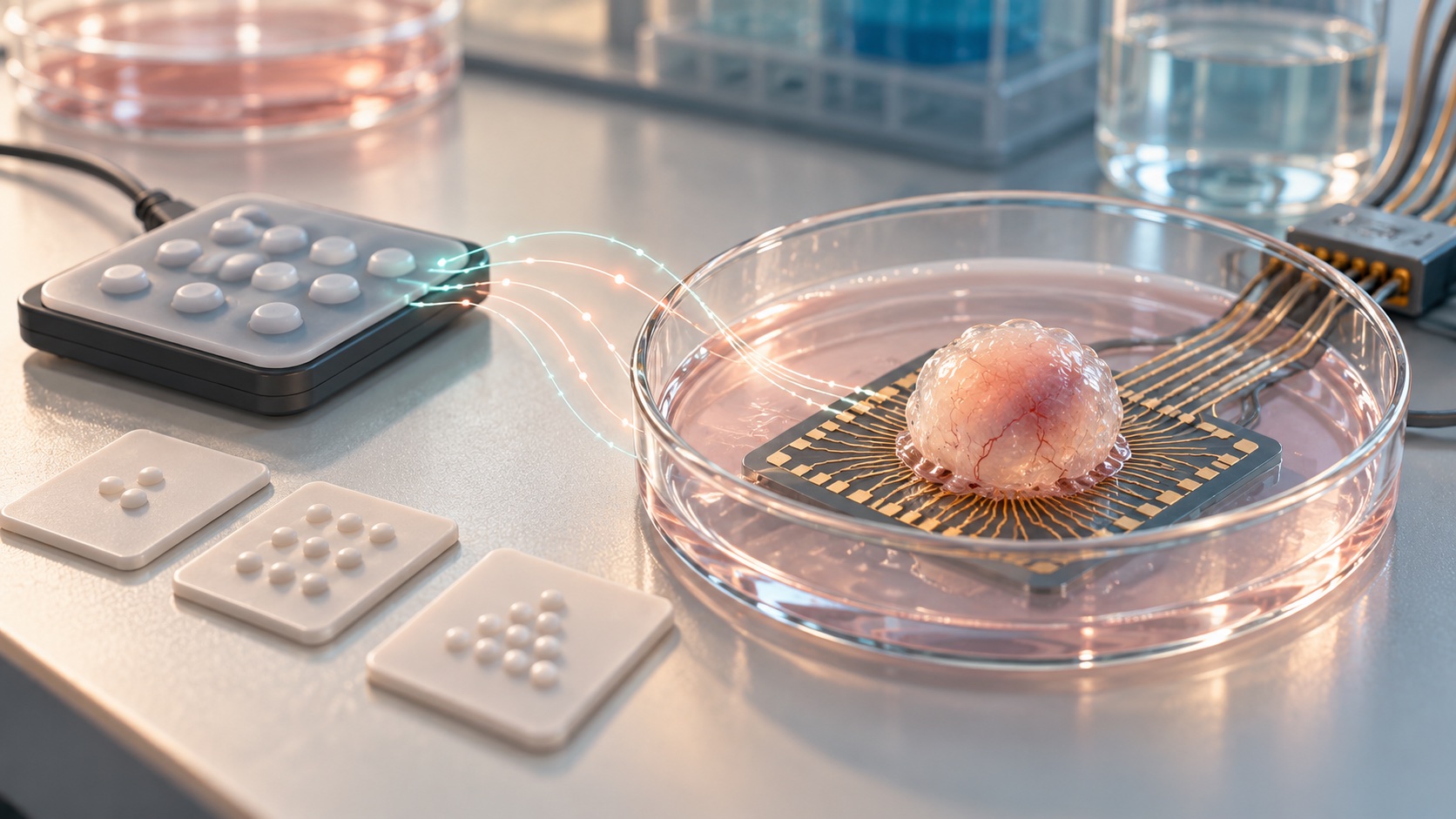
The team placed brain organoids on a low-density eight-electrode multielectrode array. A tactile sensor reading a Braille pattern was translated into a preset stimulation pattern. Researchers then measured the organoid’s electrical response, including spiking activity and center-of-activity features, and trained a support-vector machine to classify which input pattern had been presented. [1]
This pipeline involves several distinct components: a sensor represents touch, software maps the signal to electrodes, living neural tissue produces a response, and a conventional classifier labels that response. The published result concerns classification of this controlled set-up. It does not mean the organoid itself translated raised dots into words.
The accuracy numbers need their setup
The paper reports 61% accuracy using one organoid and 83% when combining data from three organoids. It also evaluates robustness under artificial noise. These are results for the paper’s chosen stimuli, recording arrangement, feature representation and classifier. They are not a general benchmark of organoid intelligence, a comparison to human Braille readers, or evidence that the system could be deployed as an assistive device. [1] [2]
The paper also compares the three-organoid result with a direct classifier on the electrical stimulation pattern, without passing through the organoid. That baseline scored 82% under clean conditions, close to the organoid ensemble’s 83%. The paper’s more distinctive result is in its artificial-corruption tests: the ensemble held up better than the direct baseline under the tested channel noise and missing-data conditions. That is a narrower claim than saying the tissue itself outperformed software at recognizing Braille. [1]
Combining multiple organoids improved the reported classification over the single-organoid condition, but biological variability is itself an engineering challenge. The paper notes that response differences make outcomes difficult to predict. For a practical system, researchers would need reliable repeatability, a clear account of the number and kinds of patterns tested, robust performance across tissue samples, and a useful end-to-end application.
Open-loop is the crucial limitation
The paper describes an open-loop approach. Inputs were encoded and delivered; responses were recorded and classified. The study does not demonstrate learning, long-term plasticity, language understanding, or a feedback process in which the tissue changes its behavior based on whether a classification was correct. The authors frame learning-capable biohybrid systems as future work, not as an outcome already achieved. [1] [3]
This is not the first organoid-computing result. A 2023 Nature Electronics paper, Brainoware, reported a different reservoir-computing set-up that used an organoid with a high-density electrode array for tasks including speech recognition and nonlinear equation prediction. Separate DishBrain work studied closed-loop game feedback with cultured neurons. Those are useful precedents, but they do not change the design of the 2026 Braille experiment: its own authors explicitly describe the present work as open-loop and say learning requires future tests. [4] [5] [1] That boundary is important because words like “reading” and “learning” carry strong human meanings. In this paper, “Braille recognition” refers to the experimental classification task: distinguish response patterns associated with tactile stimuli. The analogy can help explain the input format, but should not erase the role of the sensor, encoding method and software classifier.
Why the study is still interesting
A living neural system that produces measurable, stimulus-related patterns may offer researchers another substrate for studying signal processing. The next questions are practical and scientific: can the input mapping generalize beyond a small set of stimuli; can results be repeated across organoids; what controls are needed to separate biological signal from the apparatus; and can closed-loop learning be demonstrated safely and reproducibly?
The study’s data repository supports scrutiny of the experiment, while the peer-reviewed article describes the method and limitations. For now, the strongest conclusion is modest: in this laboratory set-up, an external classifier could distinguish encoded Braille-related stimuli from organoid response measurements above chance at the reported accuracies. That is a research milestone worth following without claiming that a mini-brain has learned to read.
Frequently asked questions
Did the brain organoids learn to read Braille?
No. The researchers encoded tactile Braille patterns as electrical stimulation and classified measured organoid responses. They explicitly describe the study as open-loop and do not demonstrate learning, language comprehension, or feedback-driven adaptation.
What accuracy did the experiment report?
The paper reports 61% classification accuracy with one organoid and 83% when combining three organoids on its evaluated task. Those figures belong to this laboratory setup and should not be generalized to human reading or practical computing performance.
What does open-loop mean in this study?
The experiment applied predetermined encoded stimuli and measured responses; it did not demonstrate a feedback loop in which an organoid learned from outcomes or changed its behavior through training.
Sources & further reading
- Encoding tactile stimuli for Braille recognition with organoids
- Study data repository, University of Bristol
- Bristol research news: mini-brain organoids and Braille marks
- Brain organoid reservoir computing for artificial intelligence, Nature Electronics
- In vitro neurons learn and exhibit sentience when embodied in a simulated game-world, Neuron
Keep reading

Google Workspace MCP Clients Face a November Agent-Use Gate
Google will require an agent-use OAuth client marker for Workspace MCP beginning November 11. Ordinary Workspace REST API integrations are unaffected.
NVIDIA Dory Makes Inference Compute a Knob. What Does That Buy?
NVIDIA Dory 1.0 reuses transformer layers at inference. Its adjustable loop count trades more computation for task performance, not free capability.

Meta’s New Feed Controls Make a Promise. The Ranking System Still Decides.
Facebook’s natural-language feed controls make preference editing easier, but the platform still translates each request into ranking signals.
/* Comments */
Comments are offline right now — we reconnect automatically, nothing is lost.