
Production AI Agents: Context Control, Deterministic Flow, and State Externalization
Move beyond brittle agent loops with deterministic flow, external state persistence, strict token pruning, and narrow scopes.
On this page
There is a widening chasm between an AI agent demo running on a developer’s laptop and an AI agent operating reliably in production under enterprise workloads. In prototype tutorials, an agent is often defined as a recursive loop: an LLM prompted with generic instructions, handed twenty tools, and told to iterate until it decides the task is finished.
In real production environments, that pattern fails quickly. Unconstrained agent loops suffer from compounding errors across multi-step chains, hallucinate completion criteria, loop indefinitely on error responses, and accumulate massive token bills while degrading context accuracy.
Building production-grade AI agents requires treating the language model not as an autonomous mind, but as a specialized, probabilistic reasoning engine embedded within a strictly deterministic software harness.
The Four Fatal Flaws of Naive Agent Architectures
+-------------------------------------------------------------+
|             THE COMPOUNDING ERROR PROBLEM                   |
|                                                             |
| Step 1 (95% accuracy) -> Output slightly drifted             |
| Step 2 (95% accuracy) -> Considers drifted output as ground  |
| Step 3 (95% accuracy) -> Misinterprets tool schema           |
| Step 4 (95% accuracy) -> Completely hallucinated result      |
|                                                             |
| Net Reliability: 0.95 ^ 4 = 81.4% success rate              |
+-------------------------------------------------------------+
When building systems that execute real financial transactions, modify databases, or interact with external customers, an 80% success rate is an outage. Four architectural failure modes account for nearly all broken production agents:
- Compounding Step Degradation: Probability compounds multiplicatively. If each reasoning hop has a 95% chance of valid execution, an agent requiring eight steps will fail nearly 35% of the time.
- Infinite and Degenerate Loops: When a tool returns a validation error or unexpected status code, an unconstrained model often retries the exact same invalid tool arguments repeatedly until the context length or timeout quota expires.
- Internalized, Ephemeral State: When an agent maintains its task history solely in the ephemeral context window, a network disconnect, process restart, or token window overflow obliterates the plan, leaving background jobs stranded.
- Context Window Contamination: Appending every intermediate observation, raw API response, and JSON payload to the prompt degrades attention, causes needle-in-a-haystack retrieval failure, and drives token costs exponentially higher on every iteration.
Architectural Pillar 1: Deterministic Control Flow
The single most impactful architectural decision is shifting the orchestration loop out of the LLM and into compiled code.
Never let the model decide the overall control flow. Use a deterministic State Machine or Directed Acyclic Graph (DAG) written in Python, Go, or TypeScript. The orchestrator determines state transitions, validation checkpoints, and stop conditions. The LLM is invoked only at specific, isolated judgment nodes within the graph.
       +-----------------------------------------------+
       |             Deterministic Harness             |
       |  (Hard iteration limits, timeout budgets)     |
       +-----------------------------------------------+
                              |
                     [Step 1: Router Node]
                              |
                    +---------+---------+
                    |                   |
            (LLM Judgment A)    (LLM Judgment B)
                    |                   |
                    v                   v
            [Schema Validator]  [Schema Validator]
                    |                   |
             (Pass) |            (Fail) | -> Return to Safe Fallback
                    v
          [Execute Tool Action]
                    |
           [State DB Checkpoint]
Under this pattern:
- The maximum number of loop iterations is enforced by an immutable integer counter in code.
- If a tool fails twice with the same status code, the harness intercepts the failure and routes to a human operator or fallback branch without asking the model.
- Timeouts, rate limits, and budget ceilings are enforced at the transport layer.
Architectural Pillar 2: Strict Context Pruning
Models do not perform better with more context; they perform worse. As prompt size grows, models experience attention dilution and increased latency.
In production:
- Own Your Prompts: Do not use dynamic automated meta-prompts that inflate behind the scenes. Maintain prompt templates in version control like code.
- Scrub Tool Observations: When an agent calls an external API that returns a 4,000-line JSON payload, never inject that raw payload into the agent’s context. Pass the payload through a deterministic parser or filter function that extracts only the three required fields before returning the observation to the model.
- Isolate Sub-Tasks: Rather than one monolithic agent managing an entire customer inquiry, spawn ephemeral worker subagents. Worker Agent A analyzes the sentiment and produces a two-word classification. Worker Agent B reads the classification, inspects the database, and exits. The parent graph maintains context cleanliness.
Architectural Pillar 3: Externalized, Serializable State
The LLM is a stateless transform function. It takes tokens in and emits tokens out. State belongs in a database.
Every state transition must be persisted to a durable datastore (such as PostgreSQL or Redis) after every tool execution. The record must include:
- The current graph node
- The validated payload
- The retry counter
- The accumulated token spend
{
  "session_id": "sess_88291a",
  "current_node": "execute_refund",
  "retry_count": 1,
  "allocated_budget_usd": 0.05,
  "spent_budget_usd": 0.012,
  "state_payload": {
    "order_id": "ord_9921",
    "customer_id": "cust_441",
    "approval_code": "APPR_OK"
  }
}
If the underlying pod crashes, the worker process is killed by Kubernetes, or an upstream API takes 30 seconds to reply, the agent can be resumed instantly on another worker node by reloading the serialized state without losing progress or re-running expensive reasoning steps.
Architectural Pillar 4: Narrow Scope and Guardrails
The broad “do anything” autonomous agent is an anti-pattern. High-performing production teams build hyper-specialized agents with narrow action spaces:
- Tool Access Quotas: Give an agent only the exact tools needed for its immediate sub-task. An agent handling address changes should not have access to the payment refund API.
- Schema Enforcement: All tool inputs and outputs must pass through strict Pydantic or Zod validation schemas. If the model outputs malformed JSON or an unknown parameter, the harness rejects it before touching external systems.
- Reversible vs Irreversible Actions: Distinguish between read operations (safe, autonomous) and write operations (dangerous). Irreversible actions (charging a card, dropping a table, sending a public email) must require a two-phase commit or human-in-the-loop sign-off.
Reliability is not an emergent property of bigger models; it is the deliberate product of defensive systems engineering.
Keep reading
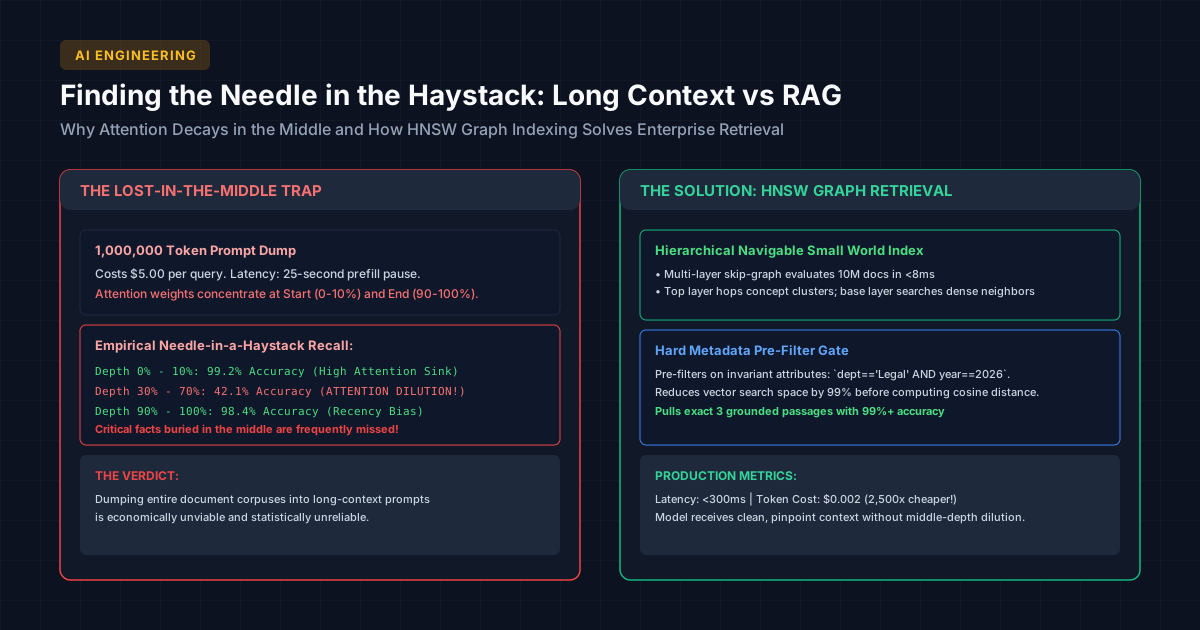
Finding the Needle in the Haystack: Embeddings, HNSW Indexes, and Long-Context Retrieval
Why long-context models suffer from the lost-in-the-middle phenomenon: HNSW graph indexing, metadata pre-filtering, and retrieval safeguards.
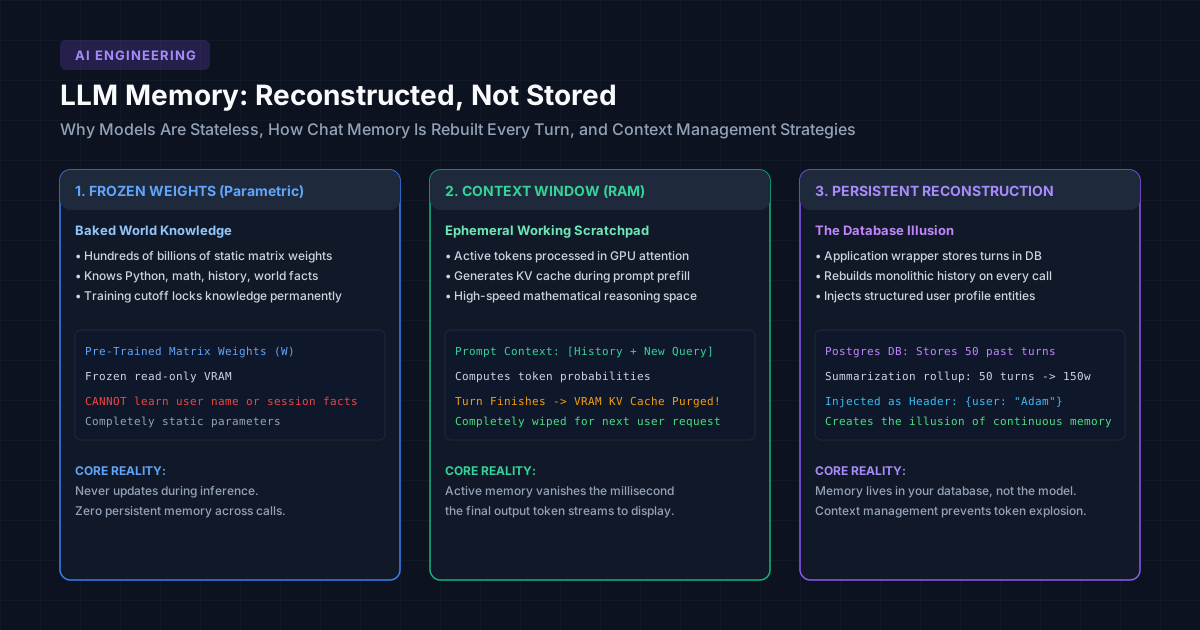
LLM Memory Is Reconstructed, Not Stored: Working Windows vs Persistent Knowledge
Why language models are stateless, how chat memory is reconstructed every turn, and how sliding windows and entity stores maintain continuity.
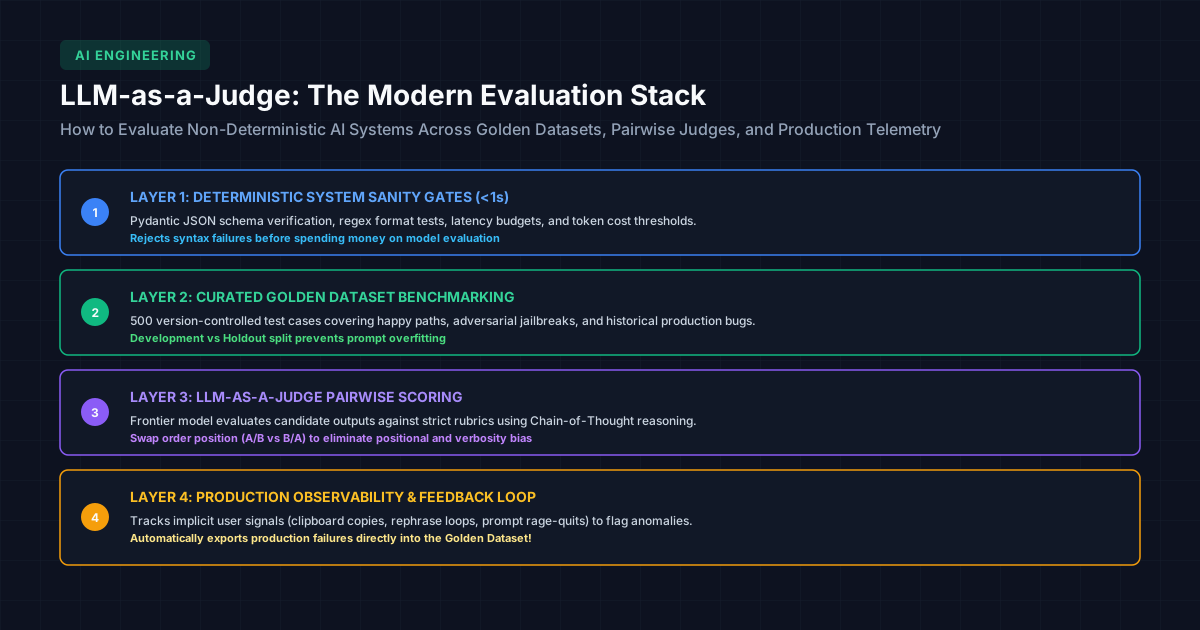
LLM-as-a-Judge and the Evaluation Stack: How to Monitor Health Before and After Shipping
Traditional unit tests fail on non-deterministic outputs: golden datasets, pairwise judge models, human calibration, and production observability.
/* Comments */
Comments are offline right now — we reconnect automatically, nothing is lost.