
On this page
A sterilization cycle may need a short, hot burst even when its heat source produces energy steadily. Rice University engineers have demonstrated a small fluidic system designed for that mismatch: let heat accumulate in paired, counter-flowing channels, then change how the streams interact so the outlet gets a concentrated pulse.
Borrowing a control idea from pulsed lasers
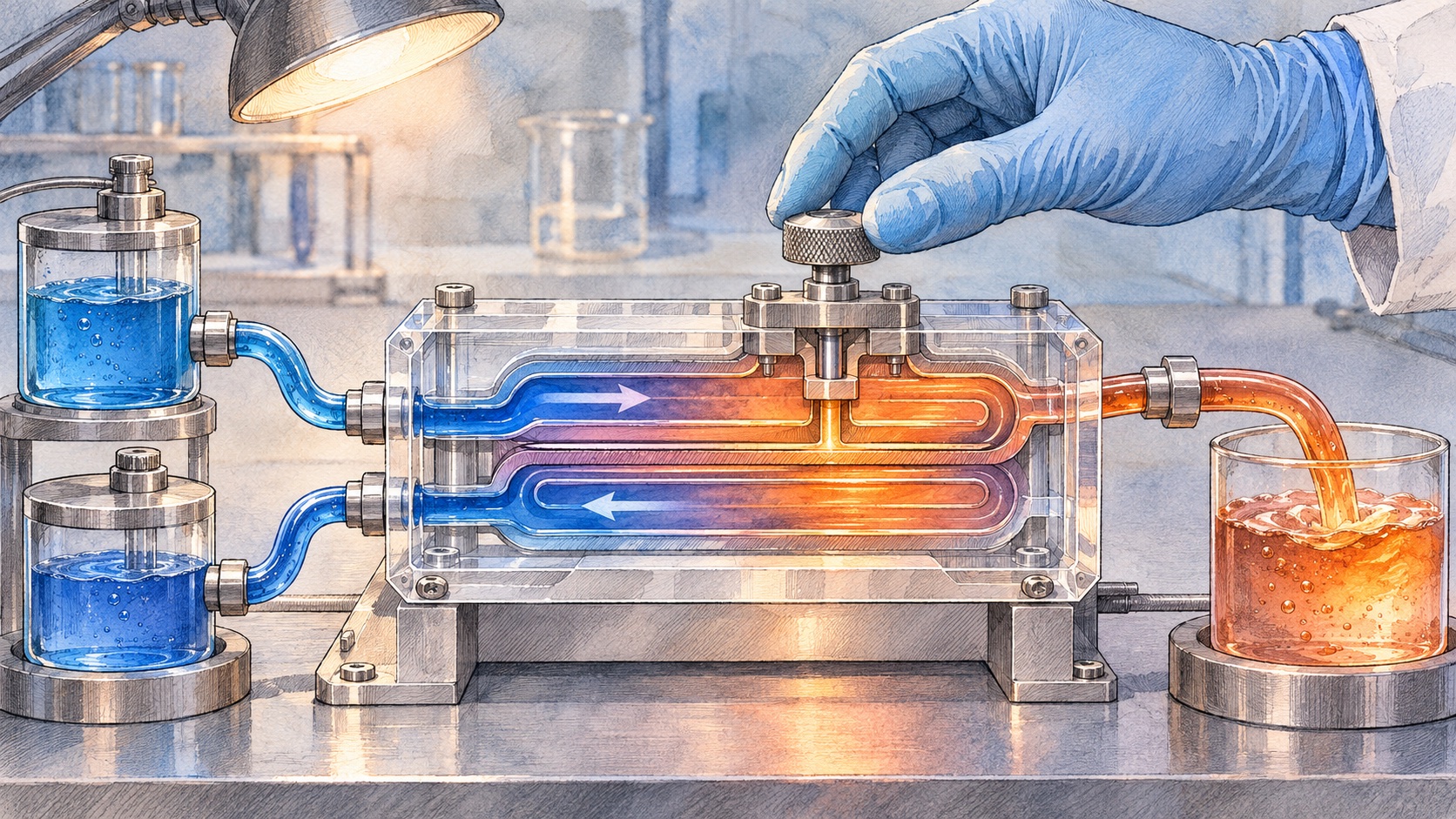
The method is called active heat Q-switching. In a Q-switched laser, energy builds up in a resonator and is released as a brief pulse when the system’s losses are changed. Rice’s team applied the broader storage-and-release principle to heat moving through liquid. The experimental device uses two thermally connected channels carrying water in opposite directions. A controlled change in their coupling lets heat that has accumulated in the system leave over a shorter period. [1] [2]
The paper reports an experimental outlet-power increase of about five times relative to the pre-switch output. The important unit is power: how quickly energy is delivered. The device does not create more thermal energy than its input supplied. It stores energy over time, then concentrates its release into a shorter interval. That can be useful when a process needs a temporary heating peak but its source is steady or limited.
This is a different design problem from simply adding a larger heater. A larger source must be sized for the highest instantaneous demand, even if that peak is brief. A thermal buffer can instead be charged gradually and discharged when the process calls for it. Rice’s work adds active control over that release, rather than relying only on a passive reservoir.
What the study did—and did not—show
The proof-of-concept experiment used water. The paper and university release also discuss simulations for other working fluids and possible designs with greater energy delivery per footprint. Those modeled results are not experimental performance, and the exact amplification depends on the device geometry and operating conditions. The university article mentions sterilization, cleaning, distillation, and solar-powered desalination as potential application areas; it does not report a deployed appliance or field trial. [1] [2]
The laser analogy is helpful, but it can also mislead. A thermal channel is not an optical resonator, and a short high-power output does not imply a high-efficiency system. To judge usefulness, engineers would need to measure total stored and released energy, switching losses, outlet temperature, cycle life, response time, and behavior with realistic fluids and fouling. The current paper establishes a controllable thermal transient in a lab setup, not the economics of a product.
For an appliance designer, the next question is whether a burst fits the task. A dishwasher might need a brief high-temperature rinse, while a distillation step may benefit from heat delivered at a specific phase. In either case, the device would have to meet sanitation or process requirements, recover its thermal state, and remain safe under repeated cycling. A higher peak number alone cannot answer those questions.
Why this small result is worth following
Many energy systems are built around mismatched timescales: a source supplies energy continuously, while a process needs it in bursts. Batteries solve that problem for electricity; thermal storage can buffer heat, but often releases it according to passive material properties. Active heat Q-switching offers a way to control when the stored heat is delivered.
The next useful milestone is not a bigger simulation. It is an independently reproducible device-level study that compares energy in and out over repeated cycles, tests a realistic working fluid, and measures losses and controls. The research group’s paper is the definitive source for the demonstrated result; the Rice news release and its open manuscript provide accessible explanations of the same study rather than independent replications. Readers interested in other data-center hardware bottlenecks can see our coverage of optical I/O for GPU clusters.
Frequently asked questions
What is active heat Q-switching?
It is a method that stores thermal energy in a counter-flow heat-transfer device, then changes how the flowing streams exchange heat so the outlet receives a short, stronger pulse.
Did the Rice experiment create more energy than it used?
No. The device released heat accumulated during a steady input over a shorter interval. Its peak thermal power rose because stored energy was delivered faster, not because energy was created.
Is Rice’s heat Q-switch ready for appliances or desalination plants?
No commercial system was announced. The research demonstrated a lab experiment using water and explored other working fluids in simulations; household and industrial uses remain possibilities for future development.
Sources & further reading
Keep reading

Waseda’s Photonic Transmitter Controls Reflections Without an Isolator
A silicon nitride and lithium niobate transmitter reached 180 Gbit/s without an optical isolator in a lab experiment.

JWST’s New Exoplanet Image Shows What Better Glare Models Can Reveal
FLIP uses a physics-based model to subtract starlight from JWST images, uncovering a faint planet while exposing the limits of computational recovery.

Google’s Gen AI Python SDK 3.0 Changes Three Defaults. Check Before You Upgrade
Google Gen AI Python SDK 3.0 changes the API default, HTTP client and one result type. Here is what Gemini developers should check before upgrading.
/* Comments */
Comments are offline right now — we reconnect automatically, nothing is lost.