
ST’s STM32A Puts Software Reuse Beside Safety-Critical Control
ST’s STM32A MCU family targets automotive, industrial, and robotics systems. Code continuity is the promise; safety qualification remains design-specific.
On this page
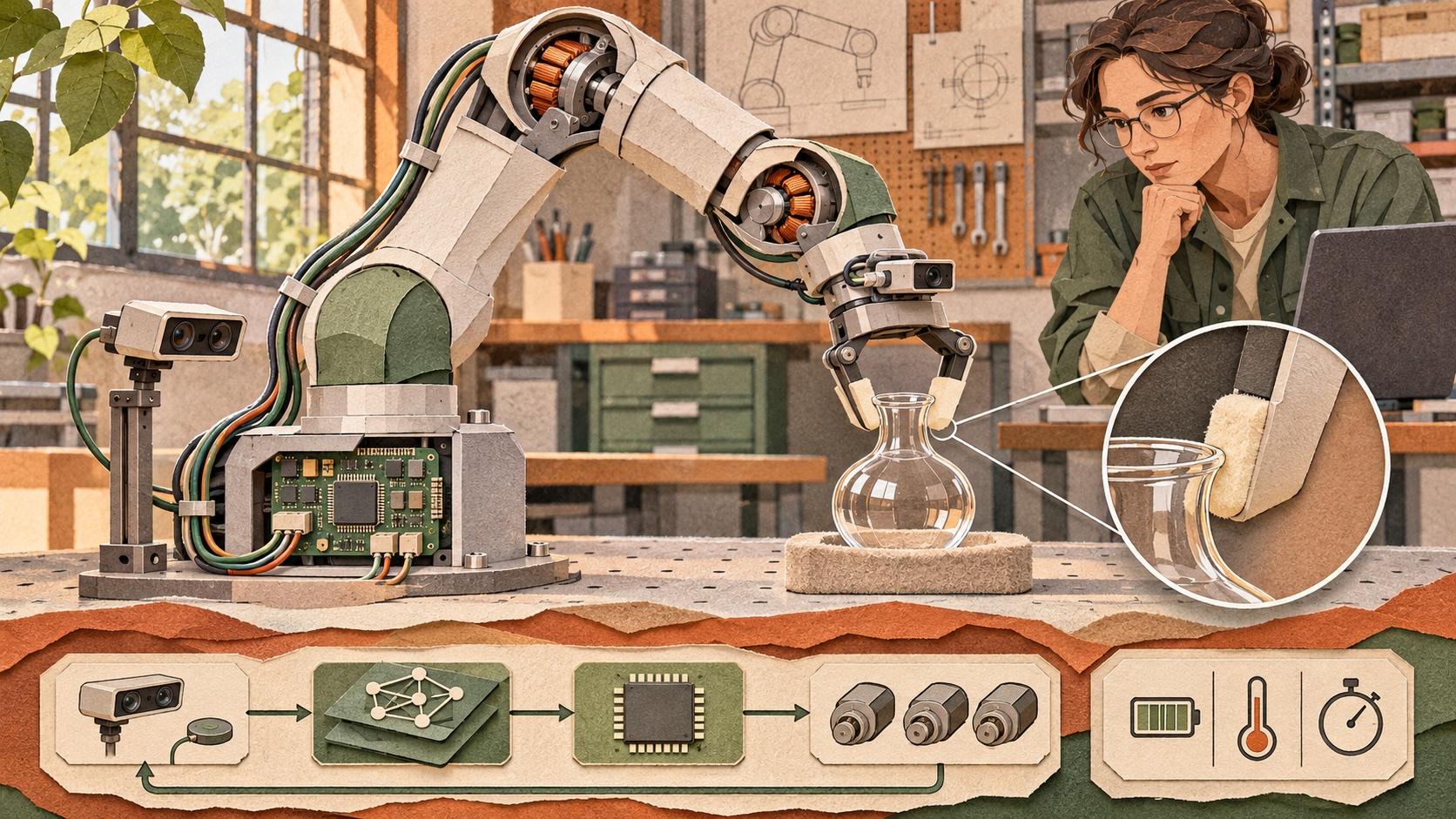
A robot’s camera can recognize a glass, but recognition is only the start. The controller must decide how to approach it, read force and position sensors, and adjust a motor quickly enough to avoid a slip. ST’s new STM32A family is aimed at this lower, less visible layer: the microcontrollers that keep sensing and control predictable while higher-level systems handle broader reasoning.
What ST announced
At its STM32 Summit on November 4, ST described a unified microcontroller platform spanning industrial, automotive, and robotics applications. Its new STM32A family extends the portfolio into automotive and higher-safety systems. ST named three lines: STM32A4 for entry-level local-control nodes, STM32A5 for mid-range safety-critical industrial and automotive applications, and STM32A9 for multi-domain control where real-time response and deterministic communications matter. The first devices were sampling to customers; broader availability is planned for 2027. [1]
The architecture pitch is continuity. ST says developers can reuse software, tools, and some design knowledge across its STM32 families, while choosing parts tailored to each market. The STM32A overview lists different memory capacities and safety features across the three lines; for example, the company describes A9 as supporting ASIL-D-oriented multi-domain control. These are product-family descriptions, not a guarantee that any finished vehicle or robot meets a safety standard. [2]
Arm frames the change as a response to physical AI systems that must combine perception, interaction, and actuation, often under power, heat, and timing limits. The idea is plausible: a common embedded ecosystem can reduce duplicated porting work as a company moves a control design from one product family to another. But software reuse is only one part of a safety-critical system. [3]
Reuse helps, but safety evidence does not travel automatically
An embedded controller works inside a specific machine, with specific sensors, motors, failure modes, and response deadlines. A driver that was safe on one board may behave differently with different peripherals, clocking, memory protection, or timing. Even a well-tested library cannot establish the safety of the complete system by itself.
Functional-safety standards such as ISO 26262 describe lifecycle processes for road-vehicle electrical and electronic systems. The standard applies to a system and its development evidence; choosing a microcontroller marketed for safety-related applications does not transfer certification to the design that uses it. Teams still need hazard analysis, requirements traceability, verification, fault handling, and a defensible safety case. [4]
The most credible near-term benefit may therefore be engineering continuity rather than a sudden leap in robot autonomy. A team might carry familiar STM32Cube tools, drivers, and tested application code into a new design, then spend the saved effort on the hardware-specific work that cannot be reused: timing analysis, fault detection, sensor validation, and system integration.
What developers should verify
The announcement leaves several buying questions open. Sampling is not general availability, and a roadmap does not say which exact parts, safety documentation, development kits, or production support a project can obtain today. Before committing, ask for the target part’s data sheet, safety manual, diagnostic coverage claims, toolchain versions, lifecycle commitments, and supported certification path. Confirm that a software component can be moved without changing its assumptions about interrupts, memory, or peripherals.
A practical evaluation is to port one non-safety-critical control task first, measure worst-case response time under load, then inject the faults the system must tolerate. Compare the result with the current MCU on the actual board, not a general vendor benchmark. For safety-related use, carry the platform into a formal assessment with the relevant assessor and standard; do not substitute the product label for evidence.
The STM32A announcement makes the boundary between reusable code and system-specific proof especially visible. As more machines use AI for perception or planning, the deterministic controller that turns decisions into motion remains a separate engineering responsibility. Our earlier coverage of physical AI’s sensor-data bottleneck and independent edge-AI evaluation looks at the neighboring parts of that stack.
Frequently asked questions
What is ST’s STM32A family?
STM32A is STMicroelectronics’ new microcontroller family extending the STM32 platform into automotive and high-safety systems. ST describes STM32A4, A5, and A9 lines for different local-control and multi-domain applications.
Are the STM32A microcontrollers broadly available now?
ST said the first three STM32A microcontrollers were sampling to customers on November 4, 2026, with broader availability planned for 2027. Sampling is not general commercial availability.
Does reusable STM32 software transfer a safety certification?
No. Reusing code and tools can reduce duplicated engineering effort, but a safety case still has to address the complete target system, its hazards, hardware, software, and applicable standards.
Sources & further reading
Keep reading
Encrypted Robot Commands Can Still Leave a Readable Rhythm on the Network
A 2026 study found robot actions could be inferred from encrypted traffic metadata, exposing a privacy gap between payload secrecy and behavioral privacy.

NTT and Safran Want Satellite Laser Links to Behave More Like a Network
A November 6 memorandum explores connecting Safran optical ground stations to NTT's network control and All-Photonics Network technologies.
AutoDNA Turns a Wet Lab Into a Workflow Engine, With Humans Still on the Bench
Nature's AutoDNA study links AI agents to more than 20 lab instruments; its real advance is coordinated, traceable execution, not a scientist-free lab.
/* Comments */
Comments are offline right now — we reconnect automatically, nothing is lost.