
The Anatomy of an AI Agent: Dissecting the Six Core Structural Layers
A comprehensive architectural guide to modern AI agents: Perception, Planning, Memory, Tools, the Orchestration Loop, and Safety Guardrails.
On this page
The technology industry uses the term AI Agent loosely to describe everything from a simple Python script calling OpenAI’s completion endpoint to autonomous multi-agent swarms refactoring enterprise codebases.
In systems engineering, an agent is not defined by marketing slogans. An agent is a closed-loop autonomous system that perceives its environment, reasons over a goal, formulates a plan, executes actions through external tools, observes the environment’s feedback, and iterates until the goal is achieved or declared impossible.
Building a production-grade AI agent requires far more than wrapping a foundation model in a while True loop. A reliable agent is composed of six distinct architectural layers, each addressing a specific category of runtime failure.
This guide provides an architectural blueprint dissecting the anatomy of modern AI agents.
The Six Structural Layers of an AI Agent
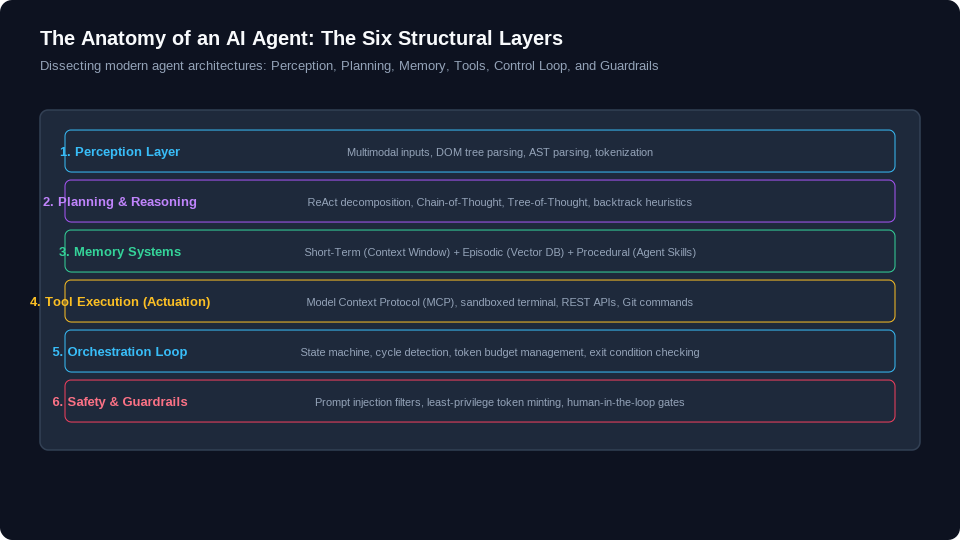
1. The Perception Layer
Before an agent can reason, it must ingest and normalize signals from the environment:
- Textual Ingestion: Sanitizing markdown, terminal stdout/stderr streams, and API JSON payloads.
- Structural Code Parsing: Generating Abstract Syntax Trees (ASTs) via tree-sitter to give the agent semantic code understanding (classes, methods, imports) rather than raw character strings.
- Multimodal Visual Inputs: Ingesting browser screenshots or vector canvas hierarchies to understand visual user interfaces.
2. The Planning and Reasoning Engine
The planning layer decomposes ambiguous, high-level objectives (“Fix flaky checkout test”) into a sequence of concrete, executable sub-tasks:
- Hierarchical Task Networks (HTN): Breaks goals into milestones, tasks, and micro-actions.
- ReAct (Reason + Act): Interleaves reasoning traces with concrete tool calls, allowing the agent to evaluate the outcome of action
Nbefore determining actionN+1. - Tree-of-Thought (ToT) with Backtracking: Explores multiple alternative solution paths simultaneously. If a speculative code edit fails unit tests, the planner prunes that branch and backtracks to a known valid state.
3. Memory Systems
Without memory, an agent is amnesic: every turn is an isolated computation. Modern agents implement a three-tier memory architecture mirroring cognitive psychology:
| Memory Tier | Mechanism | Storage Medium | Lifespan |
|---|---|---|---|
| Short-Term (Working Memory) | Active context window, message buffer. | Volatile RAM | Single interactive session. |
| Episodic (Historical Experience) | Vector similarity search over past sessions. | Vector DB (e.g., Qdrant, pgvector) | Persistent across runs. |
| Procedural (Knowledge & Rules) | Agent Skills, CLAUDE.md, runbooks. | Git repositories, filesystem | Permanent domain conventions. |
4. The Tool Actuation Layer
The actuation layer grants the agent physical agency to mutate the environment:
- The Model Context Protocol (MCP): Connects the agent to local databases, file trees, issue trackers, and external microservices over a standardized JSON-RPC protocol.
- Sandboxed Execution: Executes shell commands within isolated micro-VMs or rootless containers, isolating the host machine from rogue commands.
5. The Control Loop and State Machine
The orchestration loop is the operating system of the agent. It manages state transitions and prevents infinite runtime loops:
[ Ingest Goal ] ──► [ Plan ] ──► [ Actuate Tool ] ──► [ Observe Diff ]
                           ▲                               │
                           │                               ▼
                           └──────── (Goal Achieved?) ──► [ Exit ]
Essential Control Guards:
- Cycle Detection: Detects if an agent is repeatedly executing the exact same failed command, breaking the loop and forcing a re-planning phase.
- Token Budget Caps: Terminates runs that exceed predefined token or financial thresholds, preventing runaway API bills.
- Graceful Termination: Guarantees that when an agent is interrupted, it leaves a clean breadcrumb log explaining its current state.
6. Safety Guardrails and Policy Gates
The outermost perimeter isolates systems from unintended behavior:
- Indirect Prompt Injection Defense: Sanitizes untrusted user inputs (issue comments, web scrape outputs) to prevent adversarial prompt hijacking.
- Least-Privilege Scoping: Grants ephemeral, scoped API tokens rather than master administrative credentials.
- Human-in-the-Loop Interceptors: Mandates explicit human confirmation before executing high-risk actions (e.g., database drops, force-pushes, production deployments).
Key Lessons for Agent Developers
- The Model is Not the Agent: The foundation model is merely the reasoning engine; the surrounding infrastructure (memory, planning, tools, guardrails) dictates whether the agent succeeds in production.
- Context Economy Dictates Intelligence: Cluttering the context window with megabytes of raw logs degrades model reasoning. Filter, summarize, and curate context aggressively.
- Design for Failure and Backtracking: Autonomous systems will make mistakes. Robust agents are engineered with deterministic error recovery and rollback mechanisms.
Keep reading

Google Duplex Moves Into Gemini Tasks, Where Phone Calls Become an Agent Boundary
Google describes Duplex's shift from scripted calls to Gemini Tasks. Here is how live turn-taking works and what businesses can control.

Google Agent Registry Adds MCP Policy Hints, Not an Access Boundary
Google Cloud's Agent Registry adds preview IAP and human-review metadata for MCP tools. Learn what these hints clarify and what still must enforce access.

GPT-Live Standby Pauses Inference Without Closing a WebRTC Session
OpenAI’s standby mode pauses inference in silence and resumes on speech, trading lower idle rates for wake-up delay and an open microphone.
/* Comments */
Comments are offline right now — we reconnect automatically, nothing is lost.