
Claude's Circuit Boards Work as Prototypes. The Hard Part Starts Before Sale
Anthropic says Claude helped design three electronics prototypes. Validation, certification and production remain separate engineering work.
On this page
A circuit board can look finished on a screen and still fail when a connector hits its enclosure, a radio antenna sits beside the wrong copper, or a power supply runs hot. Anthropic’s November 9 account of Claude designing a speakerphone, voice-assistant hub and handheld virtual pet is interesting because the model worked across several of those connected constraints. It is also careful about the boundary: the devices were prototypes built by Diode engineers, not certified products produced autonomously. [1]
The progress is in the handoffs
Electronics design is a chain of representations. A requirement becomes a specification; a schematic becomes a board layout; the layout must respect signal, power and manufacturing constraints; the board must fit a case; firmware must operate the chosen parts. A defect in one stage can make work from every later stage expensive.
Anthropic says Claude used datasheets, created schematics and bills of materials, selected component placement, routed board traces, modeled enclosures and wrote firmware. On the voice-assistant hub, the model wrote a grid-search router after deciding that using KiCad’s built-in router one connection at a time would take too much stepwise guidance. Anthropic says the assistant also noticed when an audio clock trace ran too close to Ethernet signals and adjusted its routing approach. These are company-reported examples, not an independent benchmark of all hardware work. [1]
The important change is less “AI draws a board” than “AI can maintain context across tools and revise a design when a downstream constraint breaks.” In ordinary engineering, the valuable work often happens at those seams: translating a datasheet into a circuit choice, checking that the board fits the enclosure, and making a manufacturing warning actionable. Software such as KiCad provides design and verification tools; a model can help operate them, but the result still needs engineering review. [2]
What the benchmark does—and does not—show
Anthropic reports that Fable 5.2 scored 69% on Diode’s internal PCB Gym placement-and-routing benchmark, compared with 25% for Fable 5. It also reports an 83.5% score on the public BenchCAD 2.1 benchmark. Those scores are evidence about specific tasks and benchmark setups. They do not demonstrate that a generated board is safe, manufacturable at scale or compliant with every applicable standard. [1]
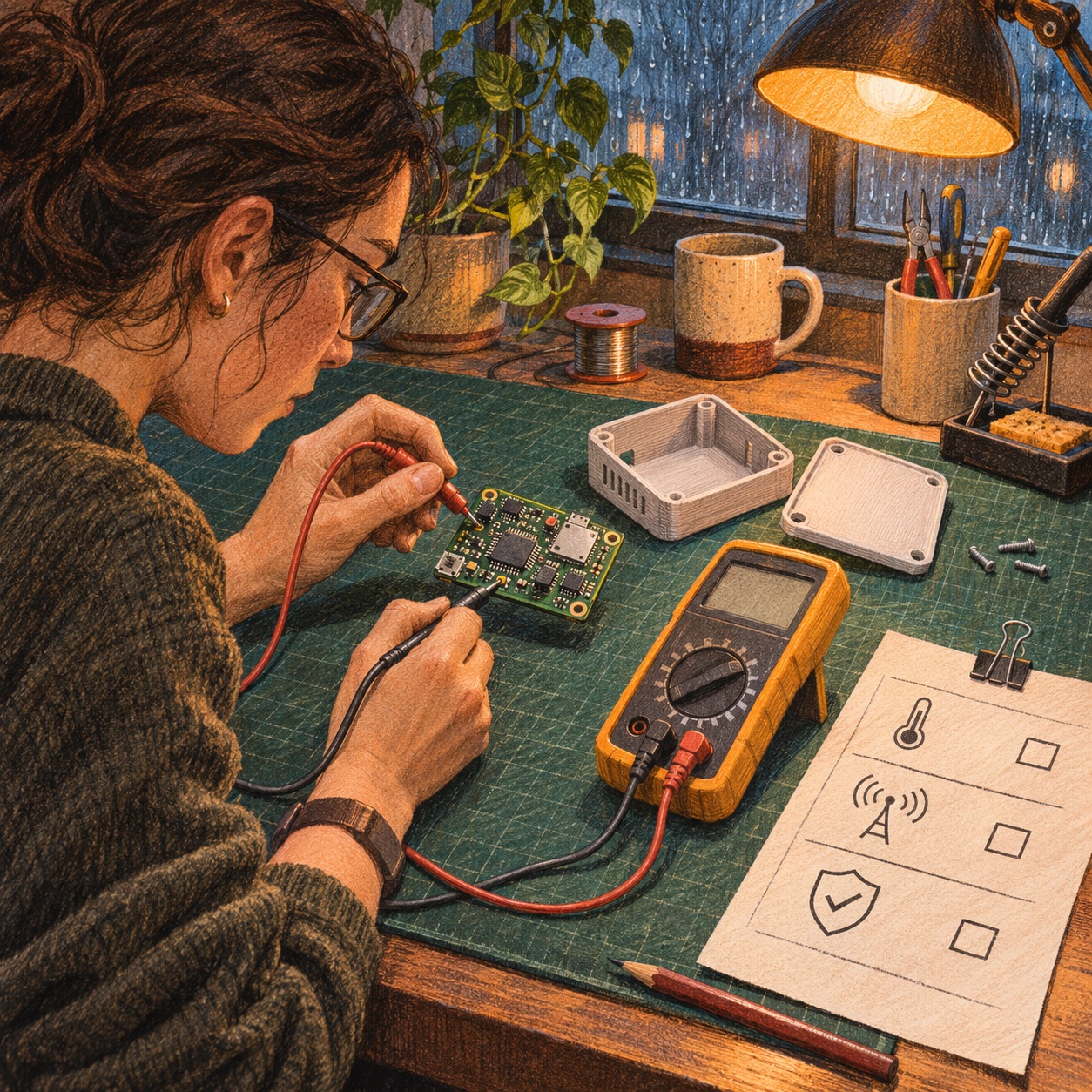
The company’s own caveat is central: the three prototypes still need electrical validation, antenna tuning, thermal testing and certification, and were not designed for mass production. Diode engineers physically assembled and tested them because Claude was not connected to test instruments or manufacturing equipment. Anthropic also has a commercial relationship with Diode, which is relevant context when interpreting the case study. [1]
This boundary is familiar in electronics. Design-rule checks catch classes of geometry or connectivity errors, but a clean design database is not the same as a device that passes environmental, electromagnetic, safety or reliability testing. Industry standards and customer requirements add further constraints that depend on the product and market. [3]
A practical evaluation plan for hardware teams
Start with a bounded task that already has a known human workflow: for example, translating a small reference circuit into a board, reviewing a schematic against a part datasheet, or checking enclosure clearance. Define acceptable outputs and failure conditions before letting an agent work. Save the prompts, tool versions, source documents and design files so another engineer can reproduce the run.
Measure more than completion. Track engineer minutes to review and repair, design-rule violations, incorrect part assumptions, routing quality, number of board revisions and bench-test results. Separate a model’s proposed change from the engineer’s accepted change. If the workflow saves drafting time but creates difficult-to-detect errors, it has moved work rather than removed it.
Keep external side effects behind explicit gates. An agent can prepare a bill of materials, but a human should verify part availability and substitutions. It can suggest a board revision, but a qualified engineer should approve the final manufacturing package. A physical prototype should be tested with appropriate instruments; product certification and safety review remain separate tasks.
A prototype is a better question than a product claim
Anthropic’s report makes a credible case that a capable model can participate in real engineering workflows when paired with specialist software and human builders. It does not establish that small teams can skip hardware expertise or that a generated design can go straight to a factory. The next useful evidence would be independent replication, broader boards and documented failure rates—not another polished render.
For readers evaluating AI in engineering, the right question is: which handoff became faster, and what new review burden appeared? That framing keeps the promise concrete while respecting the physical tests between a plausible design and a dependable device.
That distinction is useful beyond circuit boards. Our account of the sensor-data problem in physical AI looks at another tool-mediated workflow, while the guide to agentic software changes and human review shows the same pattern in code: model output becomes valuable only when a responsible person can inspect the artifact and accept or reject the change. Hardware adds an especially visible validation boundary because the design must survive in a physical environment.
The likely near-term benefit is therefore not an autonomous hardware startup in a box. It is a shorter cycle for turning an engineer’s intent into a first artifact that can be reviewed, simulated, assembled and tested. To substantiate that claim, future reports should publish task definitions, time comparisons, failure rates and the amount of expert correction required. Until that evidence is available, this remains a promising case study with a clear but narrow scope.
Frequently asked questions
Did Claude manufacture and test the devices by itself?
No. Anthropic says Claude produced design files and directed work, but Diode engineers physically built and tested the three prototypes. The model was not connected to test equipment or board manufacturing machinery.
Are the three devices ready to sell?
No. Anthropic says the prototypes have not completed electrical validation, antenna tuning, thermal testing, certification or mass-production design. A working prototype is evidence of progress, not product readiness.
What should a hardware team evaluate first?
Choose a bounded board task and measure engineering time, design-rule violations, rework and bench-test results. Keep human review for safety, sourcing, compliance and final sign-off.
Sources & further reading
Keep reading

Gemini Omni 1.2's Model Card Says More Than 'Longer Clips'—and Less Than a Benchmark
Google's 15-second video model card lists a speech-editing restriction and leaves key evaluations in an earlier card.

NIST's New Agentic AI Security Taxonomy Is a Draft Vocabulary, Not a Checklist
NIST's draft maps adversarial machine-learning attacks on agentic systems. Teams can use it to structure threat reviews while comments remain open.

When an AI Agent Visits Your Website, Who Is Accountable?
Personal agents can hide the person behind a request. Learn what site owners can measure today and what identity, consent, and accountability still require.
/* Comments */
Comments are offline right now — we reconnect automatically, nothing is lost.