Apple Finally Opened Its Rebuilt Siri to the Public — Here's the Real-World Verdict
iOS 27's public beta puts Apple's rebuilt, conversational Siri in front of iPhone users — but only iPhone 15 Pro and up can run it. Here's what testers found.
On this page
For two years, Apple used its keynotes to promise a Siri that could hold a real conversation, see what’s on your screen, and get things done without a chain of follow-up taps. On July 13 and 14, 2026, it stopped promising and started shipping: the first public beta of iOS 27 landed for anyone willing to enroll in the free Apple Beta Software Program, carrying the rebuilt Siri out of Apple’s developer channel and into ordinary hands. Apple likes to measure its own scale in superlatives, and the one that matters here is 2.5 billion active devices — the installed base the company is implicitly testing this assistant against. The catch, as usual with Apple, is in which slice of that base actually qualifies.
What did Apple actually ship in this beta?
A Siri rebuilt around what 9to5Mac describes as Apple’s “next-generation Apple Intelligence system” — not a bolt-on feature, but a reworked core. Per TechCrunch and 9to5Mac, the new Siri can hold ongoing conversations rather than resetting after every command, search across Mail, Messages, Notes, Reminders, and Calendar for personal context, understand what’s currently on screen, take actions inside apps, and — as of beta 3 — pull information from select third-party apps. It answers general-knowledge questions the way a modern chatbot does, and it’s reachable through more entry points than before: a voice command, the side button, a swipe down on the Dynamic Island, or Spotlight.
Apple also gave Siri its own dedicated app for the first time, with a persistent history of past requests, and added a Camera-based Visual Intelligence mode that can do things like turn a membership barcode into a Wallet pass. Engadget’s testing adds texture to the feature list: on-device indexing of personal content that takes several days to fully optimize after setup, a “Write with Siri” button embedded in the Dynamic Island, natural-language Shortcuts creation with no coding required, and an opt-in “Expressive Voice” mode — US English only, male or female — that lets Siri sound less robotic when it reads responses aloud.
None of this is free of the rest of iOS 27, either. 9to5Mac clocked broader performance gains alongside the Siri rebuild: app launches up to 30% faster, AirDrop transfers up to 80% faster, and the Photos capture display rendering up to 70% faster — improvements Apple extended back to iPhone 11, the oldest device iOS 27 still supports.
Which iPhones actually get the new Siri — and which just get a faster OS?
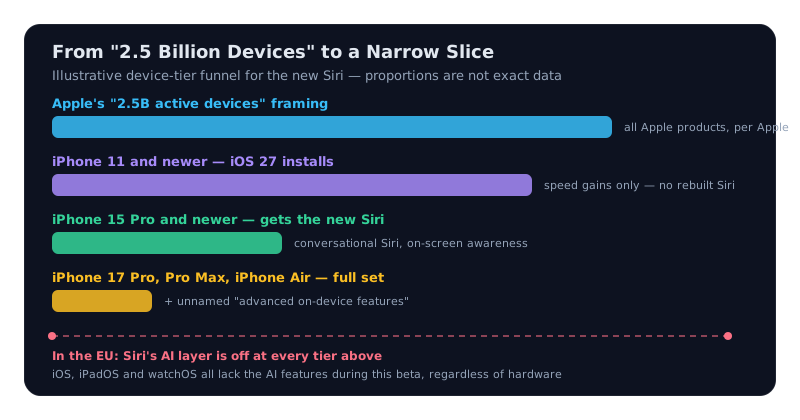
Fewer than the “2.5 billion active devices” framing implies. iOS 27 as an operating system installs on iPhone 11 and newer, including the iPhone SE (2nd generation and later) — that’s the number behind Apple’s install-base bragging rights. But Apple Intelligence, the layer the rebuilt Siri runs on, requires an iPhone 15 Pro or newer, and 9to5Mac notes that some advanced features go further still, limited to the iPhone 17 Pro, iPhone 17 Pro Max, or iPhone Air.
| Device tier | What it gets in iOS 27 |
|---|---|
| iPhone 11 – iPhone 14 (all models) | OS-wide speed gains (faster app launches, AirDrop, Photos) — no rebuilt Siri |
| iPhone 15 Pro / 15 Pro Max and up | Full Apple Intelligence, rebuilt conversational Siri, on-screen awareness |
| iPhone 17 Pro, 17 Pro Max, iPhone Air | Everything above, plus unnamed “advanced on-device features” per 9to5Mac |
| Any device, EU region | OS-wide gains only — Siri’s AI layer is unavailable on iOS, iPadOS, and watchOS in the EU |
So the “largest real-world AI test” is real, but it’s being run on a subset of a subset: only Apple Intelligence-eligible hardware, outside the EU, among the fraction of 2.5 billion device owners who bother to enroll in a public beta at all.
TechCrunch reports that Siri’s foundation models were developed in collaboration with Google, using a distillation process that runs Gemini to produce smaller, efficient models built specifically for Apple Silicon. That processing runs through Apple’s Private Cloud Compute, which Apple says keeps user data private and inaccessible even to Apple itself. Apple is positioning Siri as its answer to Gemini and ChatGPT — while quietly building part of it on Gemini’s own research. That’s not a contradiction so much as a tell: Apple’s AI ambitions still run through whichever lab has the model quality to spare.
How does it actually perform outside a keynote demo?
Unevenly — which is the expected state of a beta 3 build, but still the headline finding from both hands-on reviews. TechCrunch’s testing surfaced concrete misfires: asked about news out of Iran, the new Siri searched contacts instead of answering the question. Engadget’s reviewer was more blunt about the comparison that matters most, writing that Siri “still has a lot to catch up to” versus Gemini and ChatGPT, even while crediting the OS-wide performance work — “the performance improvements make my iPhone feel faster, even on a developer beta.”
The specific gaps both outlets found cluster around integration and polish rather than raw capability. Engadget flagged that third-party app support is incomplete — Gmail specifically isn’t fully supported yet — that Siri can’t navigate into certain phone settings on request, that uploading an image for Siri to analyze gives no confirmation feedback, and that some of the new generative photo-editing tools produce visible AI artifacts. TechCrunch’s contacts-search misfire points at a more basic problem: intent routing, the part of a conversational assistant that decides what a query is actually asking for, still isn’t reliable. It’s the same gap between keynote framing and daily use that shows up whenever big tech’s AI claims meet a public reality check — the demo works, the daily-driver version is still catching up.
A Siri rebuilt on next-generation Apple Intelligence: real conversations, full on-screen awareness, personal-data search across Mail and Messages, app actions, and a dedicated Siri app — running across a 2.5 billion-device installed base.
Available only on iPhone 15 Pro and newer, absent in the EU, with a misrouted query on basic news, incomplete third-party app support (Gmail included), and no confirmation feedback on image uploads — plus visible AI artifacts in some photo edits.
Should developers and everyday users install the public beta right now?
Only if the gap between promise and beta-quality execution doesn’t bother you — a public beta is, by definition, unfinished software, and Apple’s own device-tier table above is the clearest signal of who this release is really for. For third-party developers specifically, the still-incomplete “select third-party apps” integration (Gmail among the notable gaps) means Siri’s promise of deep app actions isn’t yet something to build a workflow around.
Do
- Back up your device through iCloud or a computer before installing any public beta
- Confirm you’re on an iPhone 15 Pro or newer if the rebuilt Siri is the feature you actually want to test
- Expect several days of on-device indexing before Siri’s personal-data search feels reliable
Don't
- Install expecting EU availability — Siri’s AI layer is off in the EU on iOS, iPadOS, and watchOS for now
- Treat beta 3 intent-routing as representative of the fall release — Apple has months left to fix misfires like the Iran-news/contacts mix-up
- Rely on third-party app actions in Gmail or similar unsupported apps yet — that integration is still incomplete
What does this mean for the AI assistant race?
It means Apple has finally entered the live-fire test it spent two years avoiding, against rivals who never paused to wait for it. OpenAI, Google, and Meta have spent that window shipping increasingly agentic assistants of their own, and Apple’s answer arrives not as a lab demo but as a beta running on real people’s primary devices — which is either Apple’s greatest structural advantage (distribution at a scale no AI-first competitor can match) or its biggest liability (a misrouted query now happens on hardware people rely on daily, not in a controlled review unit). Apple’s relationship with OpenAI is already adversarial on a separate front — the two are locked in a trade-secrets lawsuit even as Siri ships built partly on distilled Gemini models, a reminder that “rival” and “supplier” aren’t mutually exclusive in this market.
The device-tier gating is the part worth watching longest. Apple’s Gemini-distilled foundation models suggest the company is comfortable borrowing model quality where it doesn’t have an edge, saving its own differentiation for on-device privacy, OS-level integration, and — per Engadget’s “Write with Siri” and Shortcuts-by-voice features — the connective tissue between an AI assistant and everything else already living on the phone. Whether that’s enough against Gemini and ChatGPT depends less on this beta than on how fast the intent-routing misfires TechCrunch and Engadget both documented get fixed before September’s full release.
Frequently asked questions
When did the iOS 27 public beta with the new Siri come out?
Apple released the first public beta of iOS 27 on July 13-14, 2026, opening the rebuilt, conversational Siri to anyone enrolled in the free Apple Beta Software Program. It's the first time the redesigned assistant has been available outside Apple's developer beta channel. The finished version is expected with iOS 27's full release this fall.
Which iPhones can actually run the new Siri?
iOS 27 itself installs on iPhone 11 and newer, including the iPhone SE (2nd generation and later). But the rebuilt, conversational Siri requires Apple Intelligence, which needs an iPhone 15 Pro or newer — and 9to5Mac reports some advanced on-device features require the iPhone 17 Pro, iPhone 17 Pro Max, or iPhone Air specifically, without naming which ones.
Is the new Siri available in the European Union?
No. According to TechCrunch's reporting, Siri's AI features remain unavailable in the EU across iOS, iPadOS, and watchOS during this beta period, even on qualifying hardware. Apple has not said when that changes, so EU users testing iOS 27 get the OS-wide speed gains but not the rebuilt assistant.
How does the new Siri compare to ChatGPT and Gemini right now?
Early hands-on testing, including Engadget's, found real gains — on-screen awareness, personal-data search, app actions — but concluded Siri 'still has a lot to catch up to' against Gemini and ChatGPT. TechCrunch also documented misfires, including one query about Iran news that returned a contacts search instead of an answer.
Sources & further reading
Keep reading

Google Deep Review Can Challenge a Technical Document. Its Reviewer Still Owns the Call
Google Deep Review offers two weekly checks. Learn what its research pilots show, what they do not prove, and how to handle sensitive drafts.
Google Workspace MCP Clients Face a November Agent-Use Gate
Google will require an agent-use OAuth client marker for Workspace MCP beginning November 11. Ordinary Workspace REST API integrations are unaffected.

NVIDIA Dory Makes Inference Compute a Knob. What Does That Buy?
NVIDIA Dory 1.0 reuses transformer layers at inference. Its adjustable loop count trades more computation for task performance, not free capability.
/* Comments */
Comments are offline right now — we reconnect automatically, nothing is lost.