Meta, OpenAI and xAI Just Crammed Three AI Launches Into One Week
Meta's Muse Image, OpenAI's GPT-5.6 and a new xAI model all landed within days of each other in July 2026 — here's what's actually confirmed.
On this page
This was supposed to be OpenAI’s week. Instead, three separate AI labs ended up occupying the same seven days: Meta pushed out its first image-generation model, OpenAI finally cleared a government security review to take GPT-5.6 fully public, and Elon Musk’s xAI reportedly scrambled to ship a model of its own — built, of all things, with the team behind the coding tool Cursor. Nobody has confirmed the three companies coordinated. What’s confirmed is that none of them blinked and waited for a quieter week.
What did Meta actually launch, and why is it controversial?
Muse Image, Meta Superintelligence Labs’ first image-generation model, went live this week — Meta’s entry into a category OpenAI, Google, and xAI already compete in. Like its rivals, it supports prompt-based image generation and editing. Meta’s own framing is that the model can “act as the creative partner” and help users “turn ideas into high-quality visuals” to share on their feed, story, or chat.
The backlash arrived almost immediately. Muse Image let other users reference someone’s public Instagram content as source material inside their own prompts — meaning a stranger could generate images using another person’s public posts as visual reference, without that person ever being asked. Meta framed it as a default, not an option: opting out required going into settings and turning the feature off yourself.
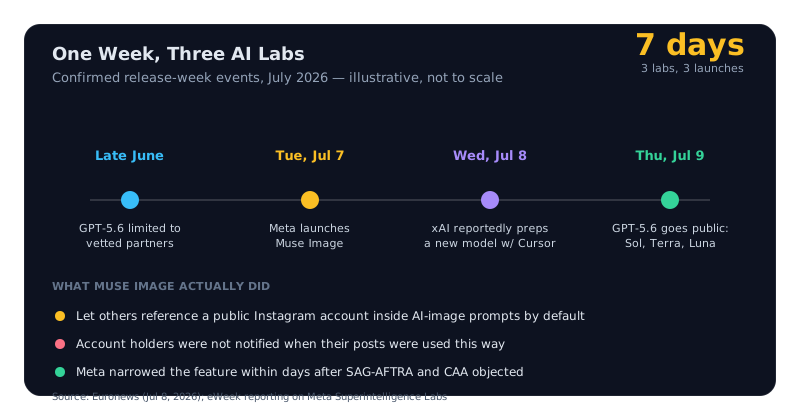
Meta’s own policy language spelled it out: “people may be able to create content with your Instagram content using AI features at Meta,” and account holders “will not be notified about content created using AI features at Meta.” For a platform whose entire business model runs on public sharing, quietly making that same public content raw material for other users’ AI generations was a policy choice, not an accident — and one Meta narrowed within days once SAG-AFTRA and CAA objected publicly.
Why did OpenAI wait until Thursday to go fully public?
Because the US government made it wait. OpenAI first unveiled GPT-5.6 in late June, but access stayed restricted to a small group of vetted partners while officials reviewed the model for national-security risk — concerns that increasingly capable AI systems could be misused for cyber or military purposes. It’s the same basic pattern that played out with Anthropic’s Fable model: release, government-prompted withdrawal, then a later re-release.
The mechanism behind the delay was a June executive order from the Trump administration, establishing a voluntary framework under which AI developers could offer “covered frontier models” to the US government for up to 30 days before releasing them to trusted partners and, eventually, the wider public. OpenAI didn’t hide its frustration with the arrangement. “We don’t believe this kind of government access process should become the long-term default,” the company wrote when the restriction began. “It keeps the best tools from users, developers, enterprises, cyber defenders, and global partners who need them.” OpenAI added that it viewed the delay as “the strongest path to broader availability in the coming weeks,” while it worked with the administration on “a repeatable process for future model releases.”
That process resolved on Thursday, July 9, when OpenAI announced it was releasing the full GPT-5.6 family — Sol, its most advanced model; Terra, a lower-cost mid-tier option; and Luna, its most cost-efficient version — publicly, ending the vetted-partner-only period.
Access limited to a small group of partners while the US government ran a national-security review, under an executive order permitting up to 30 days of government-only access before wider release.
Full public rollout of three tiers — Sol (most advanced), Terra (lower-cost mid-tier), Luna (most cost-efficient) — announced by OpenAI the night before on X.
The rollout schedule itself is the story here as much as the model: for a frontier lab, the AI race increasingly runs through who controls deployment and how governments let a model reach the public, not just what the model can do once it arrives.
What is xAI reportedly shipping the same week?
Something built with the team behind Cursor. Elon Musk’s AI venture, operating as SpaceXAI, was reportedly preparing to release a new model developed with Anysphere, the company behind the widely used AI coding tool Cursor — according to The Information, which cited an internal memo sent to staff. The reported timeline put a release as early as Wednesday, July 8, positioning the model to process information quickly and to compete, in some respects, with Anthropic’s Opus 4.8 and OpenAI’s GPT-5.5.
xAI didn’t put a name to the model in that reporting, but the release landed the same day and picked up a name and a pricing story fast once it actually shipped. Whatever the specifics turned out to be, the timing itself is the notable part: a company built by Musk to move fast chose to move into the busiest AI news week of the summer rather than around it.
Why did Meta crowd into a week it didn’t have to?
Because Meta Superintelligence Labs was built specifically to stop losing weeks like this one — and it needed a public win. The lab was formed in mid-2025 under former Scale AI chief Alexandr Wang, following a recruitment blitz that pulled in more than 50 engineers and researchers, including four former OpenAI scientists, with compensation packages reaching $100 million. That spending spree came after Llama 4 struggled against Google’s Gemini roughly nine months earlier, a stumble that defined Meta’s AI reputation heading into 2026.
The investment hasn’t bought a smooth internal ride. The lab underwent four major reorganizations in six months, splitting into specialized teams, and at least eight staffers left within two months of its formation. Set against that turbulence, shipping a consumer-facing model into the same week as OpenAI’s wide release and xAI’s own launch reads less like confidence and more like urgency — a lab under pressure to show that $100 million comp packages are producing something people can actually use, not just headlines about who got hired and who left.
What should you actually take away from this?
Treat the overlap as a signal about deployment strategy, not a verdict on which lab “won” the week. Leaderboards, government reviews, and PR timing all move on different clocks than model quality does, and this week mixed all three together.
Do
- Check your Instagram AI settings and opt out if you don’t want your public posts used as prompt material for someone else’s Muse Image generation
- Read GPT-5.6’s tier breakdown — Sol, Terra, and Luna aren’t interchangeable, and “GPT-5.6 is out” doesn’t mean one fixed price or capability level
- Expect this compressed-launch-week pattern to recur; treat it as a recurring dynamic between frontier labs, not a one-off scheduling accident
Don't
- Assume Meta, OpenAI, and xAI’s same-week timing was coordinated — nothing in current reporting shows anything beyond three independent release schedules landing close together
- Take “as early as Wednesday” reporting on xAI’s plans as a confirmed launch date — The Information’s sourcing was an internal staff memo, not an official announcement
- Read a single week’s news cycle as proof of which company is “ahead” — deployment control, government relations, and safety review timelines are the real variables in motion
The more durable story isn’t which company shipped first this particular week — it’s that the AI race is no longer just about model capability. It’s about who controls deployment, whose data powers the tools, and where and how they get used once they’re loose. Muse Image’s Instagram default and OpenAI’s month of government-vetted access are two very different versions of the same underlying fight: labs are now managing rollout as carefully as they manage the model itself, because rollout is where the actual controversy — and the actual competitive edge — lives.
Frequently asked questions
What did Meta actually launch this week?
Meta launched Muse Image, its first AI image-generation model, built by Meta Superintelligence Labs. It supports prompt-based image creation and editing, with Meta positioning it as a creative partner that turns ideas into visuals for a user's Instagram feed, story, or chat — the same basic category as rival image generators from OpenAI, Google, and xAI.
Why is Muse Image facing privacy criticism?
Muse Image let other users reference someone's public Instagram content inside their own AI prompts by default. Meta's policy stated people 'may be able to create content with your Instagram content using AI features at Meta' and that account holders 'will not be notified' when this happens — opting out required proactively changing settings, not the reverse.
Why did OpenAI wait until July 9 to release GPT-5.6 publicly?
OpenAI unveiled GPT-5.6 in late June but restricted access to vetted partners while the US government reviewed national-security risks, under a Trump administration executive order letting developers offer 'covered frontier models' to the government for up to 30 days before wider release. Public access — the Sol, Terra, and Luna tiers — opened Thursday, July 9.
What is xAI reportedly releasing the same week?
Elon Musk's xAI, operating as SpaceXAI, was reportedly preparing a new model built with Anysphere, maker of the coding tool Cursor, according to The Information's review of an internal staff memo. The model could ship as early as Wednesday, July 8, and was expected to compete in some respects with Anthropic's Opus 4.8 and OpenAI's GPT-5.5.
Why did three AI labs launch products in the same week?
No source confirms coordination between the labs. Meta Superintelligence Labs — formed mid-2025 under ex-Scale AI chief Alexandr Wang after Llama 4 struggled against Gemini — recruited 50+ engineers with packages reaching $100 million and endured four reorganizations in six months. Shipping Muse Image the same week as two rivals is its clearest sign yet.
/* Comments */
Comments are offline right now — we reconnect automatically, nothing is lost.