Apple Sues OpenAI: Inside the Trade-Secrets Lawsuit That Reads Like a Corporate Spy Thriller
Apple's 41-page federal suit accuses OpenAI's hardware chief and an ex-engineer of stealing trade secrets via codenames and a security bug.
On this page
On July 10, 2026, Apple’s legal team filed a 41-page complaint in the U.S. District Court for the Northern District of California that reads less like a routine corporate dispute and more like a screenplay treatment: a rare authentication bug exploited weeks after an employee’s exit, a company laptop that never came back, job interviews where candidates were reportedly told to bring “actual parts” for show-and-tell, and a $6.4 billion acquisition that pulled Apple’s own former hardware chief into a rival’s orbit. Two years after Sam Altman walked Apple’s campus as it announced ChatGPT’s arrival inside iOS, the two companies are now adversaries in federal court.
What exactly does Apple’s lawsuit allege?
Apple’s core claim is that trade-secret theft wasn’t the work of a rogue employee but a pattern reaching into OpenAI’s leadership. The complaint states plainly: “at every level, from members of its Technical Staff to its Chief Hardware Officer, and in coordination with business partners, OpenAI has been stealing Apple’s trade secrets and confidential information.”
The suit names four defendants: OpenAI itself, hardware subsidiary io Products, and two individuals — Chang Liu and Tang Tan. Apple is asking the court for injunctive relief to stop OpenAI from using the disputed material, monetary damages, declaratory judgments, and orders compelling OpenAI to return confidential files and preserve evidence. An Apple representative told CNBC: “Recently, significant evidence has emerged suggesting individuals employed by OpenAI wrongfully took Apple’s secret and confidential information regarding our unreleased technologies, processes, and products.”
Who are Chang Liu and Tang Tan, and what did they allegedly do?
The complaint’s most granular allegations center on two former Apple employees who now work inside OpenAI’s hardware effort — and the accusations against them are strikingly different in kind.
Liu, a senior systems electrical engineer who spent eight years at Apple, allegedly kept his Apple-issued laptop after departing for OpenAI and, weeks later, discovered a rare, previously unknown authentication bug that let him keep reaching Apple’s confidential hardware files remotely. Rather than report it, Apple alleges Liu used the bug to download dozens of files — technical specifications, engineering presentations, and unreleased product data — and coached a colleague still employed at Apple on how to copy similar material without tripping internal security.
Tan’s alleged conduct is different: it’s about recruiting, not hacking. He spent roughly 24 years at Apple as vice president of product design for the iPhone and Apple Watch before leaving for io Products in 2024, and now runs OpenAI’s hardware division as its Chief Hardware Officer. Apple alleges he used the company’s confidential internal codenames while interviewing prospective hires and, more brazenly, “directed job candidates still working for Apple to bring ‘actual parts’ from Apple to their interviews for ‘show and tell’ sessions in which he and his team at OpenAI can elicit still more Apple confidential information.”
Allegedly kept an Apple laptop after leaving and exploited a rare authentication bug to keep pulling confidential hardware files for weeks — then allegedly coached a still-employed colleague on evading security.
Now OpenAI’s Chief Hardware Officer. Allegedly used Apple’s internal project codenames while recruiting, and told job candidates still at Apple to bring “actual parts” to interviews.
Buried in the complaint is a narrower, physical allegation: Apple says it believes OpenAI has been asking hardware manufacturing partners to carry out a metal-finishing technique Apple invented — while “misleading the partner to believe they had Apple’s permission to do so,” per CNBC. It’s a small claim inside a 41-page filing, but it’s the one that most directly connects the alleged theft to the unreleased device OpenAI is actually trying to build.
Why is io Products named but Jony Ive isn’t?
io Products — the hardware design startup co-founded by Apple’s former chief design officer Jony Ive — is listed as a co-defendant alongside OpenAI itself. OpenAI acquired the company in 2025 for $6.4 billion specifically to build its own consumer AI hardware, and Tan’s path from Apple to io Products to OpenAI’s hardware division traces that acquisition directly. Yet Ive is not personally accused of any wrongdoing anywhere in the complaint — a pointed omission in a filing that otherwise names individuals by name. OpenAI hasn’t said what the device is or when it ships; CEO Sam Altman said in November that the company had finished its first hardware prototypes.
Why is this happening now?
The relationship wasn’t always adversarial. In 2024, Apple integrated ChatGPT into iOS as part of Apple Intelligence, and Altman visited Apple’s headquarters for the announcement. That partnership has visibly cooled since: Apple’s revamped Siri, shipping this fall, runs on Google’s Gemini models instead of OpenAI’s technology, and OpenAI’s move into hardware puts it in direct competition with Apple’s core business. TechCrunch reports Apple sent OpenAI a warning letter in February 2026 raising these exact concerns — and received no response, five months before filing suit.
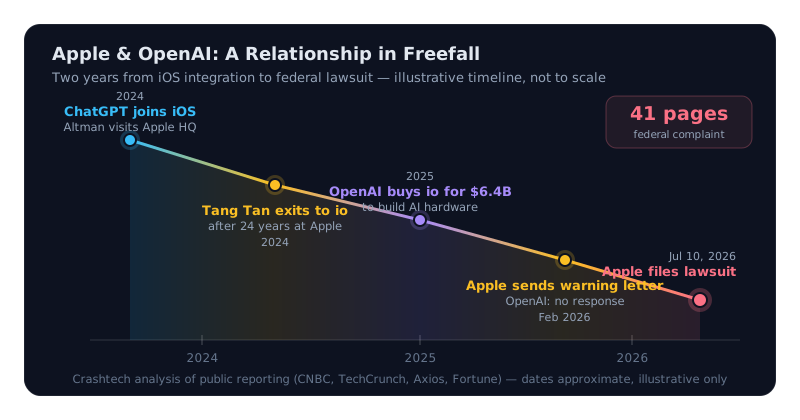
| Date | Event |
|---|---|
| 2024 | ChatGPT integrated into iOS via Apple Intelligence; Altman visits Apple HQ |
| 2024 | Tang Tan leaves Apple after ~24 years to join io Products |
| 2025 | OpenAI acquires io Products for $6.4 billion |
| Feb 2026 | Apple sends OpenAI a warning letter; no response, per TechCrunch |
| Fall 2026 | Apple’s revamped Siri ships on Google Gemini, not OpenAI’s models |
| Jul 10, 2026 | Apple files its 41-page lawsuit in the Northern District of California |
What should AI companies — and engineers switching jobs — take from this?
Whatever the court ultimately finds, the complaint is a live case study in how trade-secret exposure actually happens: not through espionage novels, but through offboarding gaps, casual interview small talk, and unreported bugs.
Do
- Revoke former employees’ cloud and system access same-day, not days or weeks after departure
- Report any inherited access bug to the system’s owner, even months after you’ve left the company
- Keep interview questions about a candidate’s prior employer general — never ask for internal codenames, specs, or physical parts
Don't
- Assume a “we have no interest in trade secrets” statement substitutes for auditing what departing hires actually took
- Ask job candidates to bring former employers’ hardware or confidential terminology into an interview
- Sit on knowledge of a security bug — silence between discovery and disclosure is exactly what a trade-secret complaint is built to highlight
What happens next?
The case is in its earliest stage — a complaint, not a verdict — and OpenAI has offered only a blanket denial so far, with a company representative saying: “We have no interest in other companies’ trade secrets. We remain focused on building innovative technology that empowers people everywhere.” Apple’s demands, though, are concrete: stop OpenAI from using the disputed material, hand back confidential files, preserve evidence, and pay damages.
The timing compounds the pressure. OpenAI is simultaneously gearing up for what’s expected to be a historic IPO, a run-up we’ve tracked in detail in OpenAI’s shaky trillion-dollar financials — and a federal trade-secrets suit naming the company’s own hardware chief is not the kind of headline that IPO roadshow decks are built to survive. Whether Apple’s allegations hold up in discovery or get whittled down in motions, the lawsuit has already done one thing for certain: it’s put OpenAI’s unreleased hardware device, and the Apple veterans building it, under a federal microscope before the product has even shipped.
Frequently asked questions
What is Apple accusing OpenAI of in its lawsuit?
Apple's 41-page complaint, filed July 10, 2026 in the Northern District of California, accuses OpenAI of trade-secret theft "at every level, from members of its Technical Staff to its Chief Hardware Officer, and in coordination with business partners." Apple is seeking injunctions, damages, and an order forcing OpenAI to stop using its confidential information.
Who are Chang Liu and Tang Tan?
Both are former Apple employees now named as individual defendants. Chang Liu, an ex-senior systems electrical engineer who spent eight years at Apple, allegedly exploited an authentication bug to download confidential files after leaving. Tang Tan, OpenAI's Chief Hardware Officer and a 24-year Apple veteran, allegedly used Apple's internal codenames while recruiting Apple staff for OpenAI.
What role does io Products play in the case?
io Products, the hardware startup co-founded by former Apple design chief Jony Ive, is named as a defendant alongside OpenAI. OpenAI acquired io for $6.4 billion in 2025 to build its own AI hardware device. Ive himself is not personally accused of wrongdoing anywhere in Apple's complaint.
How has OpenAI responded to the allegations?
OpenAI issued a short statement: "We have no interest in other companies' trade secrets. We remain focused on building innovative technology that empowers people everywhere." The company has not publicly addressed the specific claims involving Chang Liu's file downloads, the authentication bug, or Tang Tan's recruiting conduct in detail.
What is Apple asking the court to do?
Apple's suit seeks injunctive relief barring OpenAI from using the disputed trade secrets, monetary damages, and declaratory judgments, plus orders requiring OpenAI to return confidential materials and preserve evidence. io Products, the hardware startup OpenAI acquired for $6.4 billion, is named as a co-defendant alongside OpenAI itself.
Sources & further reading
Keep reading

OpenAI's Rosalind Academic Plan Has a Narrow Lab-Shaped Door
The Rosalind Academic Plan offers up to 30 seats for eligible US university labs for up to a year, but excludes API access and requires trusted-access review.
The 'AI Washing' Debate: Is Big Tech Using AI to Disguise Mass Layoffs?
AI mentions on earnings calls surged 310% in early 2026. With AI now the top cited reason for US job cuts, the line between strategy and spin blurs.
The $1.65 Trillion Time Bomb: The Off-Balance-Sheet Debt Powering the AI Boom
Big Tech carries $1.65 trillion in hidden off-balance-sheet compute obligations, exceeding its $1.35 trillion in reported debt. What happens next?
/* Comments */
Comments are offline right now — we reconnect automatically, nothing is lost.