TSMC Posted a Record Profit — Chip Stocks Had a Brutal Week Anyway
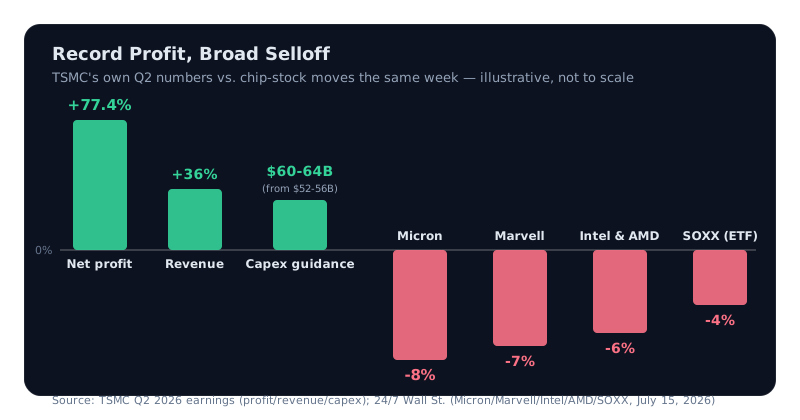
TSMC's Q2 profit jumped 77.4% to a record NT$706.6B and it raised 2026 capex to $60-64B, the same week Micron's CXMT scare sent chip stocks lower.
On this page
Beat-and-raise quarters are supposed to be simple good news. On July 16, 2026, Taiwan Semiconductor Manufacturing Co. delivered everything a beat-and-raise quarter is supposed to deliver — record profit, revenue ahead of estimates, a headline-grabbing $100 billion increase to its Arizona build-out — and buried in the same release was a number that complicates the good-news story: a freshly raised capital-expenditure budget that told investors the world’s most important chipmaker plans to spend even more before it sees a cent of extra return. That landed in the same week a Chinese memory maker’s rise sent Micron reeling 8% in a single session, dragging Intel, AMD, and Marvell down with it. Two chip stories, one week, and the same underlying question — has AI-chip spending outrun what investors are willing to underwrite?
What did TSMC actually report on July 16?
TSMC’s fiscal Q2 2026 (ended June 30) delivered a fifth consecutive record-profit quarter: net income of NT$706.56 billion, up 77.4% year-over-year, on consolidated revenue of NT$1.27 trillion — $40.20 billion in US dollar terms, up 36% year-over-year in NT$ terms. Both lines beat what Wall Street had modeled: analysts had penciled in NT$632.64 billion in net income and NT$1.264 trillion in revenue. Profitability held up too — gross margin came in at 67.7%, operating margin at 60.3%, net margin at 55.6% — figures that would be extraordinary for almost any industrial company, let alone one running $60 billion-plus in annual capital spending.
The engine, unsurprisingly, was AI. High-performance computing — TSMC’s category for AI accelerators and related silicon — accounted for 66% of second-quarter revenue, with smartphones a distant second at 22%. Advanced nodes of 7-nanometer or smaller made up 77% of wafer revenue, split between 5-nanometer (33% share) and 3-nanometer (30% share) — the process nodes powering the newest AI accelerators and flagship phones. For the third quarter, TSMC guided to $44.6-45.8 billion in revenue and 56-58% operating margin, implying the growth run isn’t slowing.
Why did TSMC raise spending right after a record quarter?
Because the same release that showed record profit also showed TSMC committing to spend significantly more, well before that spending shows up as cash back to shareholders. CEO C.C. Wei used the earnings announcement to reveal $100 billion in additional investment in Arizona, lifting TSMC’s total committed spending in the state to $265 billion. Wei said the funds would go toward wafer fabrication facilities capable of 2-nanometer mass production plus advanced packaging capacity, and indicated roughly four more plants could eventually be built there on top of the eight already announced or underway — though he said timing would hinge on how market conditions develop. “We believe this investment will help to further foster the development of the U.S. semiconductor ecosystem, strengthen the supply chain, and support an increasing number of high-tech, high-paying jobs in the United States,” Wei said.
Alongside the Arizona news, TSMC raised its full-year 2026 capital-expenditure guidance to a range of $60-64 billion, up from the $52-56 billion it had guided to previously, and said aggregate spending over the next three years would exceed the prior three-year period. That combination reads less like confidence and more like a bill coming due: higher capex today means lower free cash flow now, heavier depreciation later, and a longer wait before that spending converts into returned capital. It’s the trade-off buried under the record numbers — a company funding a record profit and an even bigger spending plan in the same breath, while asking investors to wait longer to see it come back as cash.
Nothing in TSMC’s Q2 numbers points to weakening AI demand — HPC revenue share and advanced-node mix both climbed. What complicates the picture is TSMC telling investors, in the same breath as a record quarter, that it needs to spend even more just to keep up. When the company building the chips keeps raising its own spending forecast, that’s a live data point in the debate over whether AI infrastructure spending is a moat or a treadmill.
What’s the Micron connection?
TSMC’s spending plans weren’t the only chip story rattling investors that week — Micron had already taken a much harder hit a day earlier, for a completely different reason. On July 15, 2026, Micron shares dropped 8% to $903.50 in early trading as concerns mounted that Chinese competition in memory chips is intensifying. The specific trigger: ChangXin Memory Technologies (CXMT), now the world’s fourth-largest DRAM producer, is reportedly having its chips tested by Apple for devices sold in China — a signal that a homegrown Chinese supplier is closing in on qualifying for one of the industry’s most demanding customers. Electric-vehicle maker Nio has also put $23.3 million into CXMT, another sign of Chinese industrial backing building behind the company.
The selloff didn’t stay contained to Micron. Intel and AMD both fell 6%, Marvell dropped 7%, and the iShares Semiconductor ETF (SOXX) slid 4% to $546.72 — even though none of those three companies compete directly with Micron in memory chips. That’s sector-wide, risk-off positioning: SOXX holds all of them, and when one high-profile name gets hit on a structural threat, the whole basket gets marked down with it. The move also followed a serious run-up worth noting — Intel was up 177% year-to-date, AMD up 142%, and Marvell up 145% before the drop, so part of the pullback reflects profit-taking on stretched gains as much as new fear.
Beat every estimate on the table for Q2 2026, then raised 2026 capex guidance to $60-64 billion and added $100 billion to its Arizona build-out — a spending hike that pressures near-term free cash flow even as the operating numbers keep improving.
Dropped on no earnings news at all — just a competitive threat. ChangXin Memory Technologies (CXMT), China’s rising DRAM maker, is reportedly being tested by Apple, dragging Intel (-6%), AMD (-6%), and Marvell (-7%) down with it.
| Metric | Q2 2026 | vs. estimate / prior guidance |
|---|---|---|
| Net income | NT$706.56B | +77.4% YoY, beat NT$632.64B estimate |
| Revenue | NT$1.27T ($40.20B) | +36% YoY (NT$), beat NT$1.264T estimate |
| Gross margin | 67.7% | operating margin 60.3%, net margin 55.6% |
| HPC (AI) share of revenue | 66% | vs. 22% smartphones |
| 2026 capex guidance | $60-64B | raised from $52-56B |
| Arizona total commitment | $265B | +$100B announced this quarter |
| Q3 2026 revenue guidance | $44.6-45.8B | operating margin 56-58% |
Is this an AI chip glut signal, or just a valuation reset?
TSMC’s own operating numbers argue against a glut. Chip stocks had already lost roughly $1.3 trillion in market value in early July on fears that AI infrastructure spending might plateau, and that same coverage flagged TSMC’s July 16 earnings as the next real test of the demand story. TSMC’s answer: AI-linked HPC revenue grew as a share of the business, advanced-node mix held up, and the company raised its own spending forecast rather than pulling back. That’s the opposite of a company anticipating a demand air pocket. What’s actually being tested is the market’s tolerance for how much a chipmaker should spend to stay ahead — a question sharpened by the same week’s China-driven selloff in Micron, Intel, AMD, and Marvell, and one that arrives just days after SK Hynix priced the largest foreign IPO in US history on the strength of that same AI memory boom.
Do
- Separate TSMC’s operating numbers (record profit, growing AI/HPC share) from its spending story (a $60-64B capex plan that pressures near-term free cash flow)
- Track free-cash-flow trajectory, not just the profit headline — a capex hike from $52-56B to $60-64B pressures FCF well before it shows up as revenue
- Treat Micron and TSMC as two distinct risk stories: one is spending-driven margin pressure, the other is a China-based competitive threat
Don't
- Don’t read TSMC’s bigger capex bill as evidence AI chip demand is slowing — HPC revenue share and advanced-node mix both grew this quarter
- Don’t assume Intel, AMD, and Marvell fell because of memory-chip competition — none of them compete directly with Micron in DRAM
- Don’t treat CXMT as an immediate threat to TSMC — the competitive pressure reported so far is specific to Micron’s DRAM business, not TSMC’s foundry model
What does this mean for developers and AI-native teams?
Nothing about this week’s numbers changes near-term chip supply. TSMC didn’t cut capacity — it raised its spending plan and its Q3 revenue guidance ($44.6-45.8 billion) in the same release. The more relevant signal for anyone budgeting multi-year AI infrastructure costs is what this pattern reveals about investor patience: capital markets are scrutinizing chip-sector capex the way they scrutinize any other capital-intensive bet, likely to discount spending increases until they convert into cash flow. That’s a preview of how the next few AI-hardware earnings cycles are likely to be read — profit beats will keep happening, but the spending line is now getting read just as closely as the headline number.
Frequently asked questions
How much profit did TSMC report for Q2 2026?
TSMC posted net income of NT$706.56 billion for the quarter ended June 30, 2026, up 77.4% year-over-year and its fifth straight record quarter. Revenue reached NT$1.27 trillion ($40.20 billion), up 36% year-over-year in NT$ terms, beating analyst estimates of NT$632.64 billion in profit and NT$1.264 trillion in revenue.
Why did TSMC raise spending even after a record quarter?
Even after beating estimates on both revenue and profit, TSMC raised its 2026 capital-expenditure guidance to $60-64 billion from $52-56 billion and announced $100 billion more in Arizona spending, bringing that commitment to $265 billion. The higher spending pressures near-term free cash flow, and total three-year capex is now set to exceed the prior three-year period.
How much is TSMC now investing in Arizona?
CEO C.C. Wei announced an additional $100 billion for TSMC's Arizona operations, bringing the company's total committed investment there to $265 billion. The funds are expected to build roughly four more plants beyond the eight already underway, aimed at 2-nanometer mass production and advanced packaging, though Wei said timing depends on market conditions.
What happened to Micron and other chip stocks that same week?
On July 15, 2026, Micron shares dropped 8% to $903.50 as fears intensified that China's ChangXin Memory Technologies (CXMT), now the world's fourth-largest DRAM maker and reportedly being tested by Apple, threatens its pricing power. Intel and AMD fell 6%, Marvell fell 7%, and the SOXX semiconductor ETF dropped 4%.
Does this signal an AI chip glut?
Not conclusively. TSMC's own numbers show AI-linked high-performance computing demand still growing, at 66% of Q2 revenue, and it raised rather than cut its spending outlook. The same week's broader chip-stock selloff traces to a separate story — memory-chip competition fears from China hitting Micron, Intel, AMD, and Marvell — rather than evidence of falling AI chip demand.
/* Comments */
Comments are offline right now — we reconnect automatically, nothing is lost.