Anthropic Is Racing OpenAI to Go Public — and Betting the Real Money Is in Deployment, Not Models
Anthropic started IPO investor meetings for an October listing at $965B, while its Ode venture bets deployment beats models.
On this page
Two Anthropic stories broke within days of each other in mid-July 2026, and they only make sense read together. One is about becoming a public company. The other is about admitting, in effect, that the model itself isn’t where the durable margin lives — that the harder, stickier, more billable problem is getting enterprises to actually use the thing.
What did Anthropic actually announce on July 15?
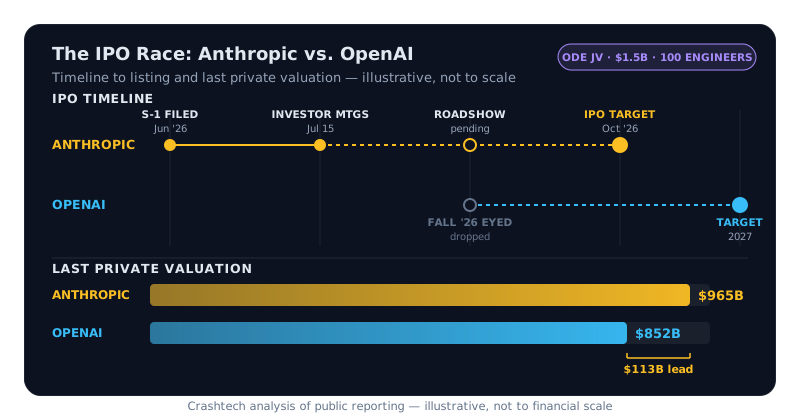
Anthropic started meeting investors ahead of a potential IPO, aiming for a debut as soon as October 2026. The company confidentially filed its IPO prospectus with the SEC in June, and July’s investor meetings are the intermediate step — after the paperwork, before the public roadshow — where banks test how much institutional demand actually exists for a listing this size.
Goldman Sachs, Morgan Stanley, and JPMorgan Chase, Wall Street’s three biggest banks by revenue, are running the offering. That’s not a syndicate assembled for a routine tech listing; it’s the bench you put together when you expect the deal to be oversubscribed and scrutinized in equal measure.
The backdrop matters. Anthropic’s last private mark was $965 billion, set in a May 2026 Series H round that itself raised $65 billion — one of the largest single funding rounds in tech history. For the first time, that valuation puts Anthropic ahead of OpenAI’s reported $852 billion figure. OpenAI, which had once eyed a fall 2026 listing of its own, has since pushed its timeline to 2027, effectively ceding the “first frontier AI lab to go public” milestone to Anthropic if October holds. Neither company set out to race the other publicly, but the calendar makes the competition impossible to ignore — and OpenAI’s own leaked financials are part of why the timing looks so pointed.
Why is Anthropic betting on deployment instead of just the model?
Because the same week it was courting IPO investors, Anthropic was quietly scaling a business built on the premise that selling access to a model is the easy part — getting a company to actually rewire its workflows around it is the hard, expensive, defensible part.
Ode with Anthropic is a $1.5 billion joint venture launched in May 2026, backed by private equity giant Blackstone, Hellman & Friedman, and Goldman Sachs. Its first move, made shortly after launch, was acquiring Fractional AI, an AI engineering services startup that wound down an 11-month partnership with OpenAI to join — a detail that reads less like coincidence and more like a marker of where technical talent thinks the next phase of the AI build-out actually pays. Ode now employs 100 engineers, described by leadership as “elite generalist software engineers,” with more than half being former founders.
Ode CEO Chris Taylor, a Fractional AI co-founder, put the ambition plainly: “It’s pretty easy to imagine this as a trillion-dollar company someday if we execute well.” He also flagged the real constraint isn’t demand — it’s maintaining quality while growing that fast. Eddie Siegel, Ode’s chief technologist, went further on where the value actually sits: “Model selection matters, but it’s not where the majority of calories are spent.” Ode operates on a “Claude-first” principle but will use competing models when a client’s problem calls for it — a tell that even Anthropic’s own implementation arm doesn’t treat model loyalty as the product.
What’s the actual argument being made here?
The argument is that AI implementation, not the underlying model, is becoming the scarcer resource — and therefore the more valuable one. Foundation models are converging on capability and getting cheaper to access; what’s genuinely hard to find is the engineering talent that can take a frontier model and rebuild a company’s actual workflows around it without breaking everything downstream. Taylor’s framing was explicit: Ode targets companies where AI implementation is “the top one or two priority for the CEO,” not a side experiment run by an innovation team with no budget authority.
That’s a bet on services economics, not software economics — high-touch, engineer-hours-heavy, harder to scale than API calls, but also harder for a cheaper competitor to undercut. It’s the enterprise-software playbook (see: every consulting arm ever bolted onto an ERP vendor) applied to frontier AI, except this time the parent company supplying the model has equity in the implementation layer too.
Confidential S-1 filed June 2026. Investor meetings started July 15. Target debut as soon as October 2026. Banks: Goldman Sachs, Morgan Stanley, JPMorgan Chase. Aims to list ahead of OpenAI, which has pushed its own IPO to 2027.
Launched May 2026 with Blackstone, Hellman & Friedman, Goldman Sachs — its first move was acquiring Fractional AI. Now 100 engineers, over half ex-founders. CEO Chris Taylor: “easy to imagine this as a trillion-dollar company.”
Does this actually change anything for developers building on Claude?
It signals where Anthropic thinks the growth curve bends next — and it’s not purely in model releases. If the company that trains Claude is simultaneously building (and funding, via Blackstone and Goldman) a services arm to sell Claude implementation at scale, that’s a strong hint that raw model capability is treated internally as necessary but not sufficient for revenue growth. Developers and technical leads evaluating Claude for enterprise deployment should read Ode less as an isolated venture and more as Anthropic’s own admission of what the hard part of adoption actually looks like: integration debt, workflow redesign, and the “top one or two priority for the CEO” problem Taylor described — not benchmark scores.
Do
- Track Anthropic’s actual S-1 disclosures once public, not the pre-IPO valuation headline alone
- Treat Ode’s Fractional AI acquisition as a signal about where implementation talent is consolidating
- Watch whether “Claude-first” implementation shops stay model-agnostic in practice, not just in messaging
Don't
- Assume October is locked — confidential S-1 filings don’t fix a listing date
- Conflate Anthropic’s $965B private valuation with any confirmed IPO price or public market cap
- Treat Chris Taylor’s “trillion-dollar company” line as an Anthropic corporate forecast — it’s Ode’s CEO, one step removed
What should you actually watch next?
Three things, in order of how soon they’ll resolve. First, whether Anthropic’s investor meetings convert into a formal roadshow on schedule — that’s the next concrete checkpoint before October. Second, whether OpenAI’s 2027 slip holds or gets pulled forward if Anthropic’s debut goes well, given how directly the two companies are now being valued against each other ($965B versus $852B). Third, whether Ode’s engineer count and client roster keep growing at the pace that would make Taylor’s trillion-dollar framing look prescient rather than promotional — 100 engineers and one acquisition is early proof of concept, not proof of scale.
None of this is settled. A confidential filing can stall in SEC review, a roadshow can go quiet, and joint ventures backed by private equity have a well-documented habit of overshooting their own ambition. But the pattern — a frontier lab racing toward public markets while simultaneously building an internal services arm to sell its own product’s implementation — is a genuinely new structure for this industry, and worth watching independent of whether either number, $965 billion or “trillion-dollar,” ever prints. For more on how IPO windows are opening across the AI supply chain this summer, see SK Hynix’s record Nasdaq debut, which reopened investor appetite for exactly this kind of mega-cap listing just days before Anthropic’s own meetings began.
Frequently asked questions
When could Anthropic go public?
Anthropic is targeting a debut as soon as October 2026, though the timing could still slip. It confidentially filed an IPO prospectus with the SEC in June 2026 and began investor meetings with bankers on July 15, 2026, ahead of a formal roadshow — the step before pricing and listing.
How much is Anthropic worth, and how does that compare to OpenAI?
Anthropic was valued at $965 billion in its May 2026 Series H round, which raised $65 billion. That figure puts Anthropic ahead of OpenAI's reported $852 billion valuation for the first time, even as OpenAI — which once eyed a fall 2026 listing — has pushed its own IPO timeline to 2027.
Which banks are running Anthropic's IPO?
Goldman Sachs, Morgan Stanley, and JPMorgan Chase — Wall Street's three largest banks by revenue — are managing the offering. July's investor meetings sit between the confidential S-1 filing and a public roadshow, letting banks gauge institutional appetite before committing to terms.
What is Ode with Anthropic, and why does it matter?
Ode is a $1.5 billion AI-implementation joint venture Anthropic launched in May 2026 with backers Blackstone, Hellman & Friedman, and Goldman Sachs, acquiring services firm Fractional AI as its first move. It has since grown to 100 engineers, betting that helping enterprises actually deploy AI is worth more than the models themselves.
Is Ode's 'trillion-dollar company' claim from Anthropic?
No — it's from Ode CEO Chris Taylor, a Fractional AI co-founder, not from Anthropic itself. Taylor said it's 'pretty easy to imagine this as a trillion-dollar company someday if we execute well,' framing implementation services, not model-building, as the bigger and more durable business opportunity.
/* Comments */
Comments are offline right now — we reconnect automatically, nothing is lost.