IBM Just Had Its Worst Trading Day in 115 Years
IBM stock crashed 25.2% on July 14, 2026, erasing $67 billion after a modest earnings miss — worse than Black Monday 1987.
On this page
A company that survived two world wars, the mainframe era, the dot-com bust, and the 2008 crash just had its single worst trading day ever — and the earnings miss that caused it was, by historical standards, small. That gap between cause and effect is the actual story.
What happened on July 14?
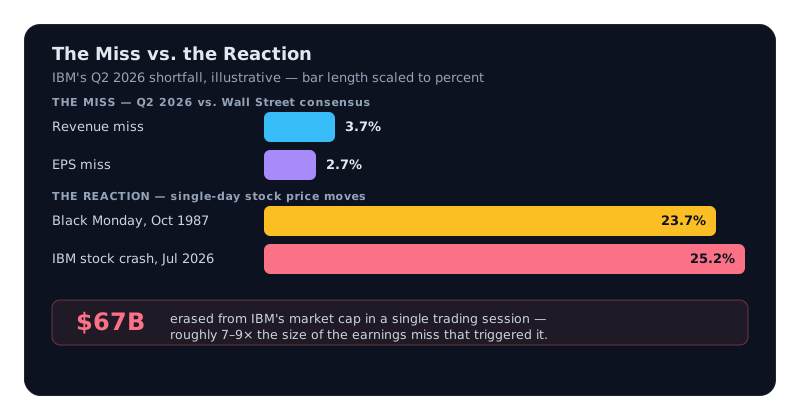
IBM stock fell 25.2%, closing around $217 a share and wiping out roughly $67 billion in market capitalization in a single session, dropping the company’s valuation to just under $205 billion. It is the largest one-day decline in IBM’s 115-year history, exceeding the 23.7% the stock lost on Black Monday, October 19, 1987, when the entire market crashed simultaneously.
This time was different in one crucial way: the market didn’t crash. IBM did. The trigger was a preliminary second-quarter update, released ahead of the company’s scheduled July 22 earnings call, showing adjusted earnings per share of $2.93 against a Wall Street consensus of $3.01, and revenue of $17.2 billion versus $17.86 billion expected — a shortfall of roughly $660 million.
Why did a ~3% miss cause a 25% crash?
Because the number that spooked investors wasn’t the miss itself — it was what CEO Arvind Krishna said caused it. In a letter to shareholders, Krishna wrote: “These conditions require our teams to execute perfectly, and this quarter we faltered. We did not adapt and move quickly enough, and numerous large deals failed to close on the timelines we expected, driving the majority of our shortfall.”
Krishna’s explanation: in the final weeks of June, IBM’s enterprise clients redirected quarterly capital spending away from software and infrastructure contracts and toward servers, storage, and memory chips — racing to lock in supply-constrained hardware ahead of anticipated price increases. IBM said it had planned for some supply-chain disruption, but not for the scale of the reprioritization.
IBM’s revenue missed by about 3.7% and EPS missed by about 2.7%. The stock fell 25.2% — roughly seven to nine times the size of the underlying miss. That mismatch is what turned an earnings warning into a historic crash: investors weren’t just pricing in one soft quarter, they were repricing whether IBM’s entire software growth story still holds up in an AI capex cycle.
Where did the money actually go?
Krishna’s explanation points directly at the AI chip and memory supply crunch that’s been reshaping enterprise budgets all year. Clients weighing a choice between signing a software contract or securing hardware capacity before prices rise chose the hardware — a rational move for any buyer who believes memory and server supply will only get tighter. The same dynamic that sent SK Hynix’s Nasdaq listing soaring on memory-chip demand is, on IBM’s telling, the reason its software pipeline stalled.
| Q2 2026 (preliminary) | Wall Street expected | IBM reported |
|---|---|---|
| Revenue | $17.86B | $17.2B |
| Adjusted EPS | $3.01 | $2.93 |
| Stock reaction | — | -25.2% |
Did the panic spread beyond IBM?
Partially. Software peers Microsoft, Salesforce, ServiceNow, and Intuit each fell roughly 2% to 5% the same day, as investors marked down other enterprise-software names exposed to the same capex-diversion risk. But the broader Nasdaq 100 index still closed higher, meaning this wasn’t a market-wide flight from tech — it was a targeted repricing of software companies whose growth stories assume steady enterprise IT budgets rather than budgets increasingly captured by AI hardware.
Wall Street’s sell-side response was swift and mixed. BofA cut its price target from $330 to $280 while keeping a Buy rating, arguing IBM remains “well positioned” once execution issues clear. HSBC downgraded the stock from Hold to Reduce, cutting its target from $231 to $191 on the view that IBM’s valuation was stretched relative to the sector. Goldman Sachs was blunter, warning the results would “fully validate the software bear case scenario” that bears had been making for months.
Revenue: $17.86B. EPS: $3.01. A steady, single-digit-growth enterprise software and mainframe business, largely insulated from AI infrastructure swings.
Revenue: $17.2B. EPS: $2.93. Large deals slipping, clients rerouting budgets to memory and servers, and a CEO letter admitting the company “faltered.”
What does this mean for how AI-era earnings get read?
It means the market is now hunting for AI-bubble evidence in ordinary earnings misses — and finding it. Fortune’s coverage framed the IBM crash as a sign of a potential “earnings bubble,” distinct from a valuation bubble: the risk isn’t that AI stocks are simply priced too high, but that the profit and growth assumptions baked into those prices are themselves inflated by capex spending that could just as easily reverse or redirect, as it did here. A single quarter of clients preferring memory chips over software licenses was enough to erase $67 billion.
For developers and technical leaders watching enterprise IT budgets, the read-through is concrete: capex is being actively reallocated in real time between software and infrastructure line items, and vendors on the losing side of that reallocation can get repriced violently even on modest misses. If your product sells into enterprise IT budgets, “AI adjacent” is no longer automatically a tailwind — it can be a budget line someone else is now competing for.
Do
- Separate the size of an earnings miss from the size of the market’s reaction — they measure different things
- Read CEO language in preliminary warnings closely; “did not adapt quickly enough” is an admission, not boilerplate
- Track where enterprise capex is actually flowing (hardware vs. software) before assuming a vendor’s growth story is intact
Don't
- Don’t assume a 25% crash means the underlying business collapsed by 25% — the reaction reflects repriced expectations, not realized losses
- Don’t treat one company’s warning as proof of a market-wide AI bubble without checking whether the selloff was broad or narrow
- Don’t ignore analyst target cuts that keep a Buy rating (like BofA’s) — they signal a thesis under strain, not abandoned
The bottom line
IBM’s crash is a reminder that in an AI capex cycle, “beating expectations” and “keeping your customers’ budget” are no longer the same test. A company with 115 years of trading history just had its worst day not because a war broke out or a bank failed, but because enterprise buyers, given a choice between software and hardware in a supply-constrained quarter, chose hardware. Whether that’s a one-quarter blip or the first visible crack in the “AI earnings bubble” story is exactly what the market will spend the rest of 2026 trying to figure out — starting with IBM’s full Q2 report on July 22.
Frequently asked questions
Why did IBM stock crash 25% on July 14, 2026?
IBM shares fell 25.2% to close near $217 after a preliminary Q2 warning showed adjusted EPS of $2.93 versus a $3.01 consensus, and revenue of $17.2 billion versus $17.86 billion expected. CEO Arvind Krishna said clients diverted spending toward memory chips and servers, stalling large software deals and driving most of the shortfall.
How does this compare to IBM's Black Monday crash?
IBM's 25.2% single-day drop topped the company's previous worst day, October 19, 1987's Black Monday, when the stock fell 23.7% alongside a market-wide crash. This time the selloff was narrower: the Nasdaq 100 broadly rose the same day, meaning investors were repricing IBM and software specifically, not panicking across the market.
What did CEO Arvind Krishna say caused the miss?
In a letter to investors, Krishna wrote: "These conditions require our teams to execute perfectly, and this quarter we faltered. We did not adapt and move quickly enough, and numerous large deals failed to close on the timelines we expected, driving the majority of our shortfall."
Did the crash spread to other tech stocks?
Yes, but selectively. Software peers including Microsoft, Salesforce, ServiceNow, and Intuit fell roughly 2% to 5% the same day. The broader Nasdaq 100 still rose, suggesting investors were repricing enterprise-software exposure to AI capex shifts rather than fleeing the entire tech sector.
Is this evidence of an AI earnings bubble?
It's the data point analysts are pointing to. A roughly 3% EPS miss triggering a 25% stock collapse is a wildly disproportionate reaction, which Fortune's coverage framed as evidence of an 'earnings bubble' — where the risk is that AI-era profit expectations, not just stock valuations, have become inflated.
/* Comments */
Comments are offline right now — we reconnect automatically, nothing is lost.