Chinese Open-Weight Models Now Beat US Models on Hugging Face Downloads
Chinese open models hit 41% of Hugging Face downloads this spring and now fill OpenRouter's top six, with Claude Opus 4.7 down at seventh.
On this page
For two years, the AI industry’s scoreboard was simple: whoever had the best frontier model won the news cycle, the funding round, and the developer mindshare. That scoreboard just stopped measuring what actually matters. The numbers coming out of Hugging Face and OpenRouter this month describe a different contest entirely — one being fought over cost, customizability, and who controls the weights — and right now Chinese labs are winning it by a wide margin.
What actually happened on Hugging Face this spring?
Chinese open-weight models pulled ahead of US models in raw download share. Reporting published July 14, 2026 puts the number at 41% of all Hugging Face downloads this spring going to Chinese open-weight releases, enough to surpass US models on the platform for the first time. Hugging Face itself is not a niche corner of the internet — the platform is adding a new repository roughly every seven seconds, hosts close to three million public models, and counts roughly half of the Fortune 500 among its users.
Download share is a blunt instrument. It doesn’t distinguish between a developer pulling weights to run a serious production workload and a researcher grabbing a model once to benchmark it. But at this scale, and sustained over a season, it’s a real signal about where developer attention is going — and it isn’t going to Silicon Valley’s labs anymore.
Why is OpenRouter’s leaderboard even more lopsided?
Because OpenRouter measures something closer to live usage than downloads, and its leaderboard is a near-clean sweep. According to the reporting, the top six most-used models on OpenRouter are all open-weight releases from Chinese companies, including Tencent, Xiaomi, DeepSeek, MiniMax, and Z.ai. Anthropic’s Claude Opus 4.7 trails in seventh place. That’s not a rounding-error gap; it’s six consecutive slots on a developer-facing router occupied entirely by models that were mostly unknown outside China as recently as 2024.
Z.ai’s contribution is worth naming specifically: the company’s GLM-5.2 open-weight release is reportedly competitive with Anthropic’s latest models on agentic coding and security-vulnerability identification — exactly the kind of high-stakes technical task that was supposed to be the frontier labs’ moat.
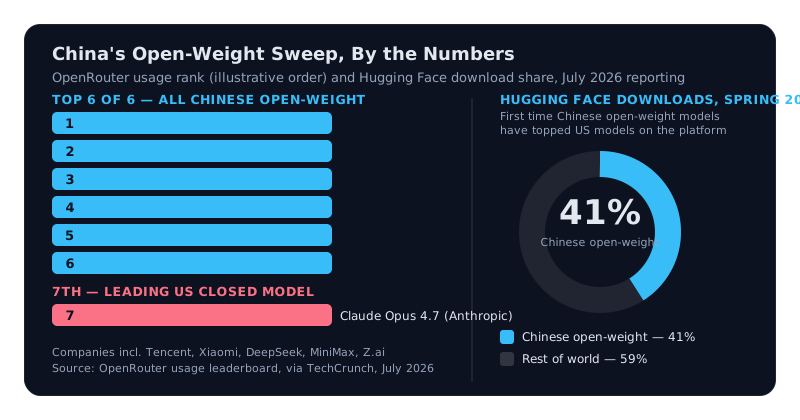
A 41% download share measures interest, not lock-in. What actually matters for the next stage of this story is retention — how many of those downloads turn into production deployments enterprises keep running for years. That’s a harder number to fake and a harder one to reverse.
What’s the real contrast here?
Highest raw capability on the hardest problems. Priced per token, accessed through an API you don’t control, and increasingly positioned — per Hugging Face’s own CEO — as a tool for experimentation and the highest-value tasks rather than everyday production traffic.
41% of Hugging Face downloads this spring. Top six spots on OpenRouter’s usage leaderboard. Nearly a third of Vercel’s June AI requests. Weights you can fine-tune, host on your own infrastructure, and stop paying for the moment you stop needing them.
Why is the shift happening now?
Because owning the model has become cheaper than renting access to a slightly better one, and enterprises are behaving accordingly. Open-weight models handled nearly a third of AI requests on Vercel’s platform in June 2026 — a production-traffic number, not a research-download number, which suggests the shift is showing up in applications enterprises are actually running in front of paying customers.
Hugging Face CEO Clem Delangue has framed the split bluntly, arguing that eventually “most of the production workloads will actually be powered… by open source models,” with frontier closed models reserved for experimentation and the handful of tasks where the capability gap still justifies the API bill. That’s not a hypothetical — it’s a description of what the download and usage numbers are already showing.
The economics reinforce it. A model you can self-host doesn’t charge you per token forever, doesn’t change its pricing or behavior without warning, and doesn’t require you to send proprietary data to someone else’s servers. For an enterprise running the same workload millions of times a month, that math compounds fast — and Chinese labs have spent the past two years shipping open weights competitive enough to make the trade credible.
| Signal | Figure | Source |
|---|---|---|
| Chinese share of Hugging Face downloads, spring 2026 | 41%, surpassing US models | TechCrunch |
| OpenRouter top 6 most-used models | All Chinese open-weight, incl. Tencent, Xiaomi, DeepSeek, MiniMax, Z.ai | TechCrunch |
| Claude Opus 4.7 OpenRouter rank | 7th | TechCrunch |
| Open-weight share of Vercel AI requests, June 2026 | Nearly one-third | TechCrunch |
| Hugging Face scale | ~3M public models, 1M datasets, ~half of Fortune 500 | TechCrunch |
What should developers actually do with this?
Nothing about a leaderboard shift obligates you to rip out a working stack. But it does mean the “just call the best frontier API” default is no longer the obviously correct starting assumption for every workload — especially high-volume, cost-sensitive, or data-sensitive ones.
Do
- Benchmark the current top Chinese open-weight models on your actual workload before assuming a closed frontier model is worth the premium
- Treat self-hosting cost and data control as real line items when a workload runs at high, predictable volume
- Reserve closed frontier models for the tasks where the capability gap still clearly justifies the API bill
Don't
- Assume a model’s OpenRouter or Hugging Face popularity tells you anything about its safety review, support, or long-term maintenance
- Migrate a production workload off a working closed-model integration purely because of a leaderboard headline
- Ignore that download share measures interest, not verified enterprise retention — check for independent adoption data before betting infrastructure on it
Does this mean the frontier race is over?
No — it means it’s no longer the only race. The companies still spending billions to push raw capability upward haven’t stopped, and Claude Opus 4.7 sitting seventh on one usage leaderboard doesn’t erase Anthropic’s position at the capability frontier, a position export-control pressure on Claude itself shows the US still treats as strategically important. What’s changed is that “most-used” and “most capable” are now visibly different lists, and the gap between them is where Chinese open-weight labs have built their entire strategy.
That strategy has already forced a domestic reckoning of its own — regulators in Beijing have been aggressive about reining in how some of these same open models get deployed inside China, including the companion-agent shutdown that hit Doubao and Qwen just a day after this Hugging Face data was reported. The models winning the download race abroad are simultaneously being reined in at home — a reminder that “open” and “unregulated” are not the same thing, even for the labs currently topping the charts.
For developers, the practical takeaway isn’t that closed frontier models are finished. It’s that the default has quietly shifted from “call the best API” to “check what you can own first” — and for the first time, the models best positioned to answer that second question aren’t coming out of San Francisco.
Frequently asked questions
Did Chinese AI models really overtake US models on Hugging Face?
Yes, by download volume. Reporting published July 14, 2026 found Chinese open-weight models accounted for 41% of downloads on Hugging Face this spring, surpassing US models on the platform for the first time. It measures download share, not model count or capability, but it is a real usage crossover.
What are the most-used AI models on OpenRouter right now?
As of the July 2026 reporting, the top six most-used models on OpenRouter are all open-weight releases from Chinese firms, including Tencent, Xiaomi, DeepSeek, MiniMax, and Z.ai. That is a near-total sweep of the leaderboard by companies that were largely absent from Western developer conversation two years earlier.
Where does Anthropic's Claude Opus rank on OpenRouter?
Claude Opus 4.7, Anthropic's flagship model, ranked seventh on OpenRouter's usage leaderboard at the time of the July 2026 reporting — behind all six top-ranked Chinese open-weight models. It remains a leading closed model, but it is no longer the most-used model on that developer-facing router by a wide margin.
Why does Hugging Face's CEO think open models are gaining ground?
Clem Delangue has argued the market is bifurcating: frontier closed models will increasingly be reserved for experimentation and the highest-value tasks, while everyday production workloads shift to models companies can own and customize. He expects most production workloads to eventually run on private or open-source models rather than proprietary APIs.
How much AI traffic on Vercel came from open-weight models in June 2026?
Open-weight models handled nearly a third of AI requests processed on Vercel's platform in June 2026, according to the reporting. That is a meaningful share for infrastructure that serves production applications rather than research demos, suggesting the shift extends beyond download counts into live, revenue-generating traffic.
/* Comments */
Comments are offline right now — we reconnect automatically, nothing is lost.