
Claude Code vs OpenClaw: Five Architectural Dimensions of Coding Agents
Compare Claude Code and OpenClaw across interaction models, execution environments, autonomy levels, memory persistence, and tool safety.
On this page
The software development tooling industry is currently experiencing a massive paradigm shift. AI coding assistants have graduated from simple autocomplete suggestions inside IDEs into autonomous agents capable of navigating large codebases, executing terminal commands, authoring tests, and self-correcting compiler failures.
Yet within the category of coding agents, two fundamentally different architectural archetypes have emerged:
- The Interactive Session Tool (exemplified by Claude Code): A developer-in-the-loop CLI assistant operating directly within the developer’s local terminal workspace.
- The Long-Running Agent Daemon (exemplified by OpenClaw): An unattended background service triggered by webhooks or schedules, operating in isolated cloud sandboxes to perform autonomous repository maintenance.
Choosing or designing an agent architecture requires understanding five critical engineering dimensions that separate these two models: Interaction Model, Execution Environment, Autonomy Level, Memory Systems, and Tool Safety Gates.
The Five Architectural Dimensions
1. Interaction Model: Synchronous CLI vs Asynchronous Daemon
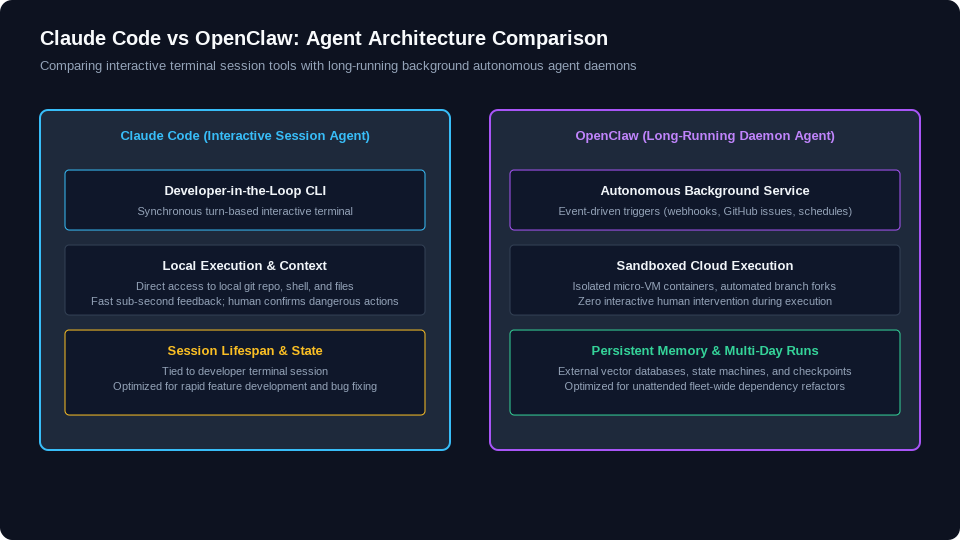
- Claude Code (Synchronous Loop): Designed for active human collaboration. A developer asks a question or instructs a feature change; the agent reads files, proposes diffs, and streams terminal actions directly to standard out. The human provides immediate mid-turn course corrections.
- OpenClaw (Asynchronous Event Loop): Decoupled from human interactive sessions. Triggered by GitHub issue labels, scheduled cron jobs, or failed CI alerts. It executes in the background over minutes or hours, emitting a finished pull request upon task completion.
2. Execution Environment: Local Workspace vs Ephemeral Sandbox
- Claude Code: Executes natively within the user’s host operating system, inheriting the developer’s local Git configuration, SSH keys, environment variables, and pre-installed toolchains. This provides blazing fast feedback, but requires trust in model-generated shell commands.
- OpenClaw: Never runs on a developer workstation. It clones repositories into isolated, ephemeral micro-VMs (such as Docker or Firecracker). After executing tests and generating a Git commit, the entire container filesystem is wiped, eliminating cross-job tampering.
3. Autonomy and Decision Boundaries
| Dimension | Interactive Session (Claude Code) | Autonomous Daemon (OpenClaw) |
|---|---|---|
| Command Approval | Prompts user before destructive commands (rm -rf, git push). | Automated policy evaluation via strict security allowlists. |
| Error Recovery | Asks user for clarification when blocked. | Iterates autonomously through backtrack heuristics or fails the job. |
| Target Workload | High-context feature engineering, active debugging. | Boilerplate migrations, dependency upgrades, automated triage. |
4. Memory Persistence and Context Architecture
A session tool manages memory within an active process lifespan. Claude Code leverages local project markdown guides (CLAUDE.md), caching hierarchical repository context in memory for the duration of the terminal session.
In contrast, a long-running daemon requires persistent external state stores:
- Task State Machines: Tracks progress through durable event logs (e.g., PostgreSQL or Temporal workflows), enabling the agent to resume execution across container restarts.
- Cross-Run Episodic Memory: Stores historical PR failures and repo conventions in vector databases to avoid repeating previous debugging mistakes.
5. Tool Safety and Blast Radius Control
In an interactive session, the human engineer acts as the final safety circuit breaker. If an agent drafts an erroneous database drop command, the engineer denies permission in the terminal.
In an unattended daemon, security must be enforced cryptographically by infrastructure:
- Read-only upstream git tokens (cannot push directly to trunk).
- Blocked internet egress proxies preventing secret exfiltration.
- Mandatory CI status checks and human code review requirements before pull request merging.
Architectural Synthesis: When to Use Which Pattern
The future of engineering is not a winner-take-all battle between these two paradigms. Top engineering organizations deploy both symbiotically:
- Use Interactive Session Agents (Claude Code): When authoring complex domain features, designing novel architectures, and conducting deep interactive root-cause analysis where human intuition is paramount.
- Use Autonomous Daemons (OpenClaw): When executing fleet-wide repetitive refactors, upgrading framework versions across 500 microservices, and triaging customer bug reports overnight.
Keep reading
Google Duplex Moves Into Gemini Tasks, Where Phone Calls Become an Agent Boundary
Google describes Duplex's shift from scripted calls to Gemini Tasks. Here is how live turn-taking works and what businesses can control.
Google Agent Registry Adds MCP Policy Hints, Not an Access Boundary
Google Cloud's Agent Registry adds preview IAP and human-review metadata for MCP tools. Learn what these hints clarify and what still must enforce access.
GPT-Live Standby Pauses Inference Without Closing a WebRTC Session
OpenAI’s standby mode pauses inference in silence and resumes on speech, trading lower idle rates for wake-up delay and an open microphone.
/* Comments */
Comments are offline right now — we reconnect automatically, nothing is lost.