
GitHub Adds Repository-Scoped Roles for Security Advisories
GitHub custom repository roles now split advisory viewing, management and publishing. See the new limits before delegating private vulnerability reports.
On this page
A vulnerability report often needs specialist attention before it is ready for maintainers or the public. Until now, giving someone enough access to work on a repository’s advisory could mean granting a broad administrator or organization-wide security-manager role. GitHub’s new custom permissions let organizations delegate more of that work at repository scope—but the handoff is not complete for every action. [1]
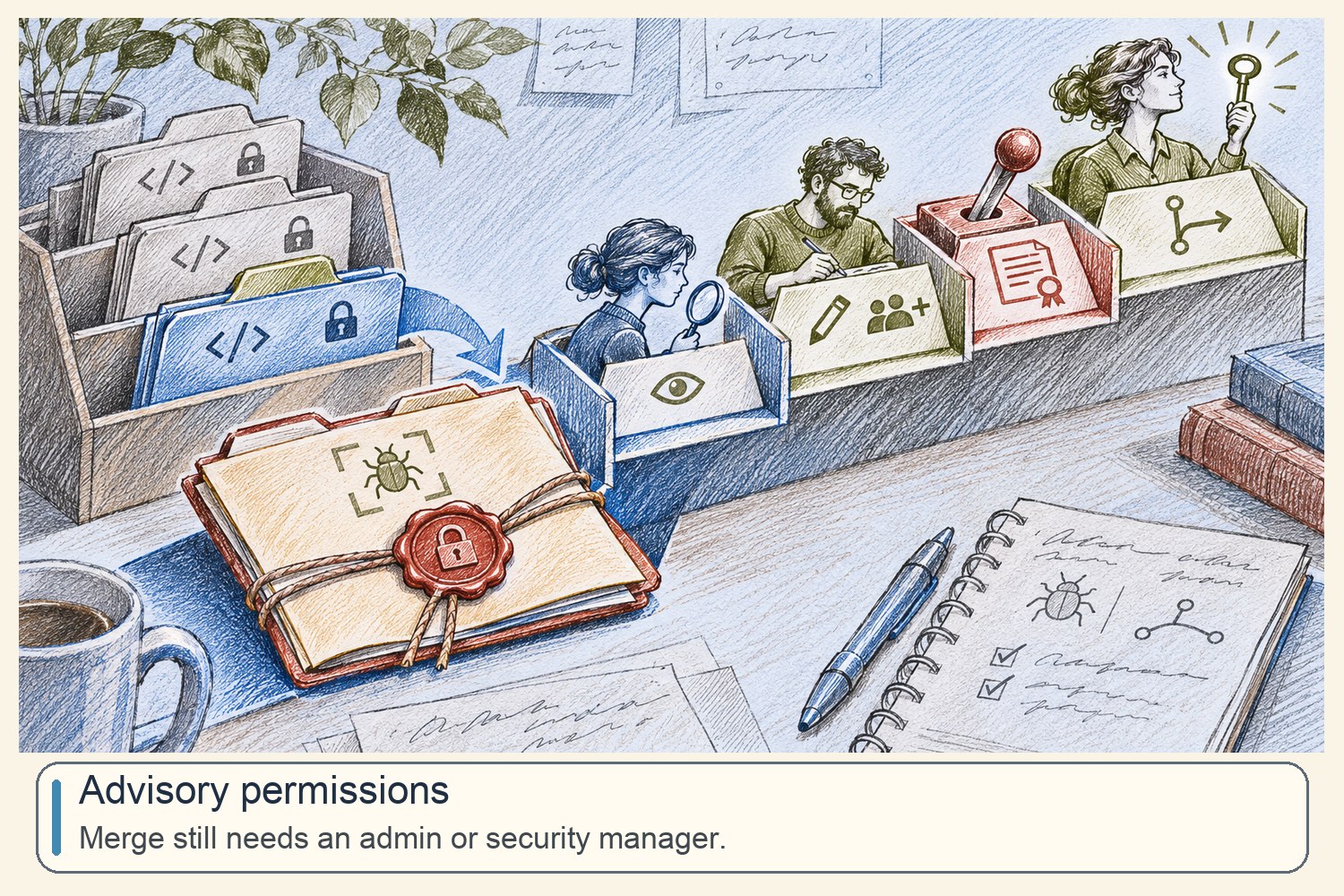
Four permissions, four jobs
Organization owners can add four permissions under Security when creating or editing a custom repository role:
| Permission | What it enables |
|---|---|
| View security advisories | See draft advisories, their status and comments. |
| Create, edit and manage security advisories | View, create or edit advisories, comment, manage collaborators and create a temporary private fork. |
| Accept private vulnerability reports and close or reopen advisories | Accept incoming reports and change advisory state; requires view or manage permission. |
| Publish advisories and request CVEs | Publish an advisory or request a CVE; requires view or manage permission. |
The role can be assigned to an individual or team on the repositories where the work belongs. That scope matters for teams maintaining many projects: a vulnerability coordinator can help with disclosure for a selected set of repositories without gaining the same advisory visibility across the organization. The feature is available to organizations on plans that support custom repository roles, including GitHub Enterprise Cloud; check the organization’s current plan and settings before designing a rollout. [1] [3]
Custom repository roles are based on an inherited role, with extra permissions added. GitHub documents that role grants are additive across sources such as organization base permissions and team membership. A new narrow role therefore does not remove access someone already has through another path. Review the effective access on each repository rather than assuming the custom role is the user’s only grant. [3]
The privileged edges still matter
The most important limit appears in the middle of a remediation workflow. A user with the new advisory permissions can create a temporary private fork, but merging changes from that fork still requires a repository administrator or security manager. People with any of the new permissions cannot delete the temporary fork. Confidential comments have another boundary: the user needs Create, Edit, and Manage and write access to the repository. [1]
Those rules suggest a role design based on tasks, not job titles. A disclosure coordinator may need to receive and triage private reports. A security engineer may need to edit an advisory and coordinate collaborators. A maintainer or security manager may need to approve and merge the fix. Publishing can be delegated separately when the organization’s disclosure process allows it. Map each action to an owner before assigning a team role.
For example, a project’s intake team could accept incoming reports and close or reopen advisories, while a smaller maintainer group keeps write access and handles fork merges. A person publishing advisories can receive the publish permission without being made an organization-wide security manager. Test the full path with a low-risk rehearsal or existing advisory procedure, including who can see confidential comments and who has the final merge key. [1] [2]
Build a disclosure path around least privilege
Start with the repository list and identify where private reports are enabled and who currently handles each stage. Create a custom role using the smallest suitable inherited role, add only the advisory actions required, then assign it to the relevant people or teams at repository scope. Check for overlapping base, team and repository access because the effective permissions add together. [3]
Then document what happens after acceptance: who confirms severity and affected versions, who coordinates a patch, who can merge a private-fork change, who requests a CVE, and who publishes the advisory. The new permissions address GitHub authorization; they do not define an organization’s disclosure timeline or incident process. Existing automatic security-risk assessments and secret-detection review practices cover neighboring signals, but neither replaces confidential report handling.
The useful change is that advisory participation no longer has to map to all-or-nothing administrator access. The remaining privileged actions are explicit, which makes it possible to keep a clean separation between triage, code changes and public disclosure—provided the organization verifies the access users already hold. [1] [3]
Frequently asked questions
Can a custom advisory role merge a temporary private fork?
No. Merging changes from a temporary private fork still requires a repository administrator or security manager, even when the person can create and manage advisories.
Are the new advisory permissions organization-wide?
No. Organizations can assign the custom repository role to a person or team only on the repositories where that access is needed.
Sources & further reading
Keep reading
nginx2root Makes One Question Urgent: Where Does HTTP/2 Actually Terminate?
Five nginx flaws put HTTP/2 and HTTP/3 listeners on the patch list. Map protocol termination, update fixed builds, and treat proxy shielding as temporary.

Dependabot Dismissal Requests Now Stay Open for a Year
GitHub extended delegated Dependabot dismissal requests from one week to one year. The extra time helps review coverage but does not approve or fix alerts.
Windows Warns Some Secure Boot Updates May Add One Restart
Microsoft says a limited number of devices may restart once more during Secure Boot updates. Plan without mistaking the extra restart for a failure.
/* Comments */
Comments are offline right now — we reconnect automatically, nothing is lost.