
AI Blind-Sweep Ultrasound Matches Experts in Two Clinics. What the Study Proves
A prospective study tested AI gestational-age estimates from scans by novice operators in Chicago and Nairobi, with important limits on generalization.
On this page
The most meaningful claim in a medical-AI study is often narrower than the launch headline. In this case, researchers tested whether a model could estimate gestational age from a standardized ultrasound sweep made by a novice operator, and whether that estimate held up at two clinics using unfamiliar equipment. The result is promising evidence about one diagnostic task. It does not show that the tool can replace prenatal care or that a new deployment will improve outcomes by itself.
What the researchers actually tested
The JAMA Network Open paper reports a prospective diagnostic study at an urban academic medical center in Chicago and a community clinic network in Nairobi. The evaluation set included 385 participants between 16 and 36 weeks of pregnancy: 192 in Chicago and 193 in Nairobi. The model had been trained on data from other sites, adapted using 120 Chicago participants, and then evaluated in both settings. The Nairobi evaluation data was not used for tuning, providing an external test at that site. [1]
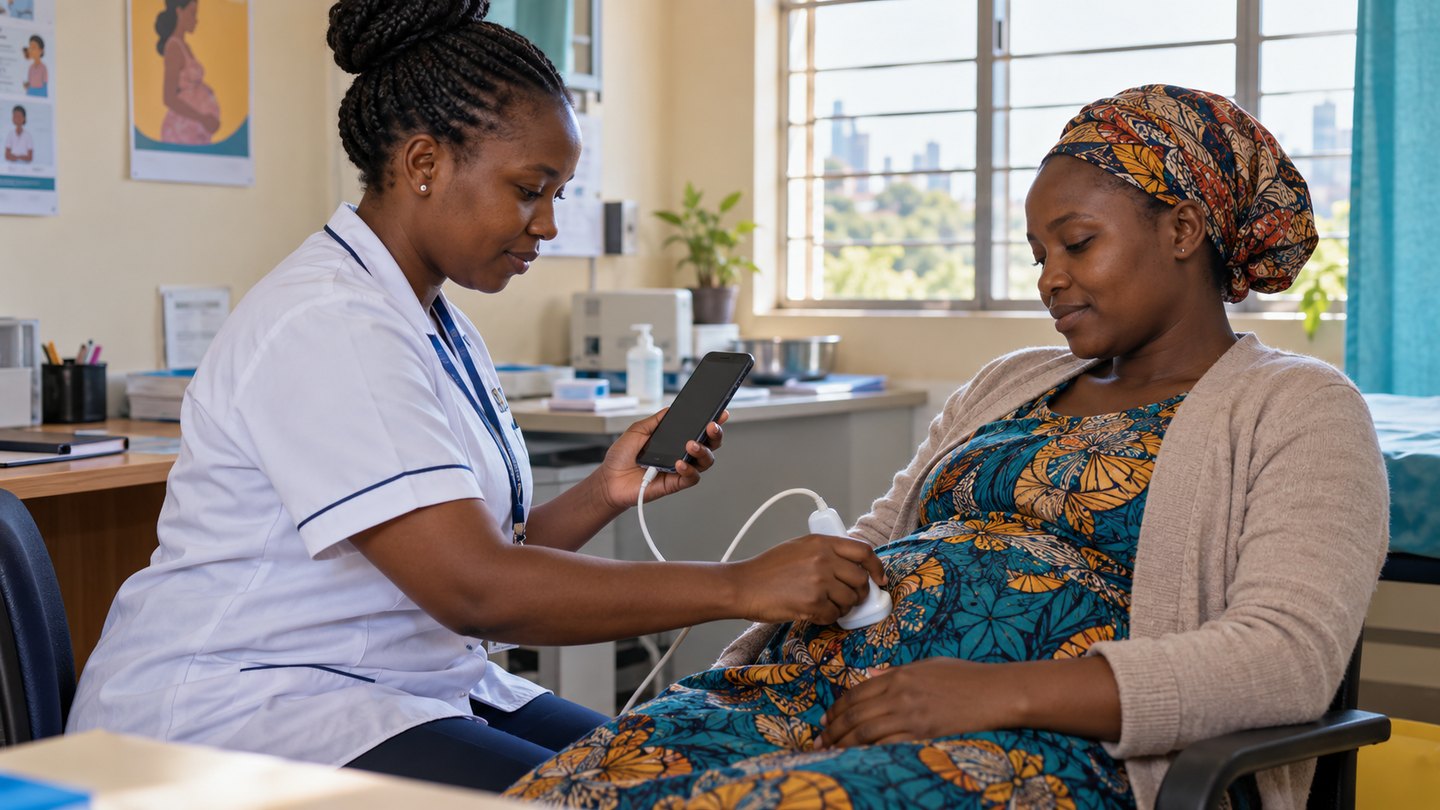
The new workflow uses a “blind sweep”: an operator follows a standardized motion with a handheld probe across the abdomen, rather than needing to locate and measure the specific fetal anatomy views used in conventional expert sonography. The model processes the sweep and estimates gestational age. That shift could make one kind of measurement less dependent on specialist image capture, but the study still involved operator instruction, clinical sites, a connected device-and-software workflow, and a defined gestational-age range. [1] [2]
Across the primary evaluation cohort, the AI estimate had a mean absolute error of 4.2 days, compared with 4.5 days for the clinical standard based on expert sonographer measurements. The study used a one-day noninferiority margin and found the model noninferior on that metric. The authors report site-level errors of 4.1 days in Chicago and 4.3 days in Nairobi. These figures describe the trial’s comparison, not a guarantee for an individual patient or a general clinical setting. [1]
Why the prospective cross-site test matters
Medical-imaging systems can look strong on data drawn from the same hospitals, equipment, and patient mix used during development. A prospective evaluation asks a harder question: does the model still work when it runs in live clinical workflows with different operators and hardware? Here, the research team adapted on a small Chicago sample, then evaluated in both Chicago and Nairobi; the Nairobi data remained untouched by that adaptation. [1]
That setup makes the Nairobi result particularly informative, but not universal. It demonstrates performance at one clinic network in one country, with one evaluated probe manufacturer and study-specific procedures. It cannot establish results for rural sites, different device families, other training conditions, or all patient populations. The paper itself calls for evaluation across more hardware and operators, and describes performance differences after 36 weeks. [1]
WHO recommends an ultrasound before 24 weeks to support gestational-age estimation and other assessments. Its guidance also stresses trained operators and notes that the effects of introducing antenatal ultrasound on population outcomes and health systems in low-resource settings remain uncertain. The study’s contribution is evidence about one technical barrier: how a scan is acquired and interpreted. It does not answer the larger questions of who receives care, whether a referral is available, or what happens after an uncertain or abnormal result. [3] [4]
Accuracy is one part of a clinical workflow
A usable clinical system needs more than a low average error. The study authors discuss device charging, equipment durability, maintenance, software updates, model confidence, and safeguards against low-quality scans. Those concerns are not side details: they determine whether a clinic can obtain a usable scan and whether a clinician knows when to disregard the model. [1]
The model estimates gestational age. That does not make it a complete ultrasound exam. It does not detect every fetal condition, assess all anatomical structures, or replace clinical judgment. The study does not report a randomized test of downstream treatment or health outcomes. And because the clinical reference standard is itself based on expert sonographer measurements, noninferiority to that reference is not the same as proving absolute biological truth in every case. [1]
For clinical leaders, a sensible next step is a bounded evaluation with the actual local operators, devices, power conditions, connectivity, referral pathways, and range of patients the service expects. Track not just average error but unusable-scan rates, confidence-based abstentions, variation by site and operator, and whether the result changes a care decision. Keep a qualified clinician responsible for interpreting findings and for follow-up.
For researchers, the next evidence should broaden the external sites and hardware, pre-specify subgroups, and measure implementation outcomes separately from model accuracy. If the claim is improved access, measure whether more patients receive appropriate scans. If the claim is better care, measure the outcomes that follow the assessment—not just the closeness of a date estimate.
A promising result with a clear boundary
The study shows that blind-sweep ultrasound plus AI can produce gestational-age estimates comparable to the expert clinical method in two prospective urban clinical settings, including one external evaluation site. That makes the approach worth further study, especially where trained sonographers are scarce. But the path from a diagnostic result to expanded care includes devices, training, confidence handling, clinician oversight, referrals, and service capacity.
The right takeaway is neither dismissal nor a claim that AI has solved access. It is a well-defined evidence step: the model generalized across these settings and this probe, within a study range and workflow, on one measured diagnostic task. Deployment and outcome evidence still have to follow. For broader context, see our explainers on AI-generated biological hypotheses and validation and how to evaluate evidence behind AI claims.
Frequently asked questions
Did the AI ultrasound study prove that it improves pregnancy outcomes?
No. It was a prospective diagnostic accuracy study comparing gestational-age estimates with a clinical standard. It did not establish that deploying the system increases access, changes treatment, or improves maternal or infant outcomes.
What does blind-sweep ultrasound mean in this study?
A novice operator follows a standardized sweep of a handheld probe across the abdomen. The AI analyzes the resulting ultrasound sequence to estimate gestational age, rather than requiring an expert to manually select every measurement view.
Sources & further reading
Keep reading

Meta’s PrivacyLib Puts Agent Data Rules at the Point of Access
Meta’s latest infrastructure account shows how shared privacy checks can follow internal AI-agent requests across connected data systems.

GPT-6.1 Terra Makes Computer Use Cheaper. Your Workflow Still Needs a Verifier
OpenAI positions GPT-6.1 Terra for visual and desktop tasks at lower API prices. Here is what its benchmarks establish and what they leave open.

Meta’s Recommender Tokens Turn Product Meaning Into Reusable Vocabulary
Meta’s GenRecs approach replaces one-item IDs with semantic token sequences. The promise is better generalization; the hard part is measuring it fairly.
/* Comments */
Comments are offline right now — we reconnect automatically, nothing is lost.