
Meta’s PrivacyLib Puts Agent Data Rules at the Point of Access
Meta’s latest infrastructure account shows how shared privacy checks can follow internal AI-agent requests across connected data systems.
On this page
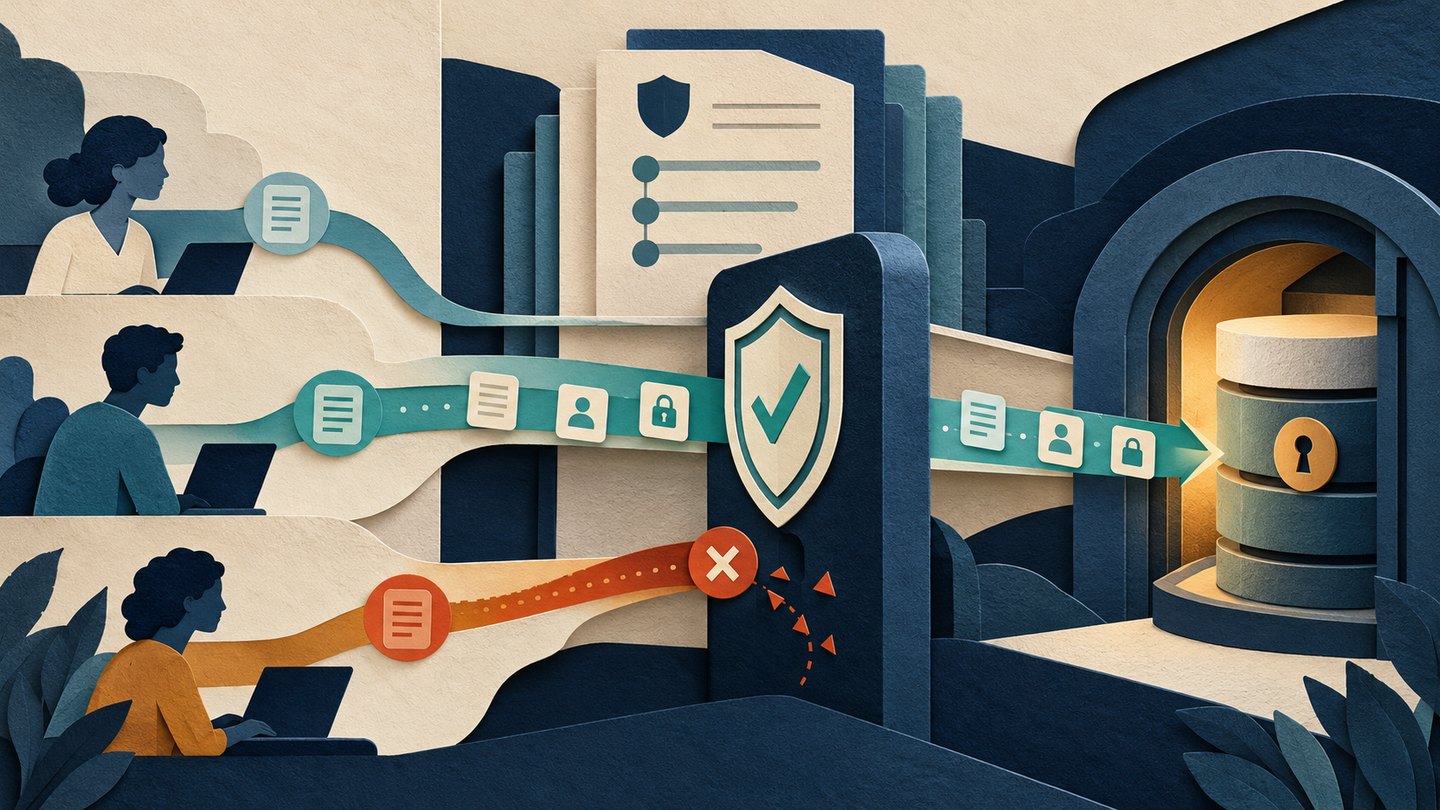
An AI agent can choose a tool that its builder did not expect. That makes a list of permitted tools an incomplete privacy boundary: the tool may call several services before it reaches the data that matters. Meta’s latest description of PrivacyLib offers a concrete infrastructure pattern for that problem. It carries the agent’s context down supported call paths and evaluates policy where a service reads or writes data.
A policy check where the data moves
PrivacyLib is a shared library running inside clients used by Meta’s data and processing systems. The October post says those integrations cover hundreds of systems and handle billions of checks each second. Meta says the common path usually evaluates locally: requirements are compiled into a simple form and most checks use process-local caches, avoiding a network call for each decision. These are company-reported scale and implementation details, not independently audited performance results. [1]
The important architectural move is separating system integration from individual privacy requirements. A service maps its native operations into a shared vocabulary. Then a reusable module can observe a flow or enforce a rule across systems that already use the library. Meta distinguishes observing modules, which record access signals, from enforcing modules, which can deny a data operation. [1]
That distinction matters because logging and enforcement have different failure costs. An observation module can help a team discover where data travels. An enforcement module can break a production write if a policy or annotation is wrong. Meta describes simulation and staged rollout controls for that reason: test changed decisions before release, increase exposure gradually, watch errors and denials, and reduce the rollout if valid traffic starts failing. [1]
Why agents make the boundary harder
Traditional service calls often follow paths that engineers can enumerate at design time. Agents introduce a dynamic choice: the model selects a tool, and that tool can call other services. Meta says it built AgentLib to associate supported internal agent tool calls with a session and propagate the context until the call reaches a system integrated with PrivacyLib. There, the policy check can consider the agent context, requested operation, and destination annotations together. [1]
The result is a more useful unit of authorization than “this agent may call this tool.” A safe decision can depend on who initiated the task, what data the destination contains, why it may be used, and what operation is requested. If a disallowed request is blocked at that boundary, the decision does not require the agent to interpret or honor its own policy instructions. Meta says the block is returned through the call chain to the agent environment. [1]
This resembles the resource-centered model in NIST’s Zero Trust Architecture: access decisions belong close to protected resources and depend on subject and context, rather than trusting a request because it came from inside a network or from an owned service. NIST provides a general architecture, not a certification of Meta’s implementation or a prescribed AI-agent design. [3]
The hard part is covering every route
A shared library is not automatically a universal boundary. Meta’s own description lists the problem plainly: a system may have multiple client libraries, legacy paths, direct RPC calls, or direct access to a backing store. The company says it integrates at both typed-client and lower network boundaries to cover different paths. This is a useful reminder for any team building a similar system: policy completeness depends on the inventory of actual data routes, not the elegance of the common library. [1]
Meta’s earlier descriptions of Policy Zones show the other half of the system. They explain how annotations and flow rules can travel with data across functions, batch jobs, and connected processing systems, with a logging phase before enforcement. The details are specific to Meta’s internal stack, but the underlying problem is common: a rule attached only to one API endpoint can be bypassed by a second path or by a downstream transformation that loses its context. [2]
There is also an operational tradeoff. Policy modules run in a hot path, so checks must remain cheap. Meanwhile, service owners deploy on separate schedules. Meta says requirements need explicit service inventories and coordinated upgrades when services need a newer policy capability. That means “one integration” reduces duplicated work but does not remove version management, rollout, or exception handling. [1]
A practical pattern for agent systems
A team designing an internal agent should begin with the protected data resources, then trace how tools reach them. For each route, record the identity and session context that must be preserved, the operation being attempted, the resource’s policy labels, and the component that can block before data is returned. Test unexpected tools and nested service calls rather than only the intended happy path.
Keep observation separate from denial. Run new rules in a mode that records what they would change; compare those results with known-good workflows and with deliberately prohibited access. Introduce enforcement to a bounded service or resource set, monitor denied and failed operations, and make rollback local to that rollout. A policy system that cannot recover from a bad annotation will eventually encourage teams to bypass it.
Finally, plan for behaviors beyond a single agent. Meta says its next questions include evaluating agent behavior during execution and reasoning about communication between agents, where a data access may be several steps removed from the person who initiated the work. Context propagation and data-access checks are foundations for those questions, not answers to all of them. [1]
The strongest takeaway is structural: put authorization at the boundary that can see both the request and the data, and keep the identity and purpose attached as the request crosses services. The implementation still needs a complete route inventory, measurable rollout behavior, and independent tests for unsupported or indirect paths. For related reading, see our guides to tool permissions for AI agents and enterprise AI data custody.
Frequently asked questions
Does Meta’s PrivacyLib watch every AI-agent action?
Meta describes coverage on supported, integrated data-access paths, where agent context and operations reach PrivacyLib. The post also identifies new questions around unsupported paths, multi-agent communication, and how to evaluate agent behavior while it is running.
What is the main design idea behind PrivacyLib?
Integrate systems once at a shared data-access boundary, then add reusable observing or enforcing modules. That lets a common control evaluate request context, operation, and destination policy without rebuilding bespoke checks in every product system.
Sources & further reading
Keep reading

AI Blind-Sweep Ultrasound Matches Experts in Two Clinics. What the Study Proves
A prospective study tested AI gestational-age estimates from scans by novice operators in Chicago and Nairobi, with important limits on generalization.

GPT-6.1 Terra Makes Computer Use Cheaper. Your Workflow Still Needs a Verifier
OpenAI positions GPT-6.1 Terra for visual and desktop tasks at lower API prices. Here is what its benchmarks establish and what they leave open.

Meta’s Recommender Tokens Turn Product Meaning Into Reusable Vocabulary
Meta’s GenRecs approach replaces one-item IDs with semantic token sequences. The promise is better generalization; the hard part is measuring it fairly.
/* Comments */
Comments are offline right now — we reconnect automatically, nothing is lost.