
Google's Malaysia Expansion Puts Grid Commitments Beside AI Capacity
Google's US$15 billion Malaysia plan includes new data center campuses, training, water projects, and more than 1 GW of planned clean energy capacity.
On this page
Google’s latest Malaysia announcement is larger than a data center announcement. It bundles compute campuses with a planned cloud region, workforce training, watershed projects, and more than a gigawatt of clean-energy capacity. That package addresses the central question facing AI infrastructure: who pays for the resources required to make a new campus useful?
On November 4, Google said it plans to invest US$15 billion in Malaysia over 2027 and 2028. The company says its first data center campus, at Elmina Business Park in Selangor, is already operational, while additional campuses are planned in Selangor and Negeri Sembilan. Computing capacity in Selangor is also intended to support an upcoming Google Cloud region for enterprise customers. [1]
The proposal sits inside a fast-changing energy picture. The International Energy Agency says global data center electricity demand grew 17% in 2025 and that investment is accelerating, while warning that local grid bottlenecks and affordability are becoming more consequential. That global context does not tell us the load of Google’s planned Malaysian campuses, but it explains why a data center announcement now needs to be read alongside power connections, generation, water, and timing. [2]
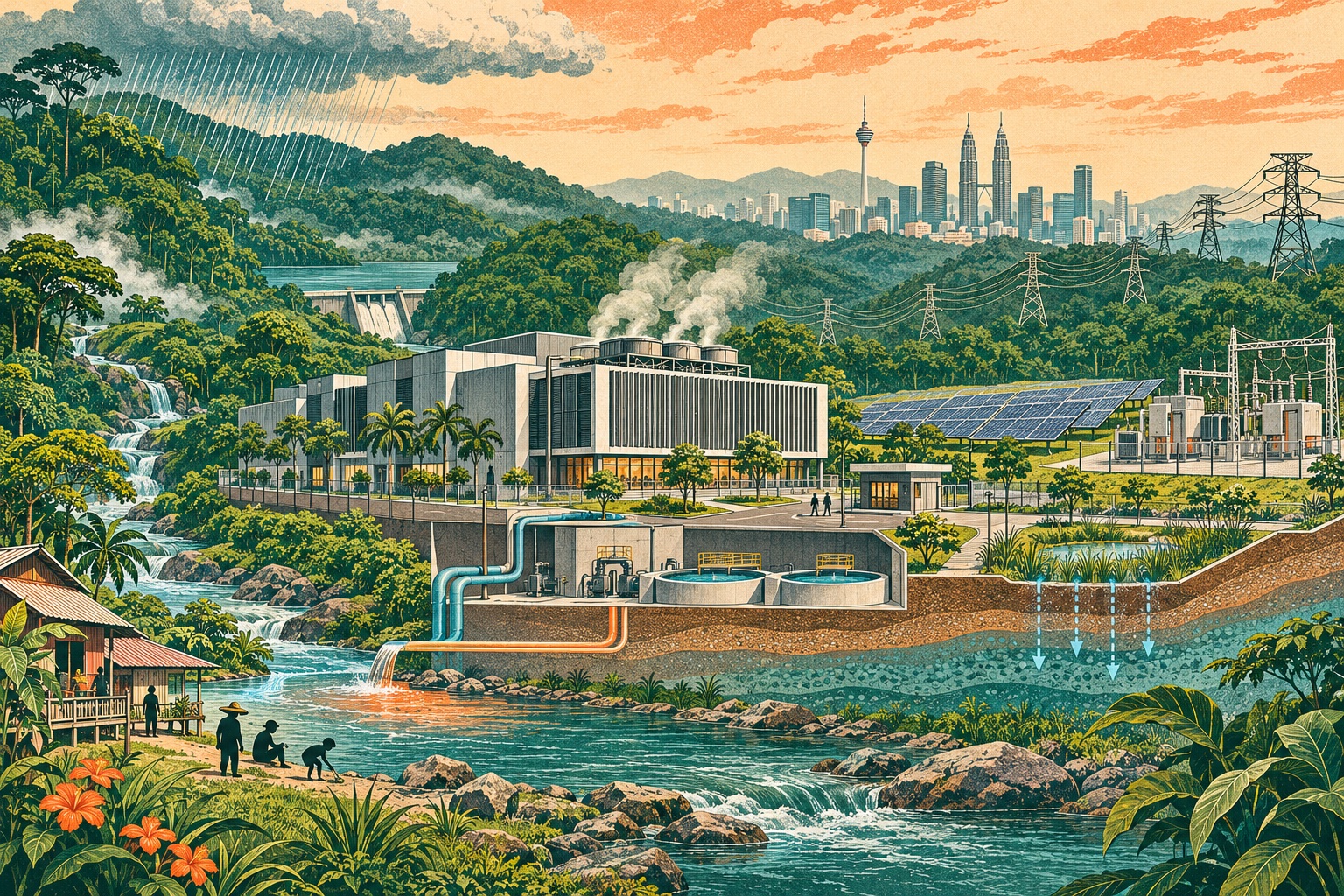
The plan is a bundle of commitments
Google says it expects the construction phase of new campuses in 2027–2028 to contribute an average US$1.1 billion annually to Malaysia’s GDP and support more than 37,000 local jobs per year. Once the campuses are operating, it projects more than 9,000 local jobs annually. These are company estimates about future construction and operations, not independently verified outcomes. The distinction matters: temporary construction jobs and long-term technical roles are different kinds of employment, and the announcement’s estimates should be measured against actual hiring and supplier contracts later. [1]
The power commitment is more than a statement of intent to buy renewable certificates. Google says it plans to enable more than 1 GW of clean-energy capacity for Malaysia’s National Grid through new generation facilities under the Corporate Renewable Energy Supply Scheme, and to explore round-the-clock clean-energy projects with Tenaga Nasional Berhad. It also says it will pay for all electricity its campuses use and the direct infrastructure required to connect them. Those are important commitments, but the release describes plans; it does not say that 1 GW is already contracted, built, or feeding the grid. [1]
Water is similarly local. Google says its risk assessments for Selangor and Negeri Sembilan did not find the relevant watersheds at high risk of scarcity or depletion, and it plans to use water cooling at its campuses. The company also described water replenishment work in river basins and rainwater storage at schools. Separately, Selangor’s government says data center approvals depend on confirming adequate power and water supply and that it is encouraging water recycling. The two sources describe company plans and public oversight; neither should be used as a substitute for ongoing measurement of actual site consumption. [1] [3]
What the efficiency numbers do—and do not—say
Google reports a power usage effectiveness (PUE) range of 1.12–1.14 for its data centers in warmer tropical climates, compared with an industry average of 1.54. PUE compares total facility energy with energy delivered to IT equipment; lower values indicate less overhead energy for cooling and other facility functions. It does not measure the campus’s absolute electricity consumption, the carbon intensity of the grid, or whether local water and power supplies are adequate. A highly efficient site can still be a large new load. Google’s data center materials describe PUE and other efficiency practices, but the number is a company-reported operating metric. [1] [4]
This is why capacity plans should be evaluated in local terms. A clean-energy project can add supply but may not be available at the hour a campus needs power. New transmission and substations take time to build. Water replenishment is not the same thing as water returned to the same watershed at the same time or quality. Training programs can expand the workforce, but their value depends on who completes them and whether durable jobs follow. These are ordinary infrastructure questions, not reasons to assume either success or failure in advance. Our coverage of data centers stalled by grid, water, and construction constraints looks at a different set of projects where the announced pipeline has not translated directly into online capacity.
What to watch next
Google says four programs aim to upskill about 800,000 Malaysians between 2027 and 2031, including educators, microentrepreneurs, civil servants, and vocational jobseekers. It also expects to establish Data Center Institutes in selected polytechnics with a ten-week curriculum. The program’s progress can be assessed through enrollment, completion, placement, and the distribution of jobs among local workers and contractors—not by the headline target alone. [1]
The first useful milestones are therefore concrete: when planned campuses reach construction and operation; the capacity and commissioning dates of power projects; campus electricity and water use by location; supplier and job outcomes; and whether community programs reach the intended groups. Our account of a local data-center pause in New York shows why these questions often become decisions about permitting and resource allocation, not just technology. Google’s announcement sets an ambitious package around AI infrastructure. Malaysia’s regulators, utilities, and communities will determine whether that package keeps resource costs and local benefits visible as the capacity comes online.
Frequently asked questions
How much is Google investing in Malaysia?
Google announced US$15 billion of investment over 2027 and 2028. The announcement includes planned new campuses and programs; it should not be read as US$15 billion already spent.
Does Google's plan include renewable power?
Google says it plans to enable more than 1 GW of new clean-energy capacity for Malaysia's National Grid and will pay for the electricity its campuses use and direct connection infrastructure. These are company commitments and plans, not a report that all capacity is already operating.
Will the campuses use water cooling?
Google says its water assessments found the relevant watersheds were not at high risk of scarcity or depletion and that it plans to use water cooling. The company also announced replenishment projects; local authorities separately assess water and power capacity for project approvals.
Sources & further reading
Keep reading

PagerDuty’s SRE Agent Benchmark Shows Why Incident Context Matters
PagerDuty’s 17-scenario SRE benchmark offers useful signals and clear limits: one trial, simulated faults, no live transcripts, little remediation testing.

Google Pay’s India Shopping Pilot Adds a New Job to a Payments App
Google is testing a personalized fashion feed, visual search and virtual try-on in Google Pay India. The pilot sends purchases to merchant sites.

Google’s Africa Skills Hub Puts Offline Learning in the Product Brief
Google says its digital-skills hub aims to reach three million people by 2030 and offers offline lessons. Completion matters more than sign-ups.
/* Comments */
Comments are offline right now — we reconnect automatically, nothing is lost.