
Google Expands SynthID Detector: What a Positive Match Can—and Can’t—Prove
Google is expanding SynthID Detector globally in English. Learn what its watermark checks can establish, and where their limits matter.
On this page
A watermark detector can answer a narrow question: does this file contain the watermark pattern the tool knows how to find? It cannot answer every question people bring to a viral video—who recorded it, whether the caption is accurate, or whether the depicted event happened. Google’s November 2 recap says SynthID Detector is expanding globally in English, after the company reported watermarking more than 180 billion images and videos and 240,000 years of audio. Those are company-reported totals, not an independent audit. [1]
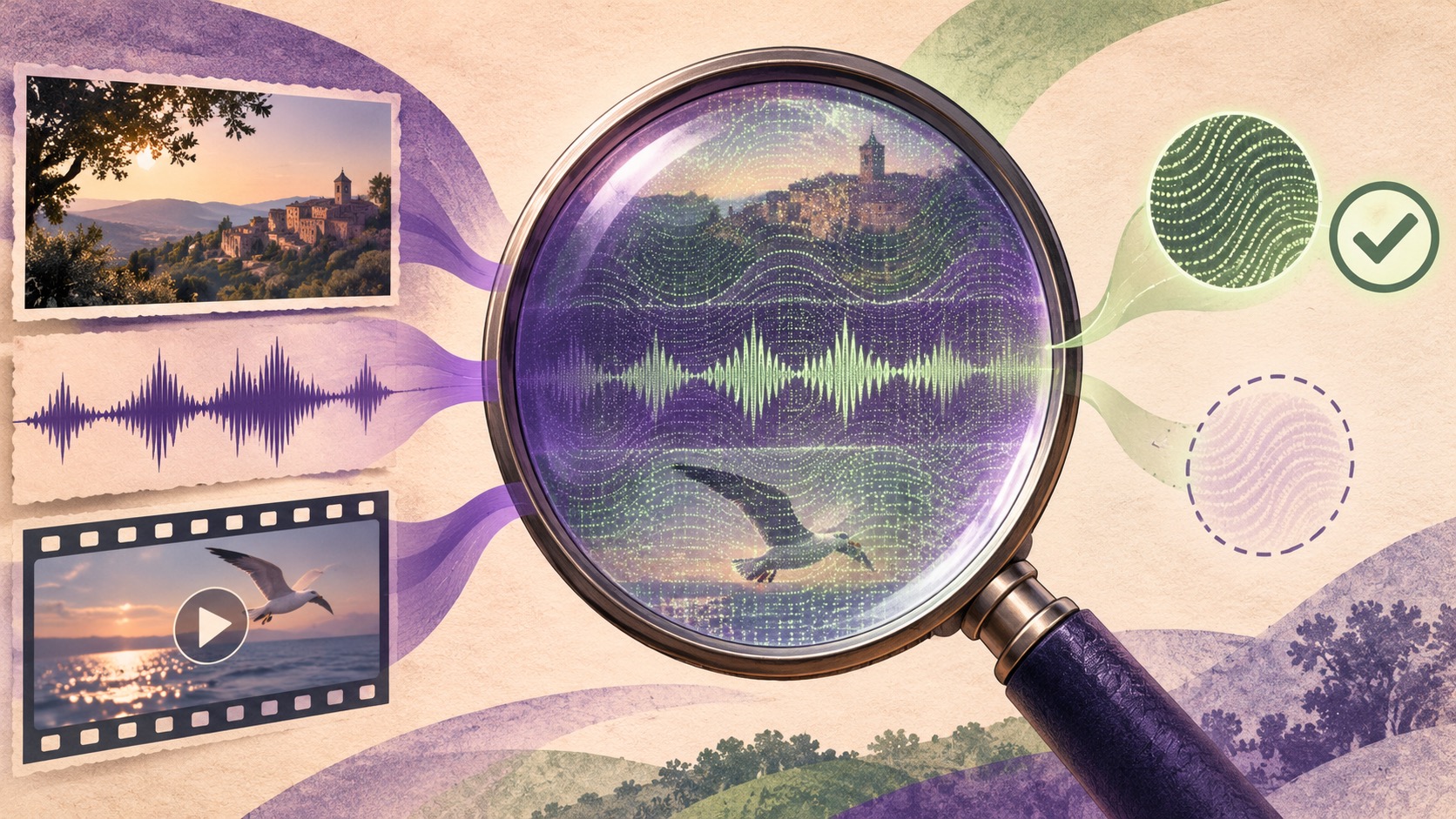
The useful signal is intentionally narrow
SynthID embeds digital watermarks into some content generated or edited with Google AI systems. Google describes the marks as designed to remain detectable after common transformations such as resizing or compression, though extensive alteration may weaken or remove them. Its Gemini help page explains that a detector may identify image, video or audio content carrying the watermark. [2] [3]
That makes the tool useful for triage. A newsroom, moderation team or researcher can submit a suspicious file and ask whether it carries a Google-associated signal. If it does, that result can guide a follow-up: locate the earliest available copy, compare versions, ask for original-source details and distinguish a synthetic illustration from a purported recording of an event.
But watermark coverage is not the same as coverage of all AI-generated media. SynthID is associated with Google’s own generation systems. Other providers may use different markers or none at all. Cropping, recompression, screen recording or editing can also complicate detection. A detector that returns no match has not proved that a person made the file.
Do not confuse origin with truth
A detectable watermark is evidence about a content-production pathway, not about the accuracy of a claim. An AI-generated diagram can accurately explain a concept; a real photograph can be misleadingly captioned; an authentic clip can be edited to omit context. The watermark cannot determine intent, authorship, consent or whether a quoted statement is true.
For consequential claims, preserve the file and record where it came from, then seek corroboration from independent reporting or primary documentation. Check whether the purported event appears in reliable local sources, whether the timestamp and location make sense, and whether the person or organization involved has issued a statement. Treat the detector as one clue in a chain of evidence, not a verdict.
A practical newsroom workflow
- Keep the original file and note its source URL, time received and any transformations made before analysis.
- Use the detector only if the tool is available in your region and supports the submitted media type; follow its current upload and privacy terms.
- Record the result as “SynthID detected” or “no detectable SynthID found,” not “AI” or “authentic.”
- Cross-check the event and caption independently. Do not publish private or sensitive media into a service without reviewing its data-handling terms.
- If the file has been edited, preserve both the received version and the analysis copy so later reviewers can reproduce what was checked. [2] [3]
The expansion makes a particular provenance signal easier to inspect. Its value depends on keeping that scope clear. Used carefully, it can support verification; used as a universal detector, it can create false confidence. Google applies watermarking to biological research in SynthID Bio, where the same principle applies: a watermark marks a source signal, not the truth of a claim. For a related policy question, see our explainer on EU AI Act transparency rules.
Frequently asked questions
Does SynthID Detector prove that media without a match is authentic?
No. A missing SynthID match only means the detector did not find that watermark. Media from other generators or altered beyond detection can still be synthetic.
What does a positive SynthID result mean?
It indicates that the submitted media contains a detectable SynthID watermark associated with Google AI generation or editing. It does not independently establish who created it, when it was made, or whether its claims are true.
Sources & further reading
Keep reading

Google Duplex Moves Into Gemini Tasks, Where Phone Calls Become an Agent Boundary
Google describes Duplex's shift from scripted calls to Gemini Tasks. Here is how live turn-taking works and what businesses can control.

Google Agent Registry Adds MCP Policy Hints, Not an Access Boundary
Google Cloud's Agent Registry adds preview IAP and human-review metadata for MCP tools. Learn what these hints clarify and what still must enforce access.

GPT-Live Standby Pauses Inference Without Closing a WebRTC Session
OpenAI’s standby mode pauses inference in silence and resumes on speech, trading lower idle rates for wake-up delay and an open microphone.
/* Comments */
Comments are offline right now — we reconnect automatically, nothing is lost.