
The First TPU: Why a Systolic Array Changed Inference Hardware
What Google’s 2017 TPU paper actually measured: an inference ASIC, an 8-bit matrix unit, software-managed memory, and workload-specific tradeoffs.
On this page
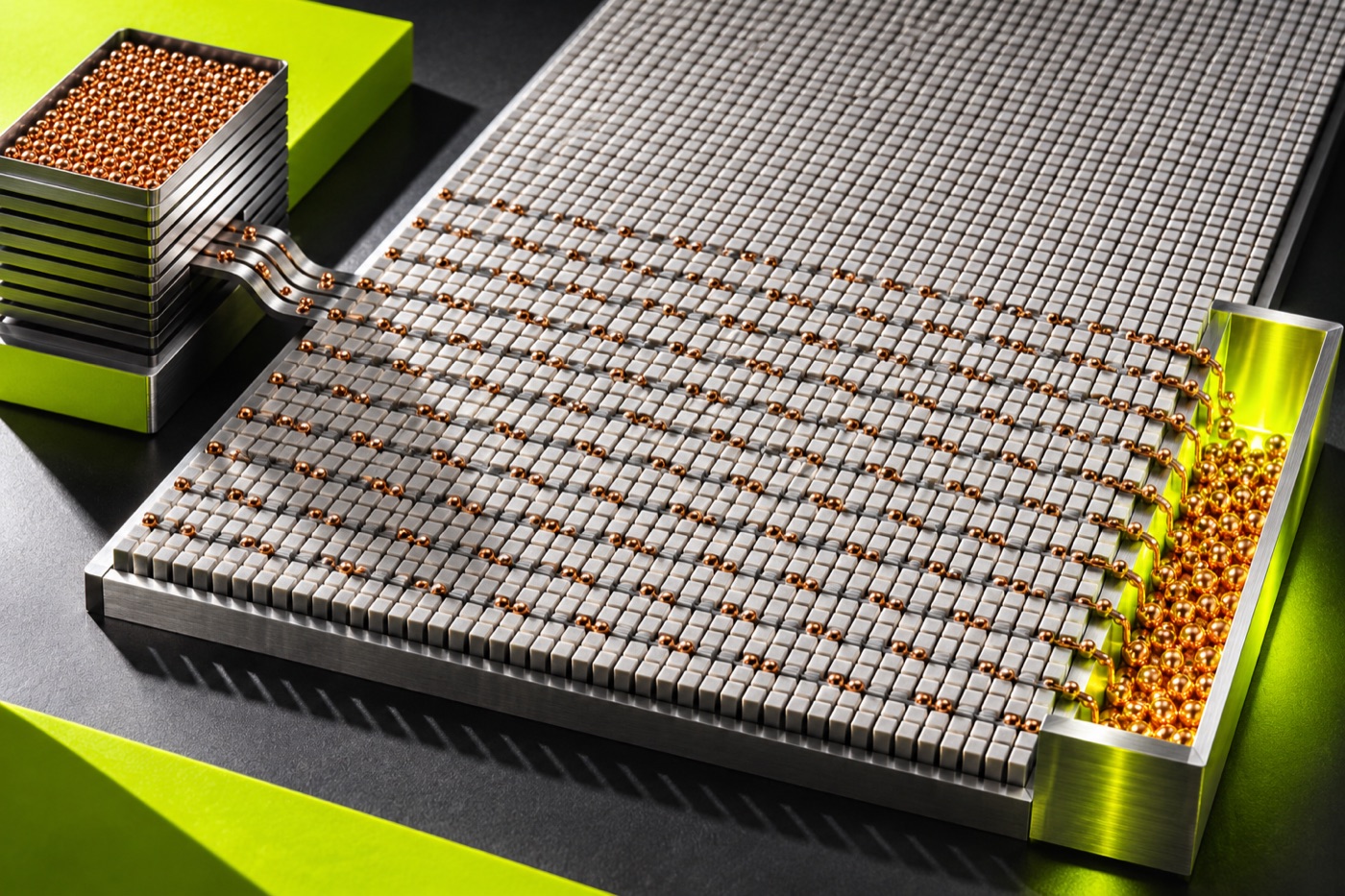
The first TPU is often summarized as “a giant matrix multiplier.” That is directionally useful but misses the engineering choice: move a predictable neural-network workload through a specialized datapath while keeping reusable values close to the arithmetic. Google’s 2017 ISCA paper documented the architecture and compared it with CPU and GPU systems used at that time. [1]
The workload shaped the chip
The paper describes a custom ASIC deployed in Google datacenters beginning in 2015 to accelerate neural-network inference. Google’s team was serving workloads in which matrix operations were common and the inputs, weights, and output shapes could often be prepared for a specialized execution path. This differs from training, where gradients and optimizer state add memory and numerical requirements, and from general computing, where branches and irregular workloads are normal.
The central unit is a matrix multiply engine containing 65,536 8-bit multiply-accumulate units. The paper reports a peak of 92 trillion operations per second under its stated counting convention. It also describes 28 MiB of software-managed on-chip memory. These figures are architecture facts for this TPU generation; “operations per second” is not a direct measure of application latency or model quality. [1]
Why arrange compute as a grid?
A conventional processor repeatedly moves values between memory and arithmetic units. A systolic array instead streams values through neighboring processing elements on a fixed schedule. In matrix multiplication, one operand can move across a row while another moves down a column; each cell multiplies incoming values and accumulates a partial result. Data movement is part of the computation’s structure rather than an unpredictable sequence of general instructions.
This can reduce repeated trips to external memory, but it does not eliminate the memory system. Inputs and weights still need to reach the array, partial results need storage, and the host software must arrange the work. The TPU paper describes a large software-managed on-chip buffer for these values and a matrix unit tuned to the supported low-precision inference operations. The design is effective when the workload can use that path; irregular control flow or unsupported operations may need another processor. [1]
Deterministic execution and tail latency
The paper emphasizes response-time behavior as well as throughput. General-purpose CPUs and GPUs use features such as caches, out-of-order execution, and multithreading to improve average performance across broad workloads. Those mechanisms can make exact execution time vary. A specialized accelerator has fewer general-purpose features but can provide a more predictable execution path for the operations it supports.
That does not mean the TPU has a guaranteed end-to-end latency for every request. Queueing, host-side preparation, memory transfers, batching, and the model graph all contribute to a serving path. The architecture can make one part more predictable; application-level tail latency remains a system property.
Read the benchmark in its historical frame
The authors compared the TPU with a server-class Intel Haswell CPU and an NVIDIA K80 GPU using production neural-network applications from their datacenter. They report an average 15–30× speed advantage and 30–80× performance-per-watt advantage over those contemporary platforms for the measured workloads. The paper also discusses utilization differences and models what changing the TPU’s memory system could do. Those are results of that study, not a current ranking of TPU, GPU, or CPU products. [1]
The first-generation device used 8-bit integer arithmetic for inference. It did not use bfloat16; that format and later TPU pod architectures belong to subsequent generations. Google’s historical account describes the original accelerator and the product’s evolution, while current Google Cloud documentation explains today’s TPU system and host topology. Keep generation boundaries clear when comparing hardware. [2] [3]
The broader lesson: move data with the math
A specialized accelerator is a bet about the shape of future work. If model execution is dominated by dense, repeated tensor operations, a fixed dataflow can use silicon and memory bandwidth efficiently. If the workload changes, the compiler cannot map a needed operator, or values cannot stay local long enough to amortize movement, that advantage narrows.
When evaluating an accelerator, ask which generation and numerical formats are supported, which operators run on the device, how host/device transfers behave, what the benchmark measured, and whether the deployment’s batch and latency targets match the tested workload. Peak arithmetic throughput alone cannot answer those questions.
Do
- Attribute TPU numbers to the first-generation design and the paper’s stated inference workloads.
- Separate peak arithmetic throughput from end-to-end serving latency.
- Check how compiler support, memory movement, batching, and fallback operators affect your own model.
Don't
- Do not apply the 2017 comparison to current chips or arbitrary neural networks.
- Do not describe the first TPU as a bfloat16 training accelerator.
- Do not infer that systolic arrays remove all memory bottlenecks.
The original TPU matters because it shows how workload knowledge can reshape a processor. The lasting idea is the close coordination of arithmetic, data reuse, and software—not the claim that one accelerator wins every benchmark.
Frequently asked questions
Was the first TPU designed for training large language models?
No. The 2017 paper evaluates a first-generation TPU deployed for neural-network inference. Later TPU generations added broader capabilities, but those should not be projected back onto this design.
What is a systolic array?
It is a grid of processing elements that pass data to neighboring elements on a schedule. In the TPU paper’s matrix unit, this movement enables many multiply-accumulate operations while reusing values on chip.
Did the 2017 TPU use bfloat16?
The paper describes an 8-bit integer matrix unit for inference. Bfloat16 claims belong to later Google TPU designs and must not be used to describe this first-generation chip.
Did the TPU outperform every CPU and GPU?
The paper compared the TPU with contemporary CPU and GPU platforms on a selected set of production neural-network inference workloads. Its reported speed and efficiency results are workload- and generation-specific, not a universal ranking.
Sources & further reading
Keep reading

Google Duplex Moves Into Gemini Tasks, Where Phone Calls Become an Agent Boundary
Google describes Duplex's shift from scripted calls to Gemini Tasks. Here is how live turn-taking works and what businesses can control.
Google Agent Registry Adds MCP Policy Hints, Not an Access Boundary
Google Cloud's Agent Registry adds preview IAP and human-review metadata for MCP tools. Learn what these hints clarify and what still must enforce access.
GPT-Live Standby Pauses Inference Without Closing a WebRTC Session
OpenAI’s standby mode pauses inference in silence and resumes on speech, trading lower idle rates for wake-up delay and an open microphone.
/* Comments */
Comments are offline right now — we reconnect automatically, nothing is lost.