
AI Protein Design Still Has to Pass Through the Lab
OpenAI reports lab evidence for GPT-6.2 protein designs, with specialist models still filtering candidates. Here is what the experiment shows—and leaves open.
On this page
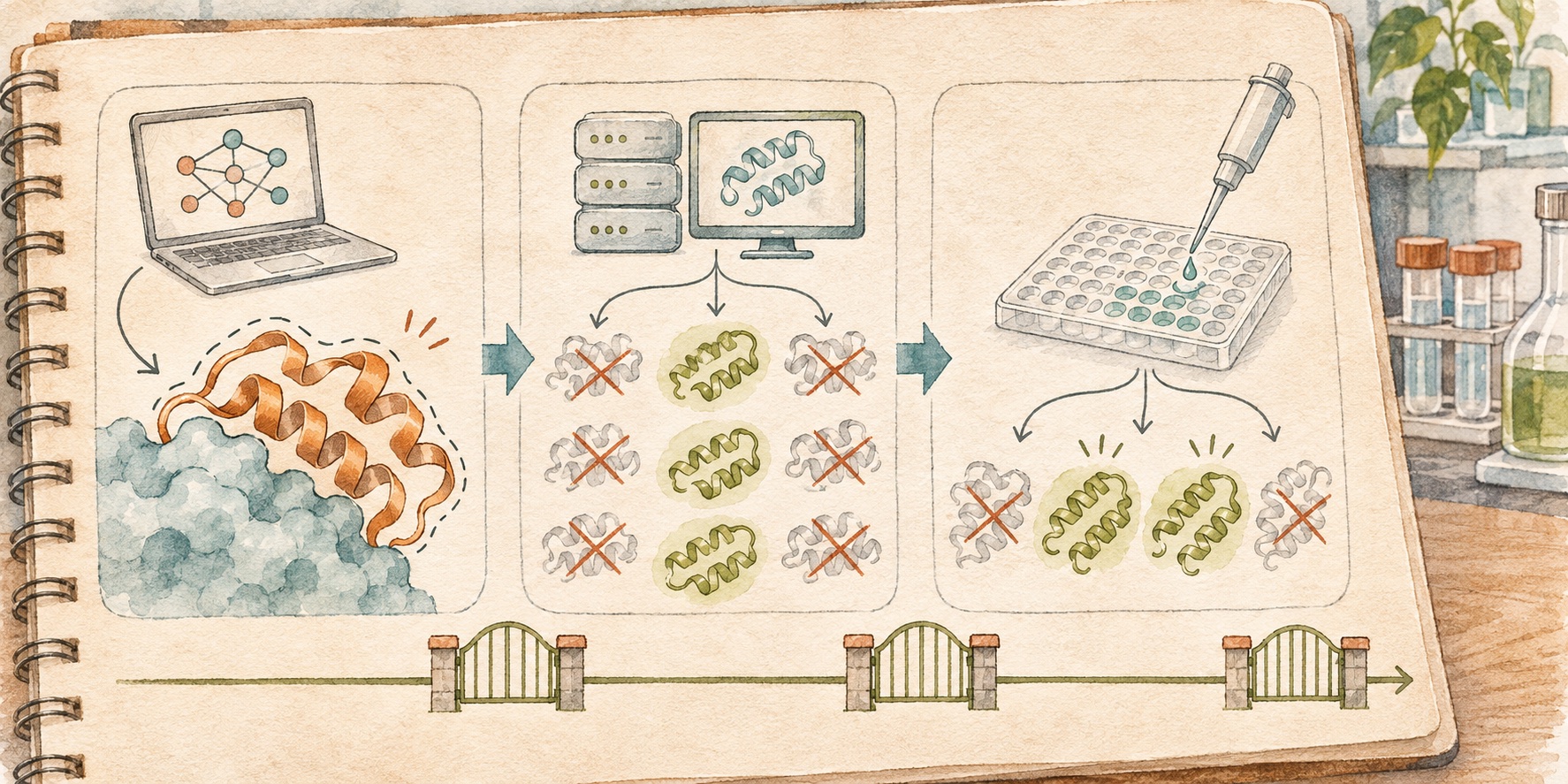
A protein design is not a protein that works. That gap is the key to reading OpenAI’s November 24 report on GPT-6 models and protein design. The company describes models proposing three-dimensional protein structures and sequences, then reports laboratory tests in which some designed candidates bound to chosen targets. It is evidence that a general-purpose model can contribute to a real design workflow—but the workflow still relied on specialized tools and experimental filtering.
The distinction matters because “AI designed a binder” can sound like a single autonomous step. In the reported experiment, the steps were separate: GPT-6.2 proposed shapes for small proteins intended to attach to five target proteins; specialized systems suggested amino-acid sequences and helped select candidates predicted to fold as intended; a research partner made and tested selected proteins in the lab. OpenAI says 35 of 322 tested minibinders showed binding to their intended target, about 10.9 percent by its reported count.[1] [2]
That result is a concrete experimental signal. It is not evidence that the model independently produced a complete therapeutic candidate or that a binder will alter disease, be safe in a person, or survive further development. Binding is one measured interaction in a much longer chain of biological questions.
What “intrinsic” means in this report
OpenAI uses “intrinsic protein capabilities” to describe models reasoning about protein structures and designs with general-purpose coding tools rather than calling specialized protein-design models to create the initial design. The company reports computational evaluations involving binding, motif scaffolding, fold design, sequence redesign, and structure prediction. Those are different tasks with different success criteria; performance on one does not imply mastery of the others.
The lab pathway also shows where specialized systems remain. OpenAI says SolubleMPNN supplied amino-acid sequences for the proposed shapes, while other specialist models helped choose candidates for laboratory evaluation. In a separate redesign experiment, models generated new sequences for existing minibinders and antibodies, then specialized selection tools again helped determine what to test. That division of labor is not a weakness to hide: it is the current mechanism behind the result.
The reported hit count also needs a comparator caveat. OpenAI notes that the original RFdiffusion study reported higher hit rates, but that hit rates depend heavily on filtering and on how binding is defined. Comparing raw percentages across different candidate-selection pipelines can therefore mislead. The meaningful question is not merely “which number is larger?” but which designs were tested, what selection steps preceded the assay, what threshold counted as a hit, and whether the experiment can be independently reproduced.[3]
The capability frontier is uneven
The company’s own report describes a jagged profile. GPT-6 models performed competitively on several design tasks, while predicting a complete protein structure from its sequence remained substantially weaker than specialized structure-prediction systems. That is an important distinction for readers: the ability to construct a shape under constraints is not the same as reliably predicting how an arbitrary sequence folds.
Even within design, computational checks and wet-lab measurements answer different questions. A predicted structure can resemble a desired shape without producing a stable molecule. A stable candidate can fail to bind. A binder can bind but still fail to produce the intended biological effect. The experimental stage converts one class of model claim into physical evidence, but it does not settle every later stage.
This is why the article’s most useful takeaway is a workflow lesson rather than a product verdict. General reasoning and code may help explore candidate structures or adapt a design to constraints. Specialist predictors can narrow the search. Laboratory work establishes whether selected candidates behave as predicted. Each handoff has its own assumptions and error modes.
How to evaluate future claims
When a new protein-design result appears, ask four questions. First, what exactly did the model create: a backbone shape, a sequence, a binding pose, or a complete candidate? Second, which specialist models or human decisions supplied sequences, filtering, or assay selection? Third, how many candidates were physically tested, and what was the pre-test selection process? Fourth, what did the assay measure—and what is still needed before claiming biological or clinical value?
A credible report should make those steps visible, including unsuccessful candidates and the definition of a positive result. Benchmarks can help compare components, but they cannot replace a reproducible lab workflow. For readers outside biology, the same discipline applies to AI claims in any technical field: separate the model’s proposed output from the tools that validate it and from the real-world outcome that matters.
OpenAI’s results make protein design a more interesting capability to watch. The evidence is strongest when described precisely: GPT-6.2 helped generate structures that, after specialist sequence design and candidate selection, produced a measurable set of binding hits in a laboratory test. That is meaningful progress, and it remains several steps short of an independently validated medicine.
Related reading
For a different kind of AI-enabled engineering, read our analysis of AI-assisted chip design and verification. For the software-engineering parallel, see when code is free: orchestration and verification platforms.
Frequently asked questions
Did GPT-6.2 design and validate a new protein without other models?
No. OpenAI says GPT-6.2 generated three-dimensional designs, while specialized models supplied candidate amino-acid sequences and helped filter which designs were likely to fold and bind before laboratory testing. The experiment is evidence of a useful design contribution, not an end-to-end model-only pipeline.
How many OpenAI-designed minibinders showed binding in the reported lab test?
OpenAI reports testing 322 minibinders against five targets, with 35 testing positive for binding under its assay definition. The result is an early experimental signal; it does not show clinical usefulness, therapeutic effect, safety, or general success across arbitrary targets.
Sources & further reading
Keep reading

OpenAI’s Healthcare API Adds a Clinical Search Path, Not PHI Permission
OpenAI’s healthcare API adds a clinical search path. Developers still need source review and a separate BAA before handling PHI.
BigQuery AI Index Makes Natural-Language Search a Managed Service
Google’s preview AI indexes simplify semantic table search, but column limits, incomplete coverage and background processing costs still shape production use.
Coding Agents Accelerate Research Unevenly: The Task Mix Is the Metric
OpenAI reports that agent success varies by research task. Learn how to evaluate task outcomes and human review rather than usage alone.
/* Comments */
Comments are offline right now — we reconnect automatically, nothing is lost.