
How Grab Built an AI Multi-Agent Platform to Reclaim Engineering Velocity
How Grab deployed specialized AI multi-agent swarms to resolve internal data help-desk tickets, saving senior engineers two full days a week.
On this page
At Grab, Southeast Asia’s leading superapp operating ride-hailing, food delivery, and digital payments across eight countries, data is the lifeblood of physical operations. Thousands of microservices generate petabytes of telemetry powering dispatch algorithms, dynamic pricing, and driver incentives.
However, scaling to thousands of engineers across Singapore, Jakarta, and Seattle created an acute internal productivity crisis: developer help-desk congestion.
Every week, internal Slack channels were inundated with repetitive operational questions from product analysts, software engineers, and business operators:
- “Where can I find the table containing Singapore passenger cancellation reasons from 2024?”
- “Why is the daily merchant payout Airflow DAG delayed today?”
- “Which upstream pipeline populates the driver rating feature in the dispatch database?”
Senior data platform engineers were spending two full working days every week manually looking up schemas, tracing pipeline lineage, and answering Slack questions. Deep architectural engineering ground to a halt.
To reclaim engineering bandwidth, Grab built an internal Multi-Agent Productivity Platform. This case study explores how Grab architected the system, why single-agent RAG failed, and what broke during initial production rollout.
Why Single-Prompt RAG Failed
Grab initially attempted to solve the problem by connecting a standard RAG pipeline to their internal Confluence and Slack documentation.
The single-agent RAG architecture failed in production for three structural reasons:
- Stale Documentation: Documentation in Confluence is perpetually out of date. An authoritative answer requires inspecting live PostgreSQL schemas and active Airflow DAG code in Git, not obsolete wiki pages.
- Multi-Hop Dependency Traversal: Answering “Why is the payout table delayed?” requires a multi-step investigation: querying the Airflow API for running jobs, identifying a failed upstream Spark task, and extracting the exception stack trace.
- Hallucinated Column Names: Standard language models hallucinate plausible column names (
user_cancellation_reasoninstead ofcancel_code_v2), producing broken SQL queries.
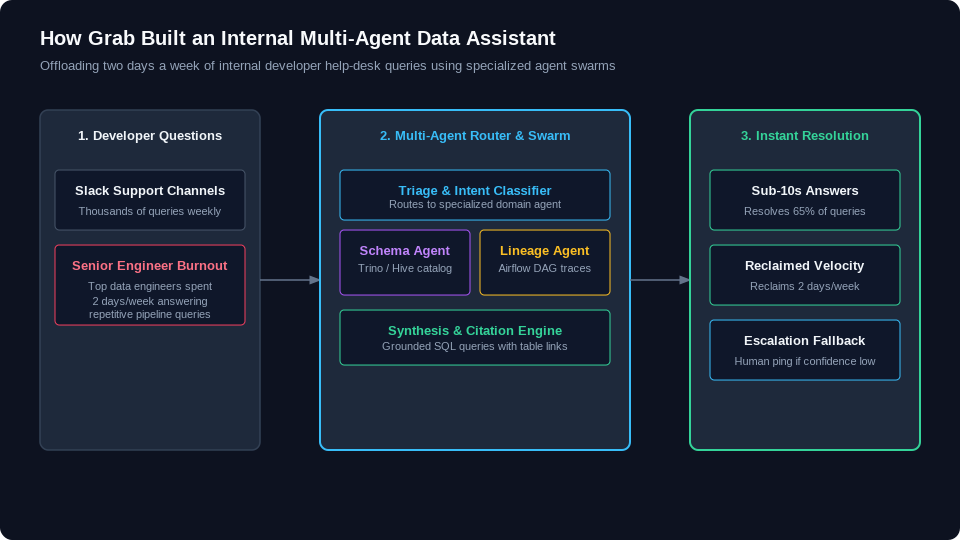
The Specialized Multi-Agent Architecture
Grab abandoned the monolithic single-agent model in favor of an Orchestrator-Worker Multi-Agent Swarm:
1. The Triage Router Agent
When a question arrives via Slack, the Triage Router classifies user intent and decomposes complex questions into targeted sub-tasks, routing work to domain specialists.
2. The Schema and Catalog Agent
Connected via MCP to Grab’s Trino and Apache Hive metastores. It validates table existence, inspects active partition keys, and checks data freshness timestamps against live cluster metadata.
3. The Lineage and DAG Agent
Equipped with specialized tools to parse Git repositories and Airflow execution logs. It constructs dependency graphs on the fly, tracing upstream dependencies and identifying failing pipeline jobs.
4. The Synthesis and Citation Agent
Merges findings from the specialist agents, formats working SQL snippets with verified column names, and returns a concise Slack reply complete with deep links to internal observability dashboards.
What Broke in Production: The Reality of Agent Tooling
Deploying agents across enterprise systems revealed painful real-world edge cases:
- Permission Leaks: Early agent prototypes answered questions by querying tables that the requesting human lacked permission to view. Grab introduced strict impersonation headers: the agent executes all queries using the requesting developer’s Okta OAuth identity.
- Runaway Token Consumption: When an engineer asked a broad question (“Tell me about all driver tables”), early agents attempted to pull 500 table schemas into the context window simultaneously. Grab enforced strict pagination and truncation filters.
- The “I Don’t Know” Imperative: If an agent is only 70% confident, attempting to guess an answer destroys developer trust. Grab calibrated confidence thresholds: if evidence is ambiguous, the agent explicitly declines and pings the on-call human on duty.
Measurable Production Results
- Reclaimed Bandwidth: Senior data platform engineers reclaimed over 1.5 to 2 days per week, shifting focus back to core platform infrastructure.
- Instant Response Times: Over 65% of repetitive internal questions are resolved autonomously in less than 10 seconds, compared to an average 4-hour human wait time previously.
- Accurate SQL Generation: Enforcing live metastore schema lookups eliminated column name hallucinations in over 92% of generated queries.
Key Lessons for Enterprise AI Builders
- Query Ground Truth, Not Stale Wikis: Agents must inspect live source-of-truth systems (Git, Metastores, APIs) rather than static documentation.
- Decompose Across Specialized Agents: A swarm of narrow agents with small, dedicated toolsets consistently outperforms a bloated generalist agent.
- Enforce User-Context Impersonation: An agent must never act as a backdoor around enterprise role-based access control (RBAC).
Keep reading

Google Duplex Moves Into Gemini Tasks, Where Phone Calls Become an Agent Boundary
Google describes Duplex's shift from scripted calls to Gemini Tasks. Here is how live turn-taking works and what businesses can control.

Google Agent Registry Adds MCP Policy Hints, Not an Access Boundary
Google Cloud's Agent Registry adds preview IAP and human-review metadata for MCP tools. Learn what these hints clarify and what still must enforce access.

GPT-Live Standby Pauses Inference Without Closing a WebRTC Session
OpenAI’s standby mode pauses inference in silence and resumes on speech, trading lower idle rates for wake-up delay and an open microphone.
/* Comments */
Comments are offline right now — we reconnect automatically, nothing is lost.