topic: ai-technology
author: Crashtech Editorial
date: Oct 7, 2026 · read: 2 min
updated: October 8, 2026
---
GraphRAG Explained: When Graphs Help Retrieval and Global Summaries
GraphRAG adds entity relationships and community reports to retrieval. It can improve broad summaries; extraction errors still need evaluation.
On this page
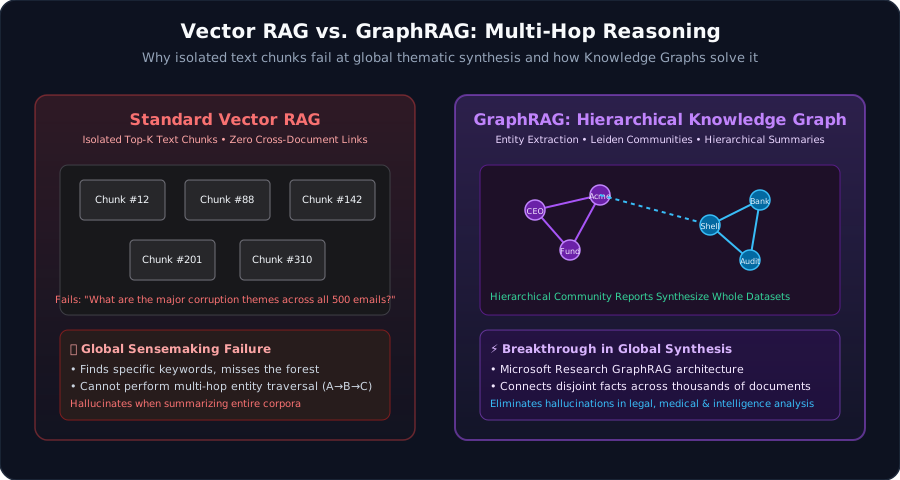
Conceptual architecture; arrows show relationships, not measured latency, energy or safety guarantees.
Local evidence and global questions
A question about one contract may be answered by a few matching passages. A question about recurring themes across thousands of contracts needs broader coverage. Taking a small top-k sample can omit important parts of the collection.
Microsoft’s GraphRAG paper studies global sensemaking questions and reports improvements in comprehensiveness and diversity over its conventional RAG baseline. Those findings do not establish universal accuracy rates for legal, medical or financial decisions. [1]
Vector retrieval can also participate in multi-step pipelines, query expansion and reranking. It is inaccurate to say that storing embeddings makes cross-document reasoning structurally impossible.
Build a graph, then summarize communities
The published approach extracts entities and relationships from source text, forms a graph and generates reports about groups of related entities. The graph and summaries provide additional routes into the source collection. [1]
Leiden is a community-detection method designed to improve the connectedness of graph partitions. A well-connected community is a structural property of the graph, not proof that the extracted relationships are factually true. [3]
Graph databases can support variable-length traversal. They are not restricted to one-hop or two-hop questions merely because they use an explicit schema.
Match retrieval to the question
GraphRAG’s documentation distinguishes local and global search approaches. Entity-focused questions can use related entities, relationships and source passages; broad questions can use community reports and aggregate intermediate answers. [2]
The indexing stage adds model calls, configuration and maintenance. Changes to the source collection may require updating derived relationships and summaries. Query latency and cost depend on the strategy, model and corpus; graph indexing is not an automatic latency reduction.
Evaluate the whole evidence path
Start with representative questions whose relevant sources are known. Compare answer coverage, factual support, cost, latency and behavior when the answer is absent. Inspect errors introduced during extraction as well as mistakes in the final answer.
In a restricted collection, the graph and every derived report must respect access boundaries. A report generated from documents a user cannot read may leak information even if the final retrieval step filters document IDs.
Choose GraphRAG when these additional structures improve the actual task enough to justify their cost. Retain simpler retrieval where it performs adequately, and keep the supporting passages available for review.
Frequently asked questions
Does GraphRAG eliminate hallucinations?
No. Entity extraction, community reports and final answers can contain errors. Evidence links, evaluation and appropriate abstention remain necessary.
When is GraphRAG useful?
It is a candidate for questions spanning many documents, especially global themes and entity relationships. Its additional indexing and maintenance costs should be compared with a simpler retrieval baseline.
/* Comments */
Comments are offline right now — we reconnect automatically, nothing is lost.