Grok 4.5 Ships, xAI Calls It Opus-Class at a Third of the Price
xAI's Grok 4.5 prices coding at $2/$6 per million tokens, undercutting the $5/$25 Musk quoted for Opus 4.7 — but the AA Index ranks it behind Opus 4.8.
On this page
For a lab that spent two years being asked when it would ship something developers actually reach for, xAI’s answer arrived on July 8 with a specific number attached to it: a third of the price of Anthropic’s flagship, and — according to Elon Musk — comparable quality. The model is Grok 4.5, it was built in an unusually literal partnership with a $60 billion acquisition, and the claim attached to it is the kind that invites exactly the scrutiny it’s about to get.
What exactly did xAI ship on July 8?
xAI, operating under the SpaceXAI banner, released Grok 4.5 on Wednesday, July 8, 2026, with wider public availability following the next day, according to TechCrunch. The model is priced at $2 per million input tokens and $6 per million output tokens — a base rate Bloomberg reports sits alongside a faster, premium tier at $4 input and $18 output per million tokens for teams that want lower latency on agentic workloads. It’s available immediately in Cursor’s desktop, web, iOS, and CLI apps, in xAI’s own Grok Build tool, and through the SpaceXAI console — though Axios reports it isn’t yet available to users in the European Union.
That distribution list is the tell. Grok has historically shipped as a consumer chatbot bolted onto X. Grok 4.5 shipped as infrastructure, live inside a third-party coding tool on day one, which only makes sense in light of who owns that tool now.
Why does the Cursor deal matter more than the price tag?
Because Grok 4.5 isn’t just priced to compete with Cursor’s other model options — it was built using Cursor’s own data, from a company SpaceX now owns. Bloomberg reports SpaceX formally agreed to acquire Cursor in a deal valuing the startup at $60 billion just weeks before Grok 4.5 shipped, and that Grok 4.5 marks the first joint model developed by the two companies. Unlike earlier Grok releases built for general chatbot use, Bloomberg describes this one as designed mainly for software engineering, legal work, financial analysis, and AI agents — a deliberate pivot toward enterprise and knowledge-work tasks rather than consumer conversation.
Axios adds the mechanics behind that pivot: Grok 4.5 was co-trained with Cursor on tens of thousands of Nvidia GB300 GPUs, and Cursor CEO Michael Truell’s team contributed trillions of tokens of developer session data — real code edits, debugging traces, and user-agent interactions pulled directly from the Cursor platform. That’s a materially different training input than scraped web text or synthetic coding benchmarks; it’s the recorded behavior of working developers, owned outright by the company now training a model on top of it.
When the company that owns your coding tool also trains the model graded on how well it codes, the usual “independent benchmark” framing gets more complicated. None of the four sources here allege anything improper about how Grok 4.5 was evaluated — but the Cursor acquisition means xAI now controls both the training pipeline and a chunk of the developer workflow it’s being judged against.
Does the “Opus-class” claim survive contact with the numbers?
Partly. Musk’s line to TechCrunch was precise and quotable: Grok 4.5 is “an Opus-class model, but faster, more token-efficient and lower cost.” He followed up with a second, more specific comparison — that it’s “roughly comparable to Opus 4.7, but much faster.” TechCrunch put a number on that second quote: Opus 4.7, Musk’s actual benchmark, “costs $5 per million input tokens and $25 per million output tokens.” But Opus 4.7 is Anthropic’s previous-generation flagship — the model Grok 4.5 is actually measured against on independent rankings is Claude Opus 4.8, a newer release that none of the four sources here put a public per-token price on. Musk’s own comparison point, in other words, is one generation behind the model doing the actual ranking.
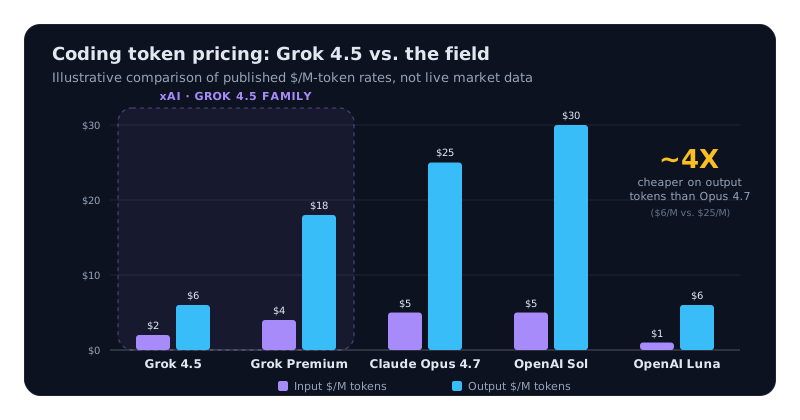
| Model | Input ($/M tokens) | Output ($/M tokens) |
|---|---|---|
| Grok 4.5 | $2 | $6 |
| Grok 4.5 (premium tier) | $4 | $18 |
| Claude Opus 4.7 (Musk’s quoted comparison) | $5 | $25 |
| OpenAI Sol | $5 | $30 |
| OpenAI Luna | $1 | $6 |
On the independent side, Grok 4.5 ranked fourth on the Artificial Analysis Intelligence Index — ahead of every open-weight model and all of Google’s Gemini models, a genuinely strong result for a lab that has spent most of the last two years playing catch-up. But fourth place means three models scored higher, and Claude Opus 4.8 — not the Opus 4.7 Musk quoted a price against — is one of them. “Opus-class” turns out to be a real description of the price bracket Grok 4.5’s namesake generation competes in — it’s a less settled description of where Grok 4.5 itself ranks against the version actually sitting above it. That ambiguity tracks a wider pattern this year, as more of the industry starts asking whether AI benchmarks themselves have become untrustworthy the more commercially loaded they get.
Co-trained on Cursor developer session data. Ranked 4th on the Artificial Analysis Intelligence Index — above every open-weight and Gemini model. Priced roughly 60% below the $5/$25 Opus 4.7 rate Musk quoted. Built for coding, legal, and financial-analysis agents, not general chat.
The model Musk actually quoted a price against, per TechCrunch. Costs roughly 4x Grok 4.5 on output tokens. The newer Opus 4.8 — unpriced in these sources — is the model that actually outranks Grok 4.5 on the Artificial Analysis Index.
What does this mean for developers picking between Grok and Claude?
It means the decision is now genuinely a cost-versus-rank tradeoff rather than an obvious call in either direction. At $2/$6 per million tokens, Grok 4.5 is cheap enough that high-volume agentic workloads — the kind that burn through tens of thousands of output tokens per task — could see real budget relief switching over, especially for teams already living inside Cursor, where Grok 4.5 is now a native option alongside every other model on the platform. But “fourth on the Intelligence Index” is not the same claim as “beats Opus 4.8,” and teams evaluating this for anything latency-tolerant or quality-critical should weigh the independent ranking as heavily as the sticker price.
Do
- Benchmark Grok 4.5 against your own codebase and task mix, not xAI’s headline framing
- Read Musk’s “Opus-class” quote alongside his separate “comparable to Opus 4.7” quote — they’re not describing the same model
- Factor in the $2/$6 vs. $5/$25 gap for high-token agentic workflows, where the savings compound fast
- Check EU availability before committing a European team’s workflow to it
Don't
- Don’t assume “Opus-class” branding means benchmark parity with Anthropic’s current flagship
- Don’t extrapolate coding-agent performance to general reasoning or chat quality
- Don’t ignore that the Artificial Analysis Intelligence Index still ranks Grok 4.5 fourth overall, with Opus 4.8 among the models ahead of it
- Don’t treat a Cursor-trained model’s Cursor benchmarks as a fully neutral evaluation
The more durable story here isn’t really about whether Grok 4.5 is “as good as” Opus 4.8 — it’s about what happens when a frontier lab acquires the tool developers use to work and starts training its models directly on the resulting behavior data. xAI didn’t just ship a cheaper model this week; it demonstrated a new supply chain for one, and every other lab racing to keep pace on price is now also racing to answer where their own training data comes from. That pressure lands squarely on Anthropic too, which is pushing toward an IPO built substantially on Opus-tier pricing power now facing its first real discount challenger.
Frequently asked questions
How does Grok 4.5's pricing compare to Claude Opus?
Grok 4.5 costs $2 per million input tokens and $6 per million output tokens. Musk's own benchmark, Claude Opus 4.7, costs $5 input and $25 output per TechCrunch — roughly a 4x gap on output tokens. Bloomberg also reported a faster Grok 4.5 tier at $4 input and $18 output per million tokens for higher-throughput agentic workloads.
What is Grok 4.5's connection to Cursor?
xAI co-trained Grok 4.5 using developer session data from Cursor, the coding assistant SpaceX agreed to acquire for $60 billion weeks earlier. Per Axios, Cursor CEO Michael Truell's team contributed trillions of tokens of real code edits, debugging traces, and agent interactions from the Cursor platform.
Did Grok 4.5 actually beat Claude Opus in independent testing?
Not outright. Grok 4.5 ranked fourth on the Artificial Analysis Intelligence Index — ahead of every open-weight model and all Gemini models — but still behind the top proprietary tier, even as Elon Musk called it an 'Opus-class model, but faster, more token-efficient and lower cost.'
What did Elon Musk actually say about Grok 4.5 versus Opus?
Musk told TechCrunch Grok 4.5 was 'an Opus-class model, but faster, more token-efficient and lower cost,' then added it was 'roughly comparable to Opus 4.7, but much faster' — comparing his new model to Claude Opus 4.7 rather than the newer Opus 4.8 that actually outranks Grok 4.5 on the Artificial Analysis Index.
When and where did Grok 4.5 launch?
Grok 4.5 launched July 8, 2026, in Cursor's desktop, web, iOS, and CLI apps, plus the SpaceXAI console and Grok Build, with broader public availability the next day. Axios reported the model is not yet available to users in the European Union.
Sources & further reading
Keep reading

Meta’s New Feed Controls Make a Promise. The Ranking System Still Decides.
Facebook’s natural-language feed controls make preference editing easier, but the platform still translates each request into ranking signals.

RTX Spark Could Bring AI Development to Your Desk—With New Tradeoffs
NVIDIA’s compact GB10 system promises local coding and model work, but shared memory, ARM software support and workload fit still decide its value.
Reflection Beam Is Open-Weight. Your Deployment Still Has a Memory Problem.
Beam’s Apache-licensed weights widen access, but 501 billion total parameters make hosting, memory and evaluation the real decisions.
/* Comments */
Comments are offline right now — we reconnect automatically, nothing is lost.