
MCP vs Agent Skills: Tool Interfaces Versus Procedural Engineering Know-How
Understand the architectural boundary between the Model Context Protocol (MCP) and Agent Skills: tool calling, context consumption, and workflows.
On this page
As autonomous AI agents evolve from simple chat completions into production engineering assistants, developers face an expanding vocabulary of extensibility mechanisms: Model Context Protocol (MCP) servers, Agent Skills, plugins, function calling, and system prompts.
Because both MCP and Skills allow agents to perform complex technical tasks, developers frequently conflate them:
- “Should I build an MCP server to enforce our git commit format, or should I write an agent skill?”
- “Does an agent skill replace our database MCP connector?”
These questions reveal a fundamental misunderstanding of the AI agent runtime. MCP and Skills operate at completely different layers of the software stack. Conflating them leads to bloated context windows, fragile agent loops, and wasted engineering effort.
This guide clarifies the architectural boundaries between MCP and Agent Skills: examining transport layers, context budget costs, and how the two technologies work together in production.
The Core Distinction: Connection vs Knowledge
To understand the difference, consider human software engineers:
- An engineer needs hands and tools (a laptop, a shell, an SSH key, a database client) to interact with physical systems.
- An engineer also needs knowledge and procedures (knowing the runbook to recover a crashed database replica, understanding the team’s Git branching doctrine).
In the agent architecture:
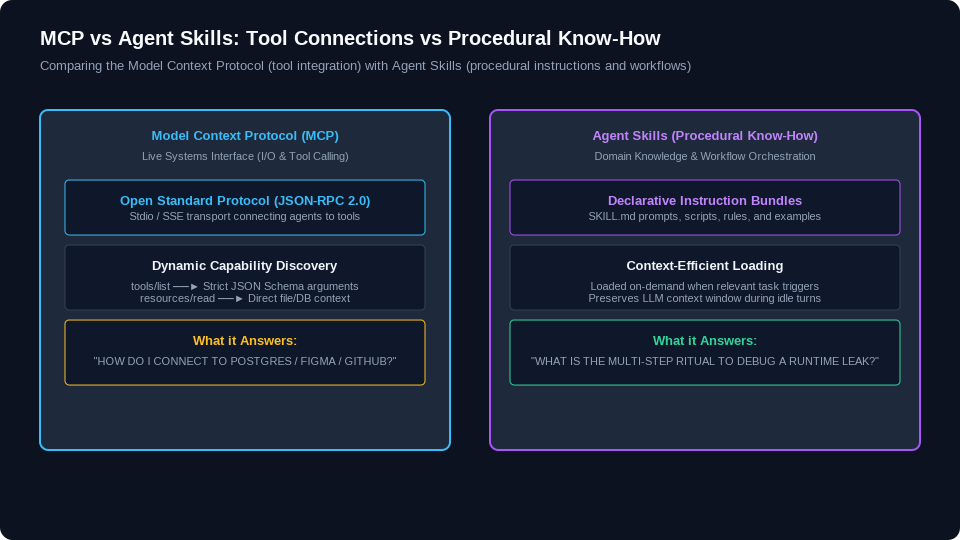
- MCP is the tool interface: It defines how an agent physically invokes an external API or reads a database.
- Skills are the engineering knowledge: They define the multi-step reasoning, constraints, edge-case playbooks, and best practices the agent follows when executing a task.
1. Model Context Protocol (MCP): The System Bus
Developed as an open standard by Anthropic, the Model Context Protocol (MCP) is a standardized JSON-RPC 2.0 communication protocol connecting LLM clients to local or remote servers.
Core Architecture:
- Transport Independence: Runs over
stdio(for local CLI processes) or HTTP Server-Sent Events (SSE) (for remote microservices). - Tool Discovery (
tools/list): The server publishes machine-readable JSON schemas describing available functions (for example,query_postgres(sql_string)orcreate_linear_issue(title, team_id)). - Resource Reading (
resources/read): Allows agents to pull contextual files, log streams, or schema definitions without invoking complex multi-turn commands. - Stateless Execution: An MCP server does not tell the agent when or why to run a query. It simply exposes the capability and executes requests faithfully.
2. Agent Skills: On-Demand Procedural Intelligence
An Agent Skill is a structured bundle of instructions, domain heuristics, scripts, and evaluation criteria packaged inside a repository.
Core Architecture:
- Declarative Frontmatter (
SKILL.md): Contains triggers and descriptions instructing the host agent when to load the skill into memory. - Context Economy: Loading documentation for twenty external platforms into an agent’s system prompt simultaneously exhausts context windows and degrades attention. Skills remain dormant until a matching prompt triggers on-demand activation.
- Multi-Step Workflows: A skill encodes the engineering playbook. For example, a
database-migration-skillinstructs the agent to:- Inspect the existing schema.
- Verify that new columns are nullable to prevent exclusive table locks.
- Draft the SQL migration file.
- Run synthetic regression tests before applying changes.
Architectural Comparison Matrix
| Dimension | Model Context Protocol (MCP) | Agent Skills |
|---|---|---|
| Primary Purpose | Connects agents to live external tools and APIs. | Teaches agents domain procedures and workflows. |
| Underlying Standard | JSON-RPC 2.0 protocol over stdio or SSE. | Markdown specifications (SKILL.md) + scripts. |
| Context Overhead | Heavy: JSON schemas must be loaded into tools. | Lightweight: Loaded dynamically only when invoked. |
| Execution Layer | Executed outside the LLM by the host runner. | Executed inside the LLM as reasoning guidance. |
| Security Boundary | Network proxies, API tokens, sandbox permissions. | Prompt boundaries, output validation assertions. |
| Ideal Use Case | Querying a PostgreSQL database or GitHub API. | Guiding a complete zero-downtime database rollout. |
How MCP and Skills Work Together in Production
The most effective agent architectures do not choose between MCP and Skills; they layer them symbiotically:
User Prompt: "Deploy the v2 billing schema update"
       │
       ▼
[ Agent Skill Activated: 'flocci-deploy' ]
  - Step 1: Instructs agent on safe migration sequencing
  - Step 2: Enforces backward compatibility check
       │
       ▼
[ MCP Tool Invocation: 'postgres-mcp' ]
  - Tool Call: execute_ddl("ALTER TABLE accounts ADD COLUMN tier VARCHAR(32);")
  - Returns: "Query executed in 14ms (0 rows affected)"
       │
       ▼
[ Agent Skill Post-Flight Check ]
  - Step 3: Verifies application health metrics
  - Step 4: Emits conventional commit message
By decoupling procedural reasoning (Skills) from physical system actuation (MCP), engineering teams build modular, maintainable, and secure AI-native developer workflows.
Keep reading

Google Duplex Moves Into Gemini Tasks, Where Phone Calls Become an Agent Boundary
Google describes Duplex's shift from scripted calls to Gemini Tasks. Here is how live turn-taking works and what businesses can control.

Google Agent Registry Adds MCP Policy Hints, Not an Access Boundary
Google Cloud's Agent Registry adds preview IAP and human-review metadata for MCP tools. Learn what these hints clarify and what still must enforce access.

GPT-Live Standby Pauses Inference Without Closing a WebRTC Session
OpenAI’s standby mode pauses inference in silence and resumes on speech, trading lower idle rates for wake-up delay and an open microphone.
/* Comments */
Comments are offline right now — we reconnect automatically, nothing is lost.