Microsoft Just Cut 4,800 Jobs — During Its Best Revenue Quarter Ever
Microsoft cut roughly 4,800 jobs (2.1% of staff) on July 6, 2026 — Xbox hit hardest — weeks after posting $82.9B in record quarterly revenue.
On this page
Microsoft doesn’t usually cut headcount when a business is struggling to make money — it cuts headcount when it’s decided that struggling to make money isn’t allowed to continue. On July 6, 2026, the company drew that line through roughly 4,800 jobs, and it drew it hardest through Xbox, which just absorbed what its own CEO called the most significant restructure in the division’s history.
What exactly did Microsoft announce on July 6?
Microsoft eliminated approximately 4,800 roles, or 2.1% of its global workforce. Chief People Officer Amy Coleman confirmed the number directly in the company’s own blog post: “Today we are eliminating around 4,800 roles, about 2.1% of our global workforce, as we focus our people, investments, and energy on the priorities that will keep Microsoft positioned to deliver for customers in a fast-changing industry.” The cuts spread across the Commercial organization — sales and consulting — and Xbox, with engineering teams touched as well, per TechCrunch’s reporting.
The company is not pretending this is painless or isolated. Coleman’s post notes more than 4,000 employees were redeployed into new roles over the past year, with another 500 redeployed this month alone, and that over 30% of eligible employees took a voluntary retirement offer extended earlier this year. None of that changes the headline number: 4,800 people are out, effective the same week the company’s fiscal fourth quarter was closing out.
Why did Xbox take the deepest cut?
Because, in Microsoft’s own telling, Xbox’s economics don’t look like Microsoft’s economics. Xbox CEO Asha Sharma was blunt about it: “Our business today is not healthy. We are operating at margins that are 3–10x lower than comparable platform and publishing businesses.” That’s the justification driving what she called “the most significant restructure in Xbox history” — 1,600 roles cut immediately, en route to roughly 3,200 total and about 20% of the global Xbox workforce by the end of fiscal 2027.
The restructuring goes beyond headcount. Xbox is collapsing its management structure from 14 layers down to a maximum of five, ideally three, and Helen Chiang has been named Xbox COO to help run the flatter org. Four studios are being pushed out of Microsoft’s direct ownership: Compulsion Games and Double Fine Productions become independent studios, while Ninja Theory and Undead Labs move under new ownership arrangements.
This isn’t only a layoff — it’s a divestment. Compulsion Games (Contrast, We Happy Few) and Double Fine (Psychonauts) were both first-party Microsoft studios; cutting them loose as independents is a different kind of decision than trimming a sales region. It signals Microsoft wants fewer, more concentrated internal studios and is comfortable letting smaller, lower-margin ones operate outside the corporate structure entirely.
Is AI actually replacing the workers who lost their jobs?
Microsoft says no, and says it plainly. Coleman’s post states: “The roles eliminated today are not being replaced by AI. At the same time, what is true is that AI is changing how work gets done.” Read literally, that’s a narrow, defensible claim — nobody is asserting a chatbot is now doing a laid-off salesperson’s job. But it’s also a carefully bounded one: it denies direct replacement without addressing whether AI-driven productivity gains are what let Microsoft decide it needs fewer people to hit the same commercial targets, or whether the capital now flowing to AI infrastructure is capital that would otherwise have funded those roles. It’s also a more careful denial than plenty of companies bother making — several employers that did blame AI outright for their layoffs are now struggling to show the productivity gains that justified the cuts.
Framed as organizational restructuring: eliminate roles tied to legacy priorities, redeploy where possible (4,000+ moved in the past year, 500 more this month), and align “people, investments, and energy” with where the industry is heading — per Amy Coleman’s July 6 post.
Microsoft’s most recently reported quarter posted $82.9 billion in revenue, up 18% year-over-year, $31.8 billion in net income, and $30.9 billion in capital spending in the quarter alone — funding an AI business already running at a $37 billion annualized pace, up 123% year-over-year.
How does a company post record numbers and cut thousands of jobs in the same breath?
Because “healthy company-wide” and “healthy in every division” are different claims, and Microsoft is only promising the first one. The company’s fiscal Q3 2026 results, reported April 29, 2026, showed $82.9 billion in revenue and Microsoft Cloud revenue of $54.5 billion, up 29%. None of these are Xbox numbers — gaming has never been where Microsoft’s growth story lives, and Sharma’s own words confirm the division has been running at a structural discount to the rest of the company for some time. Cutting the weakest-margin unit hardest, while the strongest-margin units (Cloud, AI) keep absorbing record capital spending, isn’t a contradiction. It’s exactly what you’d expect a company optimizing for margin, not headcount stability, to do. Record headline numbers not translating into safety is becoming the theme of this earnings season more broadly — TSMC posted record profit the same week its own stock sold off anyway.
That’s the pattern underneath the framing. The freed-up budget from 4,800 eliminated roles doesn’t need to go anywhere dramatic to make the math work — it just needs to not compete with the tens of billions already being committed to AI infrastructure every quarter. Microsoft also disclosed a $2.5 billion commitment to a new “Frontier Company” AI business unit alongside the transformation announcement, according to TechCrunch — new capital, arriving the same week as the cuts.
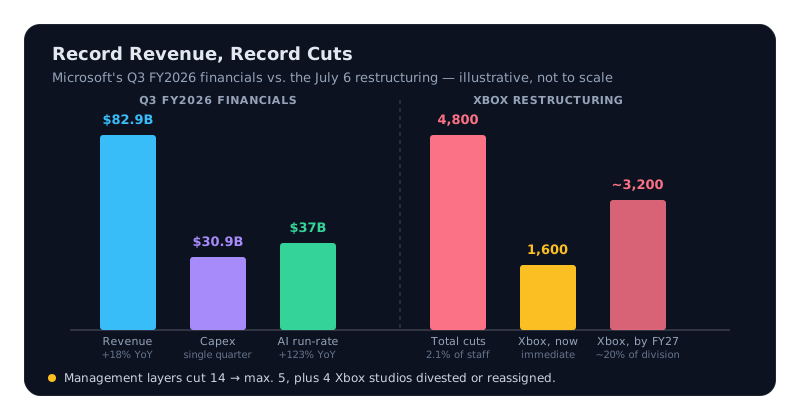
| What changed | Figure | Source |
|---|---|---|
| Total roles eliminated | ~4,800 (2.1% of global workforce) | Microsoft blog |
| Xbox cuts, immediate | 1,600 | TechCrunch |
| Xbox cuts, total through FY2027 | ~3,200 (~20% of division) | TechCrunch |
| Xbox management layers | 14 → max. 5 (ideally 3) | TechCrunch |
| Xbox studios divested/transferred | 4 (Compulsion, Double Fine, Ninja Theory, Undead Labs) | TechCrunch |
| Fiscal Q3 2026 revenue | $82.9B, +18% YoY | Microsoft investor relations |
| Fiscal Q3 2026 capital spending | $30.9B (single quarter) | Microsoft investor relations |
| New “Frontier Company” AI commitment | $2.5B | TechCrunch |
What does this mean for tech workers more broadly?
It means the “AI efficiency” layoff cycle isn’t slowing down, and profitability isn’t the shield workers might assume it is. Microsoft’s July 6 cuts land inside a stretch that has already seen roughly 154,000 tech jobs eliminated industry-wide in the first half of 2026, per TechCrunch’s reporting — and Microsoft itself isn’t a first-time participant. The company cut around 15,000 roles across 2025 and offered a voluntary separation package to an estimated 5,500 employees in April 2026; more broadly, Microsoft says over 30% of eligible employees have taken its recent voluntary retirement offer. Record revenue didn’t prevent any of those rounds, and it didn’t prevent this one.
Do
- Read layoff percentages at the division level (Xbox’s ~20% is very different from the company-wide 2.1%), not just the company-wide headline figure
- Check the same quarter’s earnings before assuming “restructuring” means the company is struggling — Microsoft’s wasn’t
- Track where the freed capital is going (Microsoft named a $2.5B AI unit commitment the same week) as closely as who lost a job
Don't
- Don’t take “not replaced by AI” as a full accounting of AI’s role — it denies direct substitution, not budget reallocation toward AI capex
- Don’t assume gaming/Xbox-specific cuts say anything about Microsoft’s core Cloud or AI business, which grew 29% and 123% respectively last quarter
- Don’t treat redeployment stats (4,000+ moved, 500 this month) as offsetting the net headcount reduction — they’re a mitigation number, not a reversal
What should developers and IT buyers watch next?
Watch whether the ~3,200 total Xbox figure holds, and watch what replaces the 4,800 eliminated roles on Microsoft’s books next quarter. The company has already signaled where new spending is going — the $2.5 billion Frontier Company AI unit, on top of quarterly capital spending north of $30 billion — while the Commercial sales and consulting reorganization suggests customers should expect a changed sales motion, not just a smaller one. For Xbox specifically, four studios moving to independence or new ownership is a real structural shift for anyone building on or partnering with those teams, not a paperwork change. The next hard data point is Microsoft’s fiscal Q4 2026 earnings report, still to come as of this writing, which will show whether the July cuts show up as margin improvement or simply get absorbed into another record capex quarter.
Frequently asked questions
How many jobs did Microsoft cut in July 2026, and what share of its workforce is that?
Microsoft eliminated roughly 4,800 roles on July 6, 2026 — about 2.1% of its global workforce — according to Chief People Officer Amy Coleman. Xbox absorbed 1,600 of those cuts immediately, with total gaming reductions expected to reach about 3,200, or roughly 20% of the division, by the end of fiscal 2027.
Did AI cause the Microsoft layoffs?
Microsoft explicitly denies it. Amy Coleman said "the roles eliminated today are not being replaced by AI," while adding "what is true is that AI is changing how work gets done." The company frames the cuts as restructuring around priorities and margins, though they land in the same quarter as record AI infrastructure spending.
Why was Xbox hit hardest by the July 2026 cuts?
Xbox CEO Asha Sharma said the division's margins run "3–10x lower than comparable platform and publishing businesses" and called the overhaul "the most significant restructure in Xbox history." Management layers are being cut from 14 to a maximum of five, and four studios are being spun off or moved to new ownership.
Was Microsoft actually profitable when it announced the layoffs?
Yes. Microsoft's most recently reported quarter — fiscal Q3 2026, posted April 29, 2026 — brought in $82.9 billion in revenue, up 18% year-over-year, with $31.8 billion in net income and $30.9 billion in quarterly capital spending. Its AI business was running at a $37 billion annualized revenue pace, up 123% year-over-year.
What happens to the Xbox studios affected by the reorganization?
Four studios are changing hands: Compulsion Games and Double Fine are becoming independent studios, while Ninja Theory and Undead Labs move under new ownership structures. Helen Chiang was named Xbox COO as part of the same overhaul that compresses management layers from 14 down to a maximum of five.
/* Comments */
Comments are offline right now — we reconnect automatically, nothing is lost.